GPS can pinpoint your location to a few meters, outdoors, with clear sky visibility. Step inside a warehouse, factory, hospital, or shopping mall, and GPS becomes useless. The satellite signals cannot penetrate the building structure, and reflections off walls and metal surfaces corrupt any signal that does make it through.
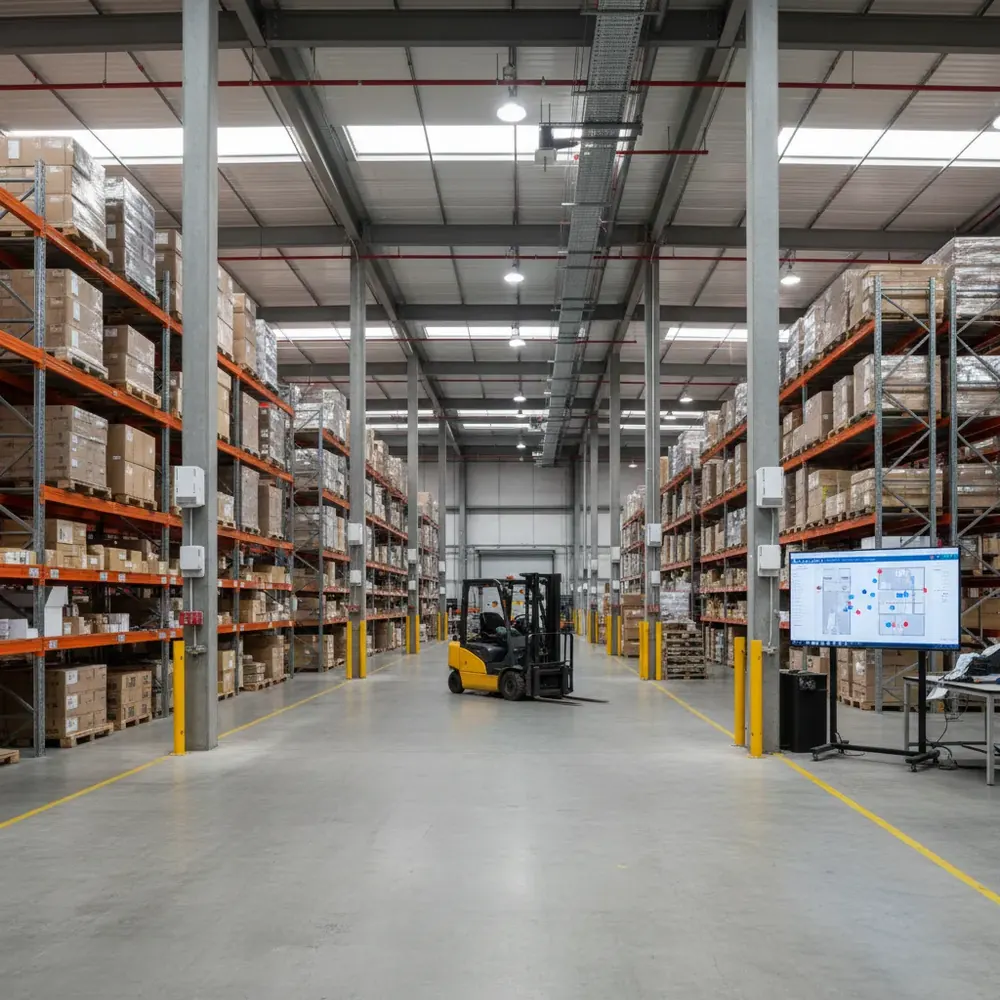
Yet the demand for indoor positioning is enormous: warehouses need to track pallets and forklifts, factories need to locate tools and work-in-progress, hospitals need to find wheelchairs and infusion pumps, and retailers want to understand customer traffic patterns.
Ultra-Wideband (UWB) technology solves this problem with centimeter-level accuracy, 10 cm or better, using time-of-flight ranging between fixed infrastructure (anchors) and mobile devices (tags). This article explains how UWB positioning works, what makes it dramatically more accurate than BLE and Wi-Fi alternatives, how the REYAX RYUW122 module enables practical UWB deployments, and where the technology is gaining traction in Indian industry.
How UWB Ranging Works
UWB positioning uses time-of-flight measurement to determine the distance between two devices. Unlike Wi-Fi and BLE, which estimate distance from received signal strength (RSSI), a notoriously unreliable indicator that varies with obstacles, reflections, antenna orientation, and multipath, UWB measures the actual propagation time of an ultra-short radio pulse. Since radio waves travel at the speed of light (approximately 30 cm per nanosecond), a timing resolution of 1 nanosecond corresponds to 30 cm distance resolution.
UWB’s wide bandwidth (500 MHz or more) enables sub-nanosecond timing resolution, achieving 10 cm ranging accuracy.
The IEEE 802.15.4z standard defines two primary ranging methods:
Two-Way Ranging (TWR)
In TWR, the tag sends a ranging request to an anchor, the anchor responds after a known processing delay, and the tag calculates the round-trip time. The distance is derived from: Distance = (Round-trip time - Processing delay) x Speed of light / 2.
TWR requires no clock synchronization between devices, the round-trip measurement cancels out clock offsets. This simplicity makes TWR ideal for small-scale deployments (a few anchors) and applications where the tag needs to know its own position (for example, a robot navigating a warehouse).
To determine a 2D position, the tag ranges to at least three anchors and trilateration (intersection of distance circles) computes the position. For 3D positioning, four or more anchors are needed.
Time Difference of Arrival (TDoA)
In TDoA, the tag transmits a single blink message, and multiple anchors receive it at slightly different times (because they are at different distances from the tag). The infrastructure computes the time differences between anchor receptions and uses hyperbolic trilateration to determine the tag’s position.
TDoA has a major scalability advantage: the tag transmits once, regardless of how many anchors are in the system. In TWR, the tag must range to each anchor individually, increasing energy consumption and limiting the number of simultaneous tags. TDoA enables thousands of tags to operate simultaneously because each tag only needs to transmit periodically, and the anchors passively receive.
The tradeoff is complexity: TDoA requires precise clock synchronization between anchors (nanosecond-level), which typically requires wired synchronization between anchors or a wireless synchronization protocol. The RYUW122 supports both TWR and TDoA, enabling system architects to choose the method that best fits their deployment scale and infrastructure constraints.
Why UWB Outperforms BLE and Wi-Fi Positioning
The accuracy gap between UWB and signal-strength-based positioning technologies is not incremental, it is fundamental.
| Technology | Typical Accuracy | Method | Primary Limitation |
|---|---|---|---|
| Wi-Fi | 3-5 m | RSSI fingerprinting | Multipath, environmental changes |
| BLE | 1-3 m | RSSI + AoA/AoD | Multipath, body absorption, interference |
| UWB | 10 cm | Time-of-flight | Line-of-sight to anchors |
Wi-Fi positioning uses RSSI fingerprinting: the system maps received signal strengths from multiple access points at known positions, then matches the tag’s observed signal strengths against this fingerprint database. The fundamental problem is that RSSI varies unpredictably with people, objects, humidity, and building changes. A fingerprint database collected on an empty warehouse floor becomes inaccurate when the warehouse fills with inventory. BLE positioning improves on Wi-Fi by adding Angle of Arrival (AoA) and Angle of Departure (AoD) measurements using multi-antenna arrays. BLE 5.1+ direction finding can achieve 0.5-1 m accuracy in controlled environments, but performance degrades in cluttered industrial environments where multipath reflections and metal surfaces corrupt angle measurements. UWB positioning is largely immune to multipath because it uses ultra-short pulses (sub-nanosecond duration) that can be distinguished from reflected copies by their arrival time. The first-arriving pulse is the line-of-sight signal. Later-arriving pulses are reflections. The receiver’s leading-edge detection algorithm locks onto the first pulse, ignoring multipath. This is why UWB maintains 10 cm accuracy in environments where BLE and Wi-Fi accuracy degrades to meters.
The DW3000 Chipset and RYUW122 Module
The RYUW122 is built on the Qorvo (formerly Decawave) DW3000 family of UWB transceiver ICs, the most widely deployed UWB chipset in the industry. The DW3000 implements IEEE 802.15.4z with hardware support for both TWR and TDoA ranging, operating on UWB channels at 6.5 GHz (Channel 5) and 8 GHz (Channel 9).
Key DW3000 capabilities that the RYUW122 inherits:
IEEE 802.15.4z security. The standard includes Scrambled Timestamp Sequences (STS) that prevent relay attacks and distance spoofing. In a relay attack, an adversary captures the ranging signal at one location and retransmits it at another, fooling the system into reporting an incorrect distance. STS makes relay attacks computationally infeasible by incorporating a shared secret into the ranging exchange. This security feature is critical for access control applications (unlocking doors or vehicles based on UWB proximity verification). Sub-nanosecond timestamp resolution. The DW3000’s timestamp precision enables the 10 cm ranging accuracy that distinguishes UWB from RSSI-based technologies. The hardware timestamps the arrival of each pulse with sufficient resolution to resolve centimeter-level distance differences. Low power operation. Despite the precision timing requirements, the DW3000 supports aggressive duty cycling, the UWB radio can be powered down between ranging exchanges, enabling battery-operated tags with months of operational life on a small battery.
The RYUW122 wraps the DW3000 in a complete module with antenna, matching network, crystal, and power regulation, exposing a UART AT command interface that eliminates the need for custom UWB firmware development. The AT command interface follows the same paradigm as REYAX’s LoRa and BLE modules, enabling hardware teams to add centimeter-accurate positioning to a product by connecting four wires and sending serial commands.
Anchor/Tag Architecture
A UWB positioning system consists of two device types:
Anchors are fixed infrastructure devices installed at known positions throughout the coverage area. Anchors are typically mains-powered (or PoE-powered for ethernet-connected anchors) and mounted at ceiling height or on walls with clear sight lines to the coverage zone. The minimum anchor density depends on the required accuracy and the positioning method: TWR requires at least 3 anchors visible from every tag position for 2D positioning. TDoA requires at least 4 synchronized anchors. Tags are mobile devices attached to the assets being tracked, pallets, forklifts, tools, people, equipment. Tags can be small, battery-operated devices that transmit periodically (every 100 ms to every few seconds, depending on the required update rate). Tag battery life depends on the update rate: a tag transmitting once per second might operate for 6-12 months on a coin cell. A tag transmitting every 100 ms (for real-time tracking of fast-moving assets) requires a larger battery.
The positioning engine, the software that converts range measurements into positions, typically runs on an edge server connected to the anchors via Ethernet or Wi-Fi. Cloud-based positioning engines are also available for multi-site deployments.
Applications in Indian Industry
UWB indoor positioning is gaining traction across several Indian industrial verticals.
Warehousing and logistics. India’s warehousing sector is modernizing rapidly, driven by e-commerce growth and the implementation of GST (which favors larger, organized warehouses over fragmented godowns). Tracking pallet positions in real time enables automated inventory management, reduces search time for misplaced goods, and optimizes picker routing. For third-party logistics (3PL) providers operating large fulfillment centers in Bhiwandi, Hosur, or Sri City, UWB tracking provides the operational visibility that manual barcode scanning cannot achieve. Manufacturing. Indian automotive and electronics manufacturers are implementing Industry 4.0 practices that require real-time asset visibility. Tracking tool positions prevents lost-tool events that cause production line stoppages. Tracking work-in-progress through assembly stations provides real-time production throughput data. Safety applications use UWB to detect workers in proximity to heavy machinery, triggering automatic shutdowns when a person enters a danger zone. Healthcare. Indian hospitals deploying asset tracking for medical equipment, infusion pumps, wheelchairs, portable monitors, defibrillators, reduce equipment search time and improve utilization rates. Staff tracking (with consent) enables workflow optimization and emergency response coordination. Patient flow tracking through outpatient departments identifies bottlenecks and improves throughput. Retail. Shopping malls and large-format retail stores use indoor positioning for customer traffic analysis (understanding which zones attract the most foot traffic), wayfinding (helping customers navigate to specific stores or products), and proximity-based marketing (triggering offers when a customer approaches a specific display). India’s organized retail expansion creates a growing market for these capabilities. Smart campus and office. Corporate campuses and co-working spaces use UWB for hot desk management (detecting which desks are occupied), meeting room utilization tracking, and asset tracking for shared equipment. Building security applications use UWB for zone-based access control, verifying that a person is physically at a door before unlocking it, preventing relay attacks that fool Bluetooth-based access systems.
Comparison to BLE and Wi-Fi Positioning
For applications where meter-level accuracy is acceptable, zone-level room detection, approximate asset location, customer density mapping, BLE beacons or Wi-Fi fingerprinting provide a lower-cost solution with simpler infrastructure. The REYAX portfolio includes BLE modules (RYB5510, RYB080I) for these applications.
UWB is the right choice when centimeter-level accuracy matters: precise asset location in dense storage environments, safety-critical proximity detection, secure access control, and applications where knowing that a forklift is in aisle 7 (BLE accuracy) is not sufficient but knowing it is at position 7-C-14 on the third shelf (UWB accuracy) is required.
In many deployments, UWB and BLE coexist: UWB provides precision positioning for high-value assets, while BLE provides zone-level presence detection for lower-value assets at a lower per-tag cost.
Get UWB Modules and Deployment Support from GSAS India
GSAS Micro Systems is an authorized REYAX engineering partner in India. Our applications engineering team provides indoor positioning system architecture guidance, anchor placement planning, TWR vs. TDoA topology selection, tag design consultation, and integration support for warehousing, manufacturing, healthcare, and retail deployments across India, backed by local stock of RYUW122 UWB modules and development kits with INR procurement.
Contact us from Bengaluru, Chennai, Hyderabad, Delhi NCR, Mumbai, or Pune for module samples, development kits, and a deployment architecture consultation.
Also appears in:
Interested in REYAX tools?
Talk to our application engineers for personalized tool recommendations.
More from REYAX
View all →
RYB5510 Deep Dive: BLE 5.4, Thread, and Matter on a Single Module
5 Apr · 4 min

RYLR998 Deep Dive: Why This LoRa Module Is the Go-To Choice for IoT Projects in India
5 Apr · 4 min

RYS8830 GNSS Module: Multi-Constellation Positioning for Indian Fleet and Asset Tracking
5 Apr · 4 min
Industrial Condition Monitoring with Wireless Sensors: A Practical Guide for Indian Factories
4 Apr · 4 min
Emulating Processor Power for Thermal Testing: Why Constant Power
7 Oct · 7 min
CRPS and Rack Power Supply Testing: The Six Tests That Matter
7 Oct · 7 min