
AUTOMOTIVE
ISO 16750-2 Electrical Loads: Supply Voltage Test Methods
ISO 16750-2 supply voltage testing in India: starting profile, voltage drops, reset behaviour and load dump on a GW Instek programmable DC bench from GSAS.
ISO 16750-2 is the part of the ISO 16750 series that covers electrical loads on electrical and electronic equipment in road vehicles. This page describes a bench that reproduces its supply-voltage conditions with a programmable DC source, and is equally clear about where that bench stops.
What the standard covers
ISO 16750-2:2023, edition 5, is titled Road vehicles, Environmental conditions and testing for electrical and electronic equipment, Part 2: Electrical loads. Per the public ISO catalogue entry, it applies to electric and electronic systems and components for road vehicles, describes the potential environmental stresses, and specifies tests and requirements for the specific mounting location on or in the vehicle.
Two exclusions are worth knowing before you plan a campaign. The document is not intended to apply to systems and components of motorcycles and mopeds, and electromagnetic compatibility is not covered by it. EMC is a separate programme.
The catalogue entry also makes a point that shapes the bench: electrical loads are independent of mounting location, but can vary with the electrical impedance, both resistance and inductance, of the vehicle wiring harness and connection system. The supply your DUT actually sees is not the supply at the battery terminals.
12 V, 24 V and 48 V
ISO 16750-2 addresses 12 V and 24 V systems. The 24 V case matters in India well beyond the obvious: commercial vehicles, buses and much off-highway equipment run 24 V nominal, so a bench scoped only to 12 V covers a fraction of the domestic programme.
48 V is a different standard. ISO 21780:2020, Road vehicles, Supply voltage of 48 V, Electrical requirements and tests, covers requirements and tests for components in vehicles with a 48 V DC nominal system, including voltage ranges and slow voltage transients and fluctuations. If your programme is 48 V, ISO 16750-2 is not the document you are testing to.
A note on how this page is written
ISO 16750-2 is a licensed document. This page does not reproduce clause numbers, test tables, waveform parameters or severity levels, and you should not plan a campaign from it. Buy the standard.
The test names below are the ones test houses publish when they describe their ISO 16750-2 capability. This page names tests and says what each one exposes in the device under test. It does not reproduce the standard’s clause structure, its test tables or its severity levels, because that is the licensed content. Confirm the structure and the applicable severities against your own copy and your customer’s specification.
Supply-voltage behaviours a programmable DC source reproduces
Each of these is a condition the vehicle’s supply actually presents to a control unit, and each exposes something different in the DUT.
Slow decrease and increase of supply voltage. The supply is walked down and back up at a controlled rate. This finds brown-out behaviour: the band where a regulator is still delivering but a microcontroller is no longer reliable, and whether the unit degrades predictably or does something unsafe on the way through.
Momentary drop in supply voltage. A short dip, as another load on the same harness switches. What matters is whether the DUT rides it through, and whether anything downstream notices.
Reset behaviour at voltage drop. The supply is dropped to progressively lower levels and the unit’s reset behaviour is observed. This is the test that finds the partial reset: the unit that neither keeps running nor cleanly restarts, and comes back with corrupted state.
Starting profile. The cranking waveform. Supply collapses as the starter motor engages, then recovers. For anything that must stay alive through a start, this is the defining test, and it is a sequence rather than a single step.
Load dump. The alternator is charging and the battery is disconnected, so its field energy has nowhere to go and the bus rises. This is the high-energy transient every automotive engineer knows by name. The PHU’s sequence programming reproduces load dump profiles for immunity testing on the device under test.
The boundary, stated plainly
A programmable DC source does not reproduce ISO 7637-2 fast transient pulses. Those pulses are microsecond and nanosecond events with defined source impedance, and they need a dedicated transient generator. A fast DC supply is not a slower version of that instrument; it is a different instrument.
ISO 7637-2 is a different standard from the one on this page. If a supplier offers you a programmable DC source as ISO 7637-2 coverage, that is the point to stop the conversation. Transient immunity is a separate purchase and a separate test plan.
Bench architecture
| Instrument | Role on this bench |
|---|---|
| PHU Series | Programmable DC source. Built-in programmable sequence function for the profiles, adjustable voltage and current rise and fall times, and C.V/C.C priority operation. |
| Oscilloscope with current probe | Captures DUT supply voltage and inrush current during steps and the starting profile. Sizes and triggers are set from the DUT’s rated current, not from the supply’s rating. |
| DAQ-9600 | Long-duration logging across repeated power cycling, where the failure you are hunting shows up on cycle four hundred rather than cycle one. |
| GPM-8320 | Power consumption measurement, where the specification places a limit on draw in a given state. |
The PHU covers 80 V to 1500 V across 5 kW, 10 kW and 15 kW models in a 3U chassis, with parallel operation of up to 10 units. Two things size the model. Current comes from the DUT’s rated current with margin for inrush, and covers the steady-state and dip profiles. Voltage comes from load dump, whose peak sits far above the nominal bus, so a campaign that includes it needs real headroom and the lowest model is not the one to buy. The high-voltage models matter again when the same bench is also asked to serve EV and photovoltaic work.
Why C.C priority matters here
During a fast voltage step into a DUT with significant input capacitance, a source operating with voltage priority will deliver whatever current the step demands, and that inrush lands on the DUT. The PHU’s C.C priority mode prevents inrush current and surge voltage at turn-on, capping current first and letting voltage follow.
The practical consequence is that the same programmed profile can produce different stress on the DUT depending on which priority mode the source is in. Record the mode in the test report. A result that does not state it is not reproducible.
Procedure skeleton
- Take the functional status classification from the customer specification, not from the standard. The standard describes the classes; which class applies to which function on your unit is a programme decision.
- Program each supply-voltage profile as a sequence on the source. Record slew settings and priority mode alongside the profile.
- Monitor DUT supply voltage and current on the oscilloscope, and the DUT’s own functional outputs, for every profile.
- Loop power cycling for the duration the specification requires, logging on the DAQ rather than the scope.
- Report per profile: the programmed condition, the measured condition at the DUT terminals, the observed functional status, and the pass criterion applied.
Step three is where most benches are thin. Measuring that the source did what it was told is not the test. The test is what the DUT did while it happened.
Where this applies in India
Supply-voltage testing is the routine obligation on passenger-vehicle infotainment, instrument clusters and body controllers, and on EV auxiliary electronics where a 12 V domain hangs off a traction battery through a DC-DC converter. The 24 V side covers commercial vehicle and bus electronics.
Note what is NOT in that list. Two-wheelers are out of scope: the standard states it is not intended to apply to systems and components of motorcycles and mopeds, which covers most of the Indian electric two-wheeler segment. A supplier quoting ISO 16750-2 coverage for a scooter programme has either picked the wrong document or is testing to a customer specification that borrows from it. Ask which.
In every one of those segments the DUT is a unit someone has to re-qualify each time a supplier changes a regulator or a connector. A bench that reproduces the profiles in-house turns that from a scheduling problem into an afternoon.
Instruments and support from GSAS
GSAS Micro Systems is an authorized GW Instek engineering partner for Karnataka, Andhra Pradesh and Telangana, supporting customers across India. We supply the PHU Series, DAQ-9600 and GPM-8320 with demonstration units, application engineering on bench architecture and sequence programming, and calibration support, from Bengaluru, Chennai, Pune, Hyderabad, Mumbai and Delhi NCR.
If you want a supply-voltage bench scoped against your own customer specification, talk to us.
Sources: ISO 16750-2:2023 catalogue entry | ISO 21780:2020 | PHU Series capability per GW Instek published product documentation
Related compliance pages: ISO 26262 Functional Safety | IEC 61508 Industrial Safety | UNECE R155 and R156 Cybersecurity
Related solutions: Automotive Solutions
Blog
Compliance & Safety Insights
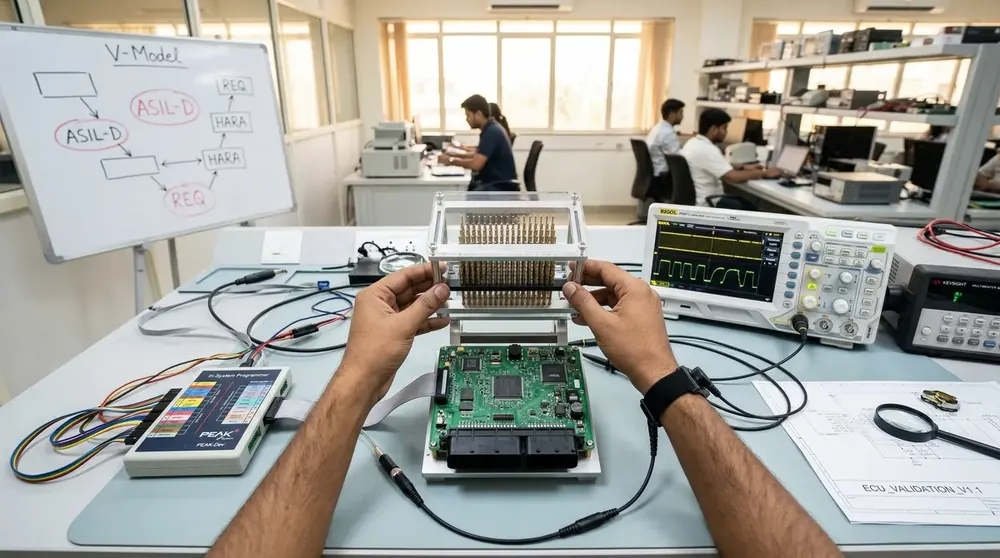
AI Inside the Engineering Process: What Is Worth Automating, and What Still Needs an Engineer
Arm, SEGGER, Perforce and Siemens EDA have each put AI inside a step of the engineering process rather than on top of it: debug, remediation, design entry, inference on the part. GSAS sets out the position behind our coverage of each: which steps are now worth automating, and which keep a human because the cost of being wrong is a recall.
Verification Economics: What a Late Defect Actually Costs, and What the Evidence Really Says
Finding a defect in month 2 instead of month 14 is a budget decision before it is a quality decision. This sets out what the published evidence supports, what it does not, including the 100x multiplier that traces back to a course handout rather than a study, and how an Indian embedded team builds the case on its own numbers.
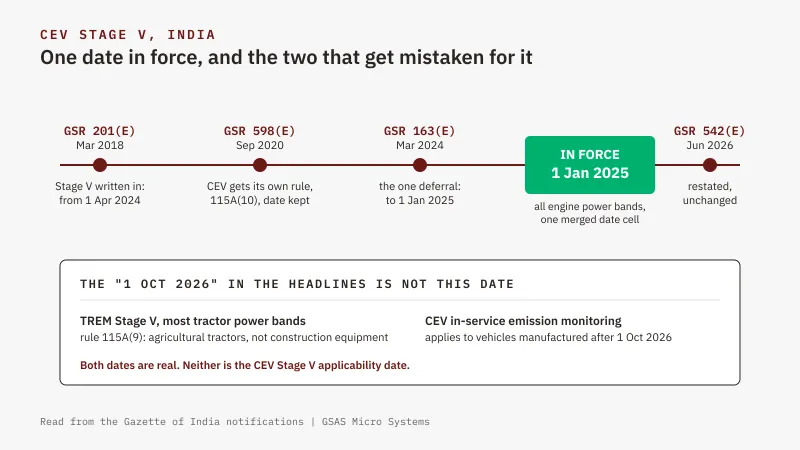
CEV Stage V Began in India on 1 January 2025
Trade coverage keeps putting CEV Stage V in October 2026. The gazette puts it on 1 January 2025, after one deferral and no band-by-band split. Here is the notification chain, what the October 2026 dates really govern, and what the limits mean on the bench.
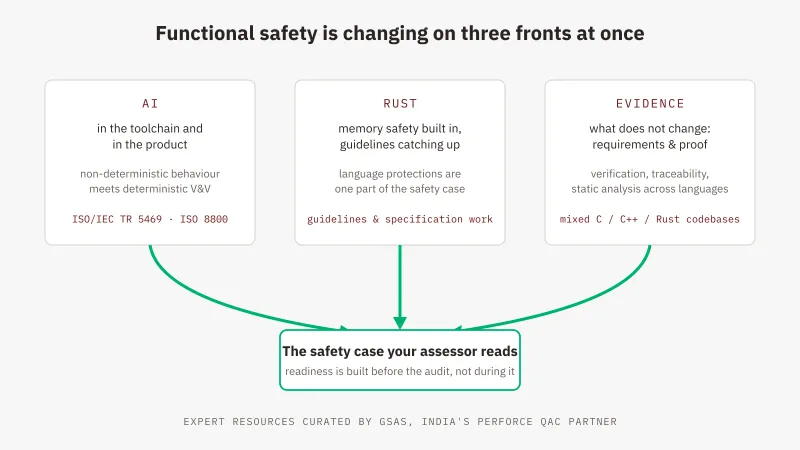
AI, Rust and the New Functional Safety Standards
AI has entered both the development flow and the shipped product, Rust is taking new safety-critical code that would once have been C, and the guidance layer is moving to cover both. A guide to five Perforce resources on that shift, from the GSAS engineering team in India.
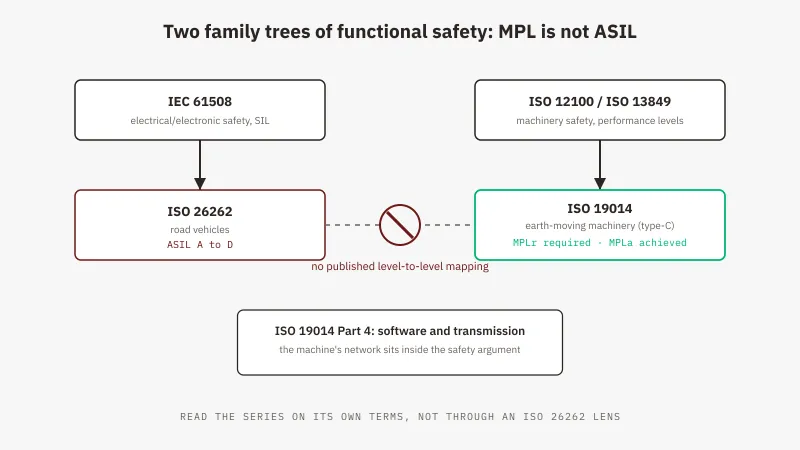
ISO 19014 for ISO 26262 Engineers: MPL Is Not ASIL
India's functional safety talent pool grew up automotive. Earth-moving machinery answers to a different series with a different family tree, and reading one through the lens of the other produces confident, expensive errors.
Automotive Ethernet Conformance: TC8 and Testing Above It
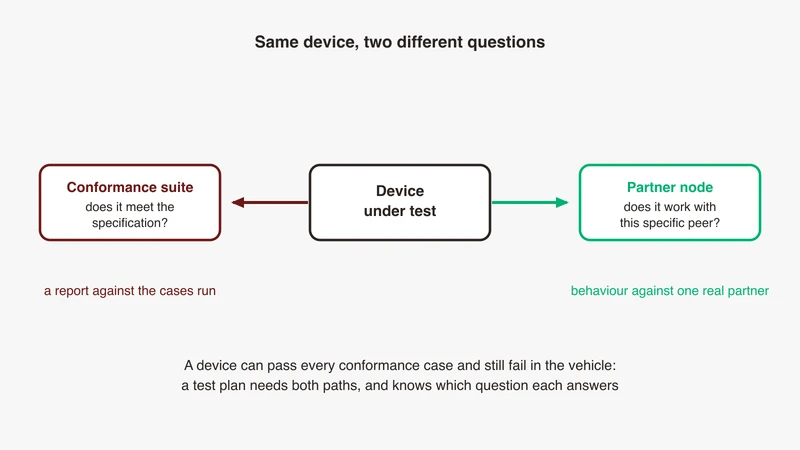
Summarising TC8 as a layer 1 to layer 4 suite is wrong in both directions. The public OPEN Alliance ECU test documents run from transmitter distortion up to a SOME/IP chapter with its own standardised test stub, and they contain exactly one time synchronisation test case. This is what those documents enumerate, chapter by chapter, what genuinely lives above their boundary, why a passing ECU can still fail against a partner node, and how much pre-compliance work a Tier-1 in India can honestly do in-house before a test house visit. Written by the GSAS Micro Systems engineering team in India.
Need Compliance-Ready Toolchains?
From tool selection to qualification evidence, our application engineers help Indian teams build ISO 16750-2 Electrical Loads workflows that stand up to assessor review.