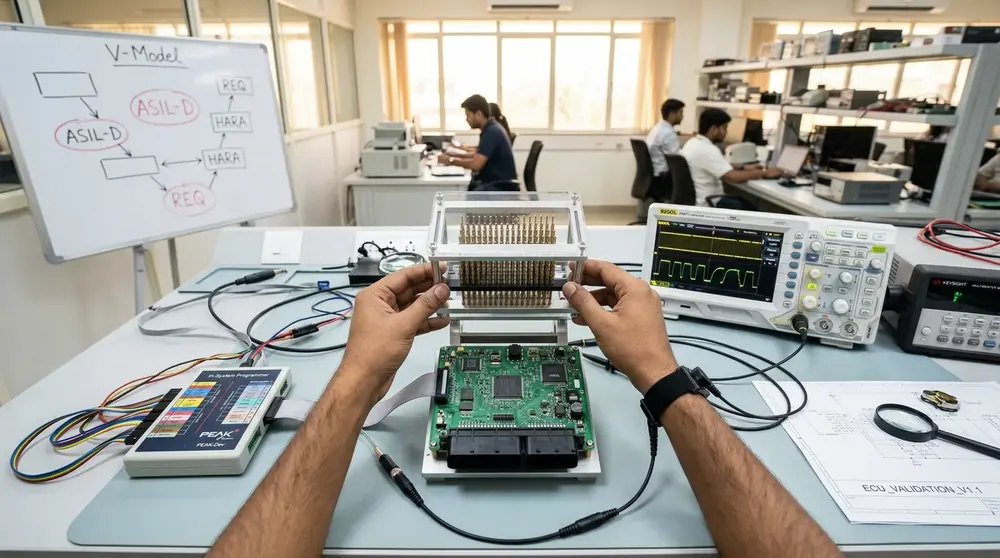
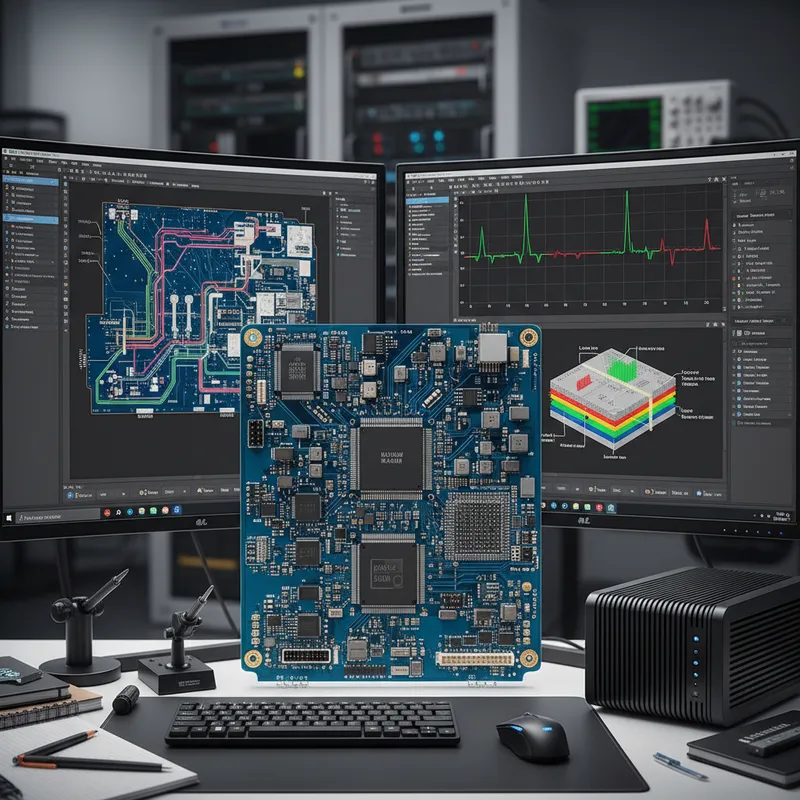
Altium Designer hidden-features showcase, serpentine length matching, contour selection, and embedded board arrays in the PCB editor

Discover Hidden Features in Altium Designer

GSAS Engineering · · 1 min read

With every release of Altium Designer, we present to you all of the significant new capabilities available to enhance your design work experience. These major new capabilities often overshadow some lesser-known features that do not get the spotlight they deserve. We want to showcase some of these in this webinar.

Many of these Hidden Secrets are not toolbar driven but reside behind hot-keys, right mouse clicks, or preference settings! In this webinar, we will share with you what you may be missing out on and make your productivity and design experience even richer in Altium Designer.

Join us during this Live Webinar to experience the following:

  • Serpentine Length Matching
  • Generic Components
  • New HotKeys for better 3D Scene Control
  • Embedded Board Arrays – Place at Any Angle
  • Component Pin to Multiple Pad Mapping
  • Contour Selection
  • Text String Alignment
  • Component & Polygon Area Calculation

Timing:

Thursday, 4th February 2021 | 02:30 PM to 03:30 PM

Event Completed

LEARN MORE ABOUT Altium Tools

What “hidden features” looks like across the Siemens Xpedition flow

Altium’s hidden-features list, serpentine length matching, hotkey 3D scene control, contour selection, polygon area calculation, are productivity touches a senior designer accumulates over years. Siemens Xpedition has its own equivalent set, and the most consequential ones for Indian PCB teams running large boards are:

  • AI command prediction (Xpedition Standard): context-aware command suggestion that learns the designer’s pattern. Practical impact: fewer hotkey misses on day-to-day routing and edit operations.
  • Sketch routing: draw the rough route intent, the autorouter snaps to constraint-compliant routing under cursor guidance. Faster than fully manual routing on dense regions.
  • Smart Datasheets and supplier-pricing panels: live component data inside the schematic capture window, similar to Altium 365 but tied to Siemens’ supplier integration backend.
  • Token-based add-ons: pay only for the advanced capability you need (rigid-flex, signal integrity, advanced packaging), turning the toolchain price into something proportional to the project.
  • Cloud DFM with Valor: 12 cloud DFM runs per year included with Xpedition Standard. Fabricator feedback before the design hits an actual fab queue.

GSAS Micro Systems is an authorized engineering partner in India. We can run a side-by-side demonstration on your team’s actual board for a clean apples-to-apples evaluation. For the canonical comparison, see Altium Designer vs Siemens Xpedition Standard for Indian PCB teams.

Compare with Xpedition Standard → | Talk to GSAS about an evaluation

Also appears in:

Need embedded development tools?

Talk to our application engineers for personalized tool recommendations.
Stay in the Loop

Get monthly compliance updates, product insights, and engineering best practices delivered to your inbox.

Related Articles

Side by side comparison of a 10BASE-T1S multidrop mixing segment, one balanced pair with four nodes on short stubs and a termination at each end, against a point to point star of four separate links into switch ports, from GSAS Micro Systems India
Automotive Ethernet Automotive & Mobility

10BASE-T1S and PLCA: Multidrop Ethernet Explained

10BASE-T1S is the one member of the T1 single-pair Ethernet family that keeps a shared medium, and PLCA is the reconciliation sublayer that stops the nodes on it from colliding. This article covers what IEEE 802.3cg standardises, how the beacon and transmit opportunities schedule a cycle, the node count and segment length figures the OPEN Alliance interoperability test suite works to, and the failure modes that put a segment quietly back into contention while every link still looks up. Written by the GSAS Micro Systems engineering team in India for teams bringing up multidrop segments on the bench.

29 Aug 2026 · 12 min read
Horizontal stacked bar showing where an ADAS test vehicle's bandwidth budget is spent, split into cameras, lidar, radar and bus traffic, with the logger uplink limit drawn as a vertical rule crossing the bar, from GSAS Micro Systems India
Automotive Ethernet Automotive & Mobility

ADAS Sensor Data Logging: Bandwidth Budgets That Add Up

Every page that tells you an ADAS test vehicle produces terabytes a day states the headline and skips the arithmetic, so you cannot redo it for your own sensor set. This article publishes the arithmetic instead: one formula, every table row derived on the page, a worked eight-hour drive that chains those rows into a sustained write rate, a media count and an offload window, and the five places bandwidth budgets go wrong. Written by the GSAS Micro Systems engineering team in India.

29 Aug 2026 · 15 min read
Storage sizing ladder for automotive data logging: four rungs stepping from an aggregate link rate of 1 Gbit/s to 125 MB per second, then 450 GB per hour, then 3.6 TB per eight-hour shift, then 18 TB per five-day week, in decimal units, from GSAS Micro Systems India
Automotive Ethernet Automotive & Mobility

Automotive Data Loggers: Capture Without Loss

Search for an automotive data logger and the results split into cheap OBD dongles at one end and enterprise ADAS recorders at the other, with nothing in between explaining the engineering that decides whether you lose frames. This is the loss budget end to end: mirror oversubscription upstream of the logger, encapsulation overhead on the capture path, sustained write rate against burst rate, rotation stalls, and storage arithmetic worked in full so you can redo it with your own numbers instead of trusting ours. Written by the GSAS Micro Systems engineering team in India.

29 Aug 2026 · 13 min read