GW Instek has added two bench instruments to its 2026 range: the LCR-7000 Series, a precision LCR meter with a 5-inch touch display, and the GPM-8340, a four-element digital power meter for single-phase and three-phase measurement. GW Instek announced the LCR-7000 in late October 2026 and the GPM-8340 in November 2026. Both are available to Indian teams through GSAS Micro Systems, and each now has its own product page: the LCR-7000 Series and the GPM-8340.
Earlier this year GW Instek also released the SPS-A switching DC power supplies and the GDS-2000HD/HG 12-bit oscilloscopes; we covered those in our June launch post.
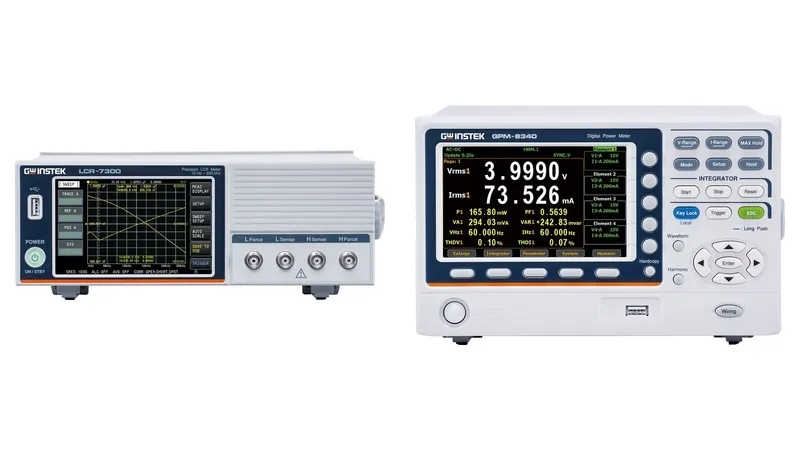
Every figure below comes from GW Instek’s product pages and specification sheets, listed at the end.
LCR-7000: a touch-screen precision LCR meter
The LCR-7000 measures capacitors, inductors and resistors from 10 Hz to as high as 300 kHz, with 0.05% basic accuracy at Slow and Medium speed. Five models differ only in their maximum test frequency.
| Model | Test frequency |
|---|---|
| LCR-7002 | 10 Hz to 2 kHz |
| LCR-7020 | 10 Hz to 20 kHz |
| LCR-7100 | 10 Hz to 100 kHz |
| LCR-7200 | 10 Hz to 200 kHz |
| LCR-7300 | 10 Hz to 300 kHz |
What the LCR-7000 offers
- Accuracy and speed: 0.05% basic accuracy (Slow/Med), 0.1% (Fast); measurement time Fast 25 ms, Med 100 ms, Slow 333 ms.
- Test signal: 10 mV to 2 V, or 100 µA to 20 mA, from a selectable 30 Ω, 50 Ω or 100 Ω source; frequency set continuously within the range.
- Parameters: 16 primary/secondary combinations plus two monitor parameters, so up to four results on screen; DCR measurement.
- Bias: internal ±5 V DC bias; the LCR-16 (±45 V) and LCR-17 (±2.5 A) bias boxes are factory options.
- Sweep and list: a two-parameter frequency sweep with more than 250 points on linear or log axes, and a 10-step list test.
- Sorting: 9 BIN + 1 AUX with a Handler interface for component sorters, plus GO/NoGO judgment and Auto Level Control (ALC).
- Interfaces: SCPI over RS-232, USB Type-C and LAN; USB host for saving data (CSV) and screen captures.
The sweep is the feature to try first in a demo. Plotting two parameters against frequency shows how a part behaves across the band, where a single spot reading only tells you one point. For incoming inspection and production, the BIN comparator and Handler interface do the sorting.
GPM-8340: a four-element digital power meter
The GPM-8340 measures power on up to four input elements from DC and 0.1 Hz to 10 kHz. Each element takes 15 V to 1000 V across seven ranges and 5 mA to 20 A directly across eight ranges, and an external sensor input (EXT) accepts voltage-output current sensors such as current probes.
What the GPM-8340 offers
- Accuracy: ±(0.1% of reading + 0.05% of range) for voltage, current and active power at 45 Hz to 66 Hz.
- Wiring modes: 1P3W, 3P3W, 3P4W and 3V3A, selected with a front-panel button.
- Parameters: up to 28 power-related parameters, including Vrms, Irms, P, VA, VAR, PF, phase angle, crest factors, THD and inrush current, plus MATH and efficiency (EFFi) calculations.
- Harmonics: voltage, current and power harmonics to the 50th order at 50/60 Hz fundamentals, following the IEC 61000-4-7 method at 50/60 Hz.
- Integration: energy measurement with manual, standard and repetitive modes and a timer.
- Display: 5-inch TFT LCD with numeric pages, a Multi-Element view of all four elements, waveforms and harmonic bar graphs.
- Interfaces: RS-232C, USB host and device, and LAN, plus a factory-fitted choice of CAN + Digital I/O or mini GPIB + Digital I/O.
The CAN or GPIB choice is made at order time, so decide which one your test system needs before you request a quote. The Digital I/O port works with a PLC for pass/fail signalling on a production line, and the 3U, half-rack chassis fits a 19-inch rack with the GRA-452 kit.
Which one do you need?
The two instruments answer different questions. The LCR-7000 characterises and sorts passive components: capacitance, inductance, resistance, impedance, D and Q at a chosen frequency and level. The GPM-8340 measures what a powered product draws and delivers: voltage, current, power, power factor and harmonics, across up to four points at once. A power electronics team may well use both, the LCR meter on magnetics and capacitors during design and the power meter on the finished converter.
Buying the LCR-7000 and GPM-8340 in India
GSAS Micro Systems is a value added distributor/reseller for these products, and an authorized GW Instek engineering partner for Karnataka, Andhra Pradesh and Telangana, supporting customers across India. We have a dedicated FAE team ready to help you with custom built solutions matching your needs. For both instruments we provide:
- Model selection: the LCR-7000 frequency grade and fixtures for your parts; the GPM-8340 CAN or GPIB variant and current sensors.
- Demonstrations on your own components or equipment, arranged through our offices in Bengaluru, Hyderabad, Chennai, Pune, Mumbai and Delhi NCR.
- INR pricing and GST-compliant quotations, with local support after delivery.
Request a quote · Book a demo · Contact the GSAS team
Frequently asked questions
What is the frequency range of the GW Instek LCR-7000? Every LCR-7000 model starts at 10 Hz. The maximum test frequency is 2 kHz on the LCR-7002, 20 kHz on the LCR-7020, 100 kHz on the LCR-7100, 200 kHz on the LCR-7200 and 300 kHz on the LCR-7300.
How accurate and how fast is the LCR-7000? GW Instek specifies 0.05% basic accuracy at Slow and Medium speed and 0.1% at Fast. Measurement time is 25 ms at Fast, 100 ms at Medium and 333 ms at Slow.
Can the GPM-8340 measure three-phase power? Yes. The GPM-8340 has four input elements and supports the 1P3W, 3P3W, 3P4W and 3V3A wiring modes, so it measures single-phase three-wire and three-phase systems, and its Multi-Element mode shows all four elements side by side.
What is the accuracy of the GPM-8340? For voltage, current and active power at 45 Hz to 66 Hz, GW Instek specifies ±(0.1% of reading + 0.05% of range). The full table in GW Instek’s specification sheet lists the accuracy for DC and the other frequency bands up to 10 kHz.
Does the GPM-8340 come with CAN or GPIB? Either one, fitted at the factory. RS-232C, USB host and device, and LAN are standard, and each unit adds CAN plus Digital I/O or mini GPIB plus Digital I/O, so choose the variant when you order.
References:
- GW Instek LCR-7000 Series product page, https://www.gwinstek.com/en-global/products/detail/LCR-7000
- GW Instek LCR-7000 specifications (LCR-7000_Spec_E), https://www.gwinstek.com/en-GB/products/downloadSeriesSpec/3877
- GW Instek LCR-7000 news release, https://www.gwinstek.com/en-GB/news_release/detail/LCR-7000_GB/1
- GW Instek GPM-8340 product page, https://www.gwinstek.com/en-global/products/detail/GPM-8340
- GW Instek GPM-8340 specifications (GPM-8340_Spec_E), https://www.gwinstek.com/en-GB/products/downloadSeriesSpec/3907
- GW Instek GPM-8340 news release, https://www.gwinstek.com/en-GB/news_release/detail/GPM-8340_GB/1
Also appears in:
Interested in GW Instek tools?
Talk to our application engineers for personalized tool recommendations.
More from GW Instek
View all →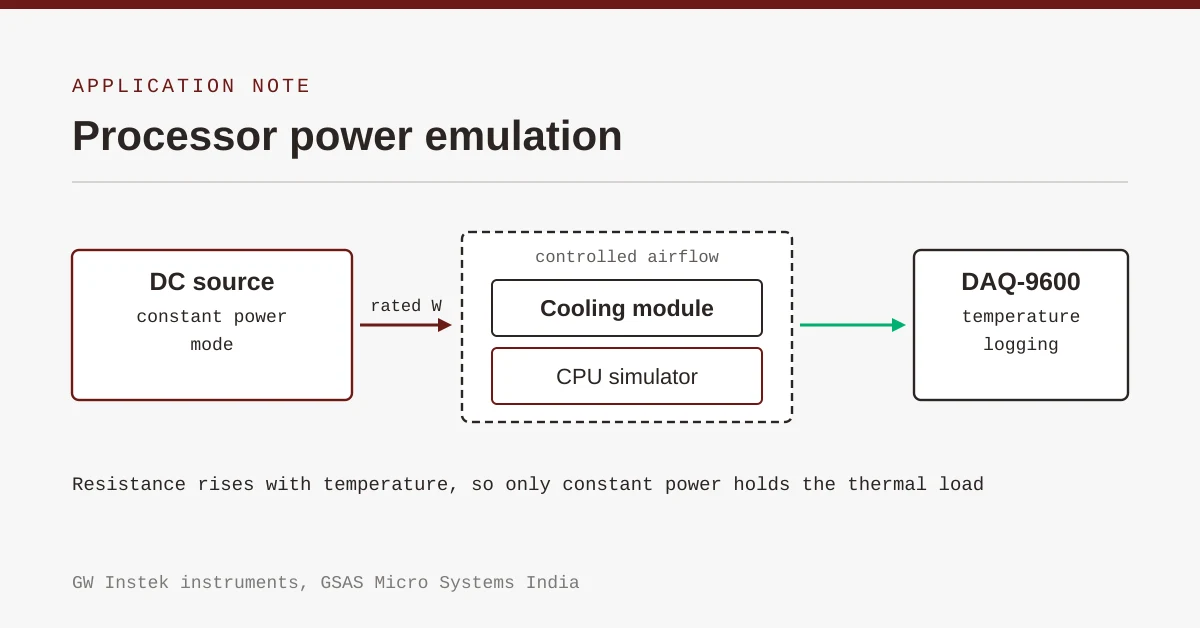
Emulating Processor Power for Thermal Testing: Why Constant Power
7 Oct · 7 min
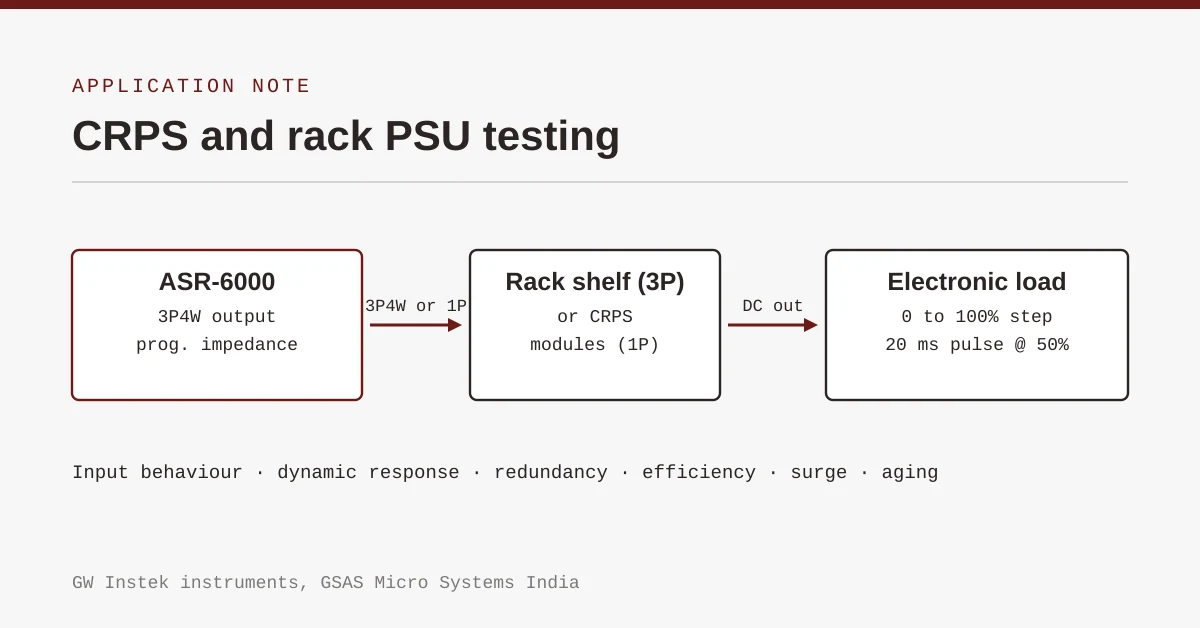
CRPS and Rack Power Supply Testing: The Six Tests That Matter
7 Oct · 7 min
GPU Power Board Testing: DC Input Verification Before Integration
7 Oct · 6 min
Servo Motor Inrush Current Testing: Method, Limits and Bench
7 Oct · 6 min
Choosing Debug and Trace Tools for Indian Automotive Tier-1s
13 Nov · 11 min
Emulation vs FPGA Prototyping vs Simulation for SoC Teams
13 Nov · 8 min