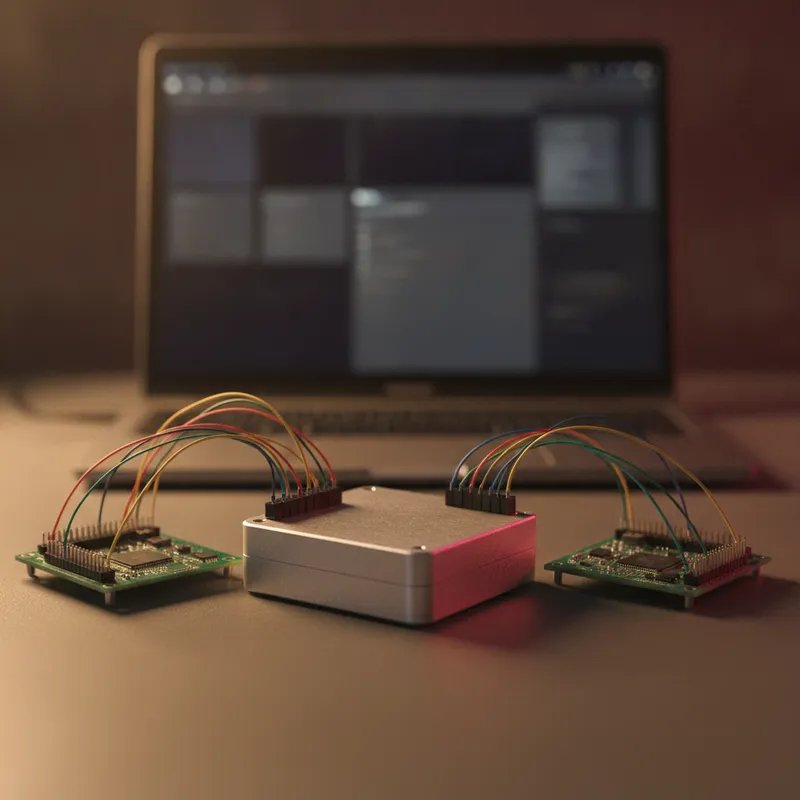

LCR meters are foundational instruments in electronics manufacturing and R&D. Every passive component, resistors, capacitors, inductors, and their parasitic elements, needs characterisation at the frequency where it will actually operate in the circuit. The Microtest 6370 delivers this characterisation with 0.05% basic accuracy across a 20 Hz to 5 MHz frequency range, serving both the incoming inspection bench and the production sorting line.
Why Frequency Range Matters
A capacitor specified as 100 nF at 1 kHz may behave very differently at 1 MHz. The capacitance value shifts, the ESR (Equivalent Series Resistance) becomes dominant, and the dissipation factor changes. An inductor’s Q factor peaks at a specific frequency and degrades at others. A resistor’s impedance deviates from its DC value as parasitic capacitance and inductance become significant at higher frequencies.
The Microtest 6370 measures across 20 Hz to 5 MHz, covering the full range of frequencies relevant for passive components used in power supplies (20 Hz to 100 kHz), audio equipment (20 Hz to 20 kHz), RF filters (100 kHz to 5 MHz), and general electronics. Multi-frequency measurement in a single instrument eliminates the need for separate low-frequency and high-frequency test setups.
Measurement Parameters
| Parameter | Symbol | Application |
|---|---|---|
| Inductance | L | Inductors, transformers, chokes |
| Capacitance | C | All capacitor types |
| Resistance | R | Resistors, contact resistance |
| Impedance | Z | Full complex impedance magnitude |
| ESR | ESR | Capacitor series resistance |
| Quality Factor | Q | Inductor and resonator quality |
| Dissipation Factor | D | Capacitor dielectric loss |
| Phase Angle | theta | Complex impedance phase |
The 6370 measures all standard LCR parameters with 0.05% basic accuracy. For incoming inspection, this accuracy level detects components that are within their marked tolerance but drifting toward the edge, an early indicator of supplier quality issues. For R&D characterisation, 0.05% accuracy supports reliable comparison between component vendors and construction types.
Production Line Features
The 6370 is not just a bench instrument. It includes production-oriented features that integrate into automated test workflows:
Multi-bin sorting. Components are measured and automatically classified into tolerance bins, for example, a 10 uH inductor sorted into bins for ±1%, ±2%, ±5%, and reject. The bin output drives external sorting hardware (pneumatic diverters, conveyor gates) through the handler interface.
Handler interface. A digital I/O port communicates with automated component handlers, feeders, and sorting systems. The handler sends a “start” trigger when a component is in position, the 6370 measures and classifies, and the handler routes the component to the appropriate bin based on the pass/fail output.
Programmable test sequences. Multi-parameter testing at multiple frequencies in a single measurement cycle. A capacitor can be measured for capacitance at 1 kHz, ESR at 100 kHz, and insulation resistance, all in one automated sequence, before the pass/fail verdict is delivered.
Measurement speed. Up to 25 measurements per second enables production throughput without sacrificing accuracy. For high-volume component manufacturers in Pune, Chennai, and Delhi NCR, this speed keeps the test station from becoming the production bottleneck.
Incoming Inspection Applications
Component manufacturers and electronics assemblers across India use LCR meters at the incoming inspection stage to verify that purchased components meet specifications before they enter production. The consequences of using out-of-spec components, assembled boards that fail functional test, field failures from marginal components, and the cost of rework, far exceed the investment in systematic incoming inspection.
The 6370’s combination of accuracy, speed, and bin sorting makes it practical to inspect 100% of incoming passive components on high-volume production lines. For lower-volume operations, sample-based inspection with SPC (Statistical Process Control) trending catches supplier quality drift before it causes production problems.
Fixture Selection
The 6370 supports standard test fixtures:
- Kelvin clip leads for through-hole components (leaded resistors, capacitors, inductors)
- SMD tweezers for surface-mount components (0402, 0603, 0805, 1206 and larger)
- 4-terminal fixtures for precision measurement where lead resistance must be eliminated
- Custom fixtures for non-standard component form factors
Fixture selection affects measurement accuracy, particularly for low-impedance components where lead resistance is significant. For production installations, dedicated fixtures with short, low-inductance connections provide the most repeatable measurements.
Comparison Within the Microtest LCR Range
Microtest offers several LCR meter models covering different accuracy and frequency requirements. The 6360 provides a cost-effective entry point for general-purpose LCR measurement. The 6370 steps up to 0.05% accuracy and wider frequency coverage.
The 6380 extends further for applications demanding the highest precision. For impedance analysis beyond standard LCR parameters, the 6632 Series impedance analyzer covers DC to 50 MHz with additional material characterisation parameters.
Why Buy from GSAS
GSAS Micro Systems is the authorised Microtest partner in India, providing the 6370 LCR meter and the complete Microtest instrument portfolio with INR invoicing, fixture selection guidance, handler interface configuration, and production line integration support. Engineering teams and quality managers across Bengaluru, Hyderabad, Chennai, Pune, Mumbai, and Delhi NCR can access local demo units, application support, and calibration coordination. Contact GSAS to schedule a demo or discuss your LCR measurement requirements.
Also appears in:
Interested in Microtest tools?
Talk to our application engineers for personalized tool recommendations.
More from Microtest
View all →
Power Measurement for Server PSUs: Microtest 7140 Power Analyzer
7 Apr · 5 min

Wireless Charger QC Testing with the Microtest 9901
7 Apr · 5 min
Motor Stator Testing in EV Manufacturing: Microtest MT-6910 Series
7 Apr · 5 min
PCB Incoming Inspection with Multichannel LCR Testing
6 Apr · 5 min

The Complete AUTOSAR Verification Chain: AUTOSAR C++14 Static Analysis with Helix QAC, SWC and RTE Testing with TESSY 6
31 Jul · 9 min
I3C FAQ for Firmware Teams: What the Bus Is, What Changes, and What You Need on the Bench
31 Jul · 8 min