Two Philosophies of Oscilloscope Design
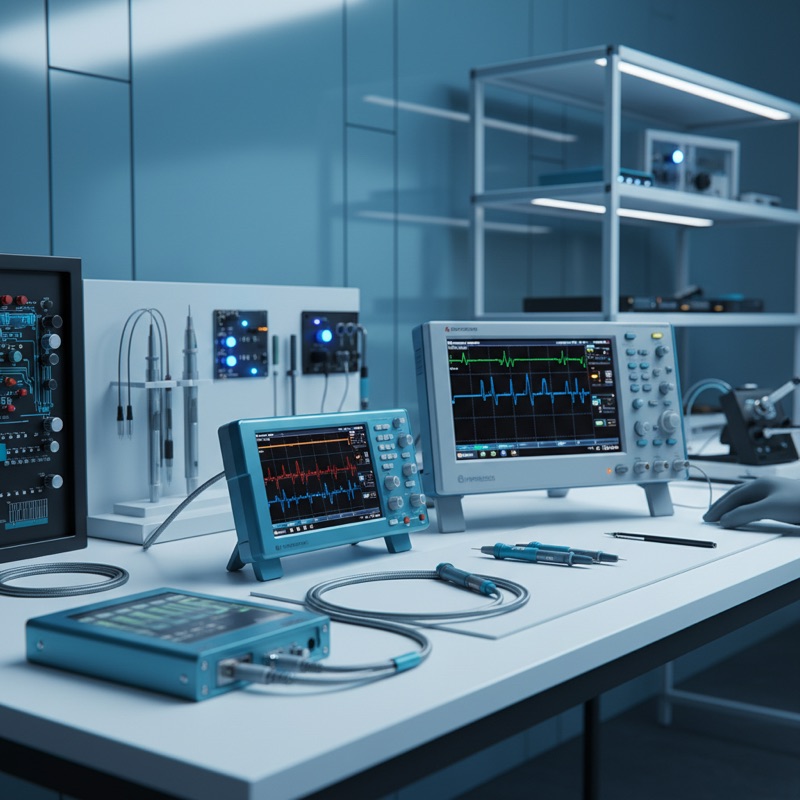
The traditional oscilloscope is a self-contained instrument, display, processor, ADC, front panel, and power supply in a single box. The PC-based oscilloscope separates the measurement hardware (ADC, front end, triggering) from the display and processing, connecting to a standard PC via USB.
Both approaches have matured significantly. The question for Indian engineering teams is not which is “better” in absolute terms, but which fits their workflow, budget, and measurement requirements.
Specification Comparison at 200 MHz
To make the comparison concrete, here is how a mid-range PicoScope compares against typical benchtop oscilloscopes at the popular 200 MHz bandwidth class:
| Specification | PicoScope 3406E | Typical Benchtop (200 MHz) |
|---|---|---|
| Bandwidth | 200 MHz | 200 MHz |
| Sample rate | 1 GS/s | 1–2 GS/s |
| Buffer memory | 512 MS | 10–50 MS (standard) |
| Channels | 4 analog | 4 analog |
| Protocol decoders | 20+ included free | Per-protocol license (Rs 30,000–1,00,000 each) |
| Spectrum analyzer | Included (up to 1M FFT) | Usually included (basic) |
| Software updates | Free for life | Paid upgrades on many models |
| Display | Your PC monitor (any size) | Built-in 7–10 inch |
| Portability | Pocket-sized, USB powered | 5–10 kg, mains powered |
| Standalone operation | Requires PC | Yes |
Where PicoScope Excels
Memory Depth
This is PicoScope’s most significant technical advantage. At 200 MHz, the PicoScope 3000E Series samples at 5 GS/s with up to 2 GS of buffer. At 500 MHz, the PicoScope 6000E offers 4 GS.
Deep memory means you can capture longer time windows at full sample rate, which matters for:
- Serial protocol analysis (capturing complete transactions)
- Intermittent fault hunting (catching rare events with full context)
- Power supply transient analysis (recording complete startup sequences)
Total Cost of Ownership
The purchase price of a PicoScope is lower than an equivalent benchtop scope, but the cost advantage widens over time:
- Protocol decoders: PicoScope includes 20+ decoders free. Benchtop scopes charge Rs 30,000–1,00,000 per protocol. A lab needing CAN, SPI, I2C, and UART decoding saves Rs 1–4 lakh in decoder licenses alone.
- Software updates: PicoScope 7 updates are free forever. Many benchtop manufacturers charge for major software versions.
- No maintenance contract: PicoScope’s USB hardware has no moving parts, no internal fan (in most models), and no display to degrade.
Display Size and Quality
PicoScope displays on your PC monitor. A 24-inch or 27-inch monitor provides vastly more screen real estate than a 7-inch benchtop scope display. For engineers who spend hours analysing waveforms, this ergonomic advantage is significant.
Portability
A PicoScope fits in a laptop bag. For field service, on-site debugging, and multi-site deployment, the form factor advantage is decisive.
Multi-OS Support
PicoScope 7 runs on Windows, macOS, and Linux. Benchtop scopes typically run embedded Windows or a proprietary OS with no user choice.
Where Benchtop Excels
Standalone Operation
A benchtop oscilloscope works without a PC. Power it on, connect probes, measure. For production floors, teaching labs, and environments where a dedicated PC is impractical, standalone operation matters.
Physical Controls
Knobs, buttons, and a dedicated trigger control provide tactile feedback that some engineers prefer over mouse-and-keyboard interaction. For rapid manual probing, adjusting timebase and amplitude while holding probes, physical controls can be faster.
Institutional Familiarity
Many Indian engineering organizations have decades of experience with benchtop oscilloscopes from established manufacturers. Purchasing, calibration, and training workflows are built around benchtop instruments. Switching to PC-based requires process adaptation.
Calibration Ecosystem
Benchtop oscilloscopes have established calibration procedures supported by NABL-accredited labs across India. PicoScope calibration is available but the ecosystem is smaller.
Making the Decision
Choose PicoScope When:
- Deep memory is critical to your measurements
- You need protocol decoders without per-protocol licensing
- Budget is a primary constraint
- Portability matters (field service, multi-site)
- Your engineers work primarily at PCs
- You want a large display for waveform analysis
Choose Benchtop When:
- Standalone operation is required (no PC available)
- Physical knobs and buttons are strongly preferred
- Your organization’s calibration and procurement processes require benchtop instruments
- You need a visible, always-on display for monitoring (production floor)
Consider Both:
Many Indian labs deploy both, benchtop scopes on dedicated test benches and PicoScopes for portable measurement, field service, and overflow capacity. The cost of a PicoScope allows labs to increase their oscilloscope fleet without major capital expenditure.
Why Buy PicoScope from GSAS
GSAS Micro Systems is an authorized Pico Technology partner. We can help you evaluate PicoScope against your current instrumentation and determine the best fit for your measurement needs.
- Side-by-side demonstration at our offices, bring your signals and compare
- INR invoicing with GST-compliant documentation
- Offices in Bengaluru, Hyderabad, Chennai, Pune, Mumbai, and Delhi NCR
- Probe and accessory selection to match your applications
Also appears in:
Interested in Pico Technology tools?
Talk to our application engineers for personalized tool recommendations.
More from Pico Technology
View all →
How to Buy an Oscilloscope in India (2026): USB vs Benchtop, Bit Depth, Bandwidth: A Buying Guide
5 Jun · 11 min
PicoScope 5000D vs 5000E: Native 16-Bit or FlexRes? A Buyer's Guide for Indian Labs
4 Jun · 11 min
PicoScope 5000E in India: The World's First 4-Channel 16-Bit USB Oscilloscope, Explained
4 Jun · 11 min
PicoScope 7 Goes Native Arm64: Apple Silicon, Snapdragon Windows and Arm Linux Test Benches in India
4 Jun · 11 min
Emulating Processor Power for Thermal Testing: Why Constant Power
7 Oct · 7 min
CRPS and Rack Power Supply Testing: The Six Tests That Matter
7 Oct · 7 min