The Inline Programming Advantage
In traditional electronics manufacturing, firmware programming happens offline, boards come off the SMT line, are moved to a separate programming station, programmed manually or semi-automatically, and then returned to the production flow. This offline approach introduces several problems at scale:
- Throughput bottleneck: the programming station cannot match SMT line speed, creating work-in-progress (WIP) inventory buffers
- Manual handling: operators move boards between the line and programming station, introducing handling damage risk and labour cost
- Traceability gaps: offline programming may not be fully integrated with the line’s MES (Manufacturing Execution System), creating traceability blind spots
- Floor space: dedicated offline programming areas consume factory floor space
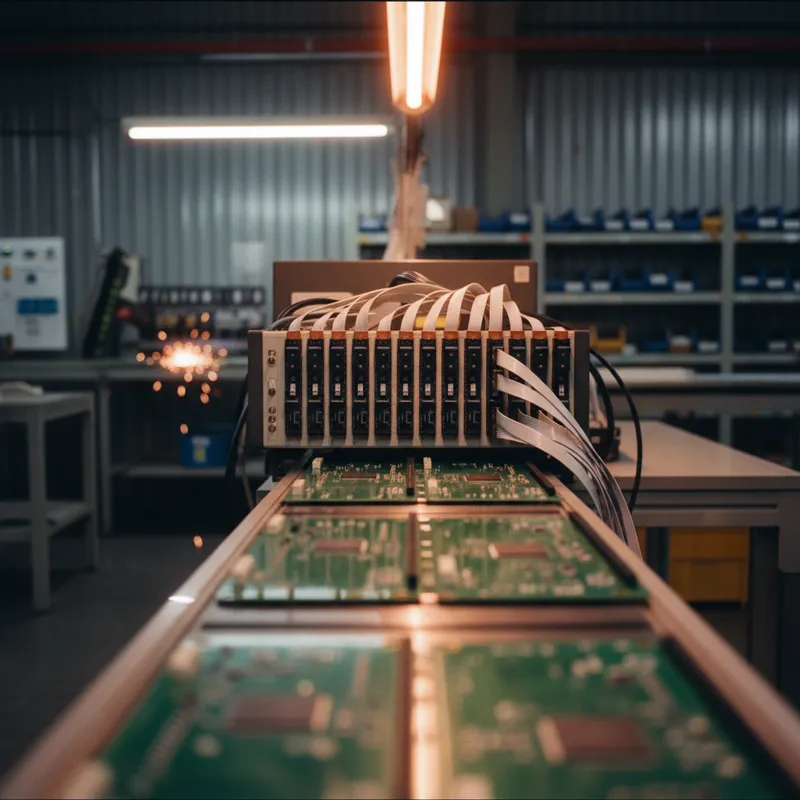
Inline programming eliminates these problems by integrating the programming step directly into the SMT production line. Boards flow through the programmer on a conveyor, are programmed automatically, verified, and continue downstream, with zero operator intervention and full MES traceability.
The ProMik XTL-i is the fully automated inline programming system designed for this integration.
XTL-i Architecture
The XTL-i integrates into SMT lines via SMEMA-compatible conveyor interfaces, the same standard conveyor protocol used by pick-and-place machines, reflow ovens, and AOI systems. Boards arrive on the conveyor, the XTL-i automatically positions the board, engages the programming fixture, programs all target devices, verifies programming, and releases the board downstream.
Key Specifications
| Feature | Specification |
|---|---|
| Automation | Fully automated, zero operator intervention |
| Conveyor | SMEMA-compatible |
| Fixture Changeover | Sub-60 seconds with auto-recognition |
| Throughput | 1,200+ ECUs per 8-hour shift |
| Verification | Automatic read-back comparison per board |
| Reject Handling | Separate lane with barcode-locked variant protection |
| MES Connectivity | OPC-UA, REST API, OPCON/ITAC |
| Monitoring | Web-based dashboard with yield analytics |
| Traceability | IATF 16949 via FlashTask Pro |
| Operation | 24/7 three-shift continuous |
Zero Operator Intervention
The XTL-i requires no operator during normal operation. Boards arrive, are programmed, verified, and released automatically. The system handles board positioning, fixture engagement, programming, verification, and pass/fail routing without human input. Status indicators and a web-based dashboard provide visibility to line operators and production supervisors.
Sub-60-Second Fixture Changeover
When production switches from one board variant to another, the XTL-i’s intelligent fixture recognition system identifies the new fixture and loads the corresponding FlashTask programming project automatically. Changeover completes in under 60 seconds, critical for high-mix production environments where product variants change multiple times per shift.
Reject Handling and Variant Protection
Every board programmed by the XTL-i undergoes automatic read-back verification, the programmed data is read back from the target device and compared bit-for-bit against the source firmware image. Boards that fail verification are rejected to a separate lane.
Barcode-locked variant protection prevents a critical error: programming a board with the wrong firmware variant. The system reads the board’s barcode, matches it against the production job’s variant table, and only proceeds if the variant matches. This prevents misprogramming errors that would otherwise require field recalls or costly rework.
MES Integration: Industry 4.0
The XTL-i supports multiple MES integration protocols:
- OPC-UA: the Industry 4.0 standard for machine-to-machine and machine-to-MES communication
- REST API: HTTP-based integration for modern MES platforms and custom factory software
- OPCON/ITAC: direct integration with ITAC MES, widely used in automotive tier-1 production
These integrations provide:
- Real-time programming status per board (serial number, timestamp, pass/fail, firmware version)
- Production job management (start job, end job, variant selection)
- Yield analytics and trend data for production quality monitoring
- Automatic production stops when yield drops below threshold
For Indian automotive tier-1 suppliers implementing Industry 4.0 factory architectures, the XTL-i’s MES connectivity ensures that programming data integrates with the digital factory infrastructure.
Programming Engine Options
The XTL-i accepts multiple ProMik programmers as its internal programming engine:
- MSP2300Net: multi-protocol programmer with JTAG, SWD, SPI, UART, I2C, and CAN support for broad MCU coverage
- XDM-ETH: automotive Ethernet programmer for next-generation ADAS, gateway, and infotainment ECUs
- XDM-USB: USB 3.0 programmer for non-Ethernet applications
The choice of programming engine depends on the target device and production requirements. For automotive ECUs communicating over Ethernet, the XDM-ETH provides automotive Ethernet programming with onboard SSD and HSM key injection. For microcontroller-based products using JTAG/SWD, the MSP2300Net covers the broadest device range.
Throughput Considerations
The XTL-i’s throughput of 1,200+ ECUs per 8-hour shift assumes typical automotive ECU firmware sizes (1-50 MB) and standard programming protocols. Actual throughput depends on:
- Firmware image size (larger images = longer programming cycles)
- Number of devices per board (multiple devices programmed sequentially or in parallel)
- Verification mode (read-back verification adds time but is required for automotive quality)
- Fixture engagement time (mechanical contact with test points)
For boards with multiple programmable devices, e.g., an ECU with a main MCU, a secondary safety MCU, and an external SPI flash, the XTL-i programs all devices in a single fixture engagement, optimising total cycle time.
Project File Compatibility
The XTL-i uses FlashTask Pro project files, the same format used across the entire ProMik ecosystem:
- Develop the programming recipe on the XDM-USB at the engineering bench
- Validate on the XTL-m during NPI first-article builds
- Deploy to the XTL-i for volume production, zero re-validation
This project file portability means that programming configurations validated during development and NPI transfer directly to production without the risk of transcription errors or configuration mismatches.
Applications in Indian Manufacturing
- Automotive tier-1 production in Pune, Chennai, Bengaluru, and Noida: inline programming for ADAS, body, powertrain, and EV ECUs
- EMS contract manufacturers: multi-variant high-mix programming for multiple OEM customers on shared SMT lines
- Two-wheeler ECU production: motor controllers, BMS units, and dashboard clusters at volumes exceeding thousands per day
- Industrial automation: inverter, drive, and sensor module programming on automated assembly lines
Why Buy from GSAS
GSAS Micro Systems is the authorised ProMik engineering partner in India, providing the XTL-i with system integration support, fixture design consultation, MES integration assistance, and production line commissioning. Engineering teams in Bengaluru, Hyderabad, Chennai, Pune, Mumbai, Delhi NCR, and Visakhapatnam support manufacturers from evaluation through production ramp.
Explore the XTL-i and ProMik product range, or contact us for production line consultation and pricing.
Also appears in:
Interested in ProMik tools?
Talk to our application engineers for personalized tool recommendations.
More from ProMik
View all →
Automotive ECU Programming and Traceability: Meeting IATF 16949 with ProMik
5 Apr · 7 min

Scaling Electronics Manufacturing in India: Programming Infrastructure for Growth
5 Apr · 7 min
FlashTask Pro: Production Programming Project Management with ProMik
5 Apr · 7 min
Gang Programmer vs Inline ISP: Choosing the Right Production Programming Approach
5 Apr · 7 min
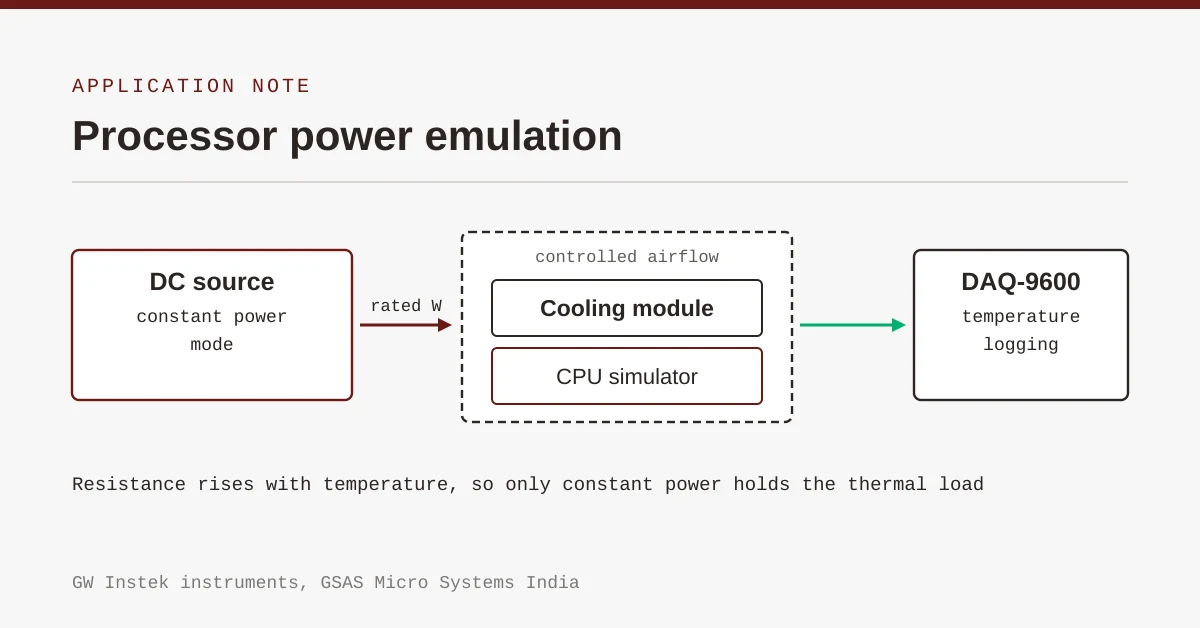
Emulating Processor Power for Thermal Testing: Why Constant Power
7 Oct · 7 min
CRPS and Rack Power Supply Testing: The Six Tests That Matter
7 Oct · 7 min