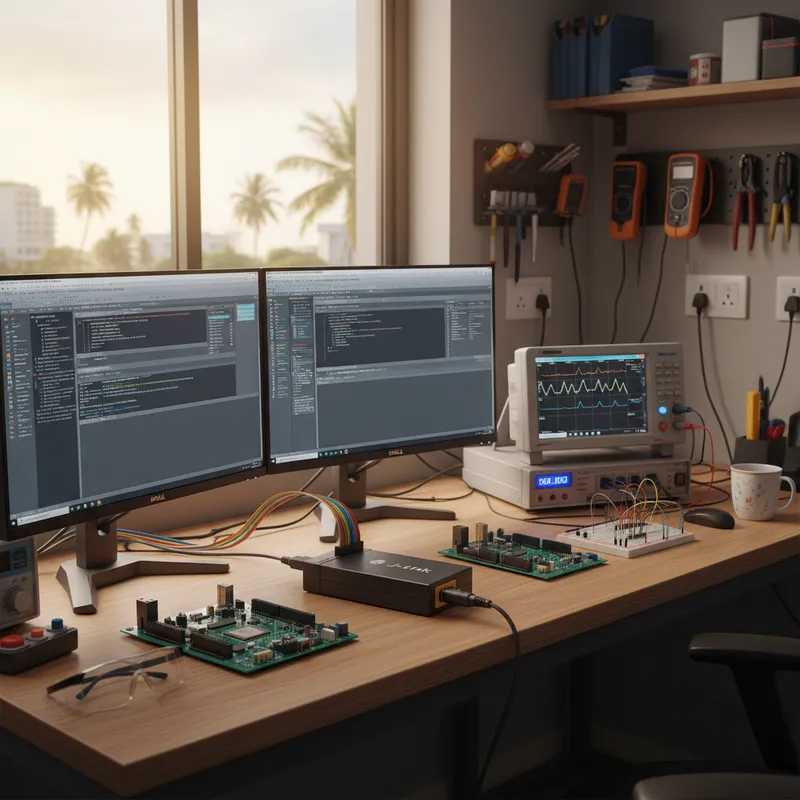
Texas Instruments has been a quiet but persistent presence in Indian product engineering for decades, the MSP430 ultra-low-power MCU inside Indian industrial metering and sensor products, MSP432 in more recent low-power Cortex-M designs, the SimpleLink CC13xx sub-GHz radio family in Indian utility metering and industrial telemetry, the SimpleLink CC26xx 2.4 GHz multi-standard parts in Indian consumer IoT and automotive keyless entry, and TM4C Tiva still shipping in legacy industrial control designs. For Indian teams building products on this silicon, debug and production tooling is usually TI’s own Code Composer Studio with the XDS110 or XDS200 probe. SEGGER J-Link is the alternative, and for teams that already own J-Links for their STM32, Nordic, or NXP work, the cross-platform reuse is a strong argument.
This guide explains which TI parts J-Link supports well, where it fits in Indian product development, where to choose J-Link over TI’s own probes, and, importantly, which TI parts J-Link does not support so that Indian teams do not specify the wrong probe for a project. GSAS Micro Systems is an authorized SEGGER engineering partner in India, stocking the full J-Link and Flasher range locally with INR invoicing and engineering support.
The TI microcontroller families in Indian product work
What J-Link supports (the Arm Cortex-M path):
- MSP432: Cortex-M4F ultra-low-power MCU, TI’s Arm-based successor to the MSP430 concept. Used by Indian battery-powered sensor and wearable product teams.
- SimpleLink CC13xx: sub-GHz wireless Cortex-M variants (CC1310, CC1312R, CC1352P, CC1352R). Widely used in Indian smart metering, utility telemetry, industrial sensor networks, and non-cellular rural asset tracking. The sub-GHz band is attractive for India because of range characteristics in rural deployments.
- SimpleLink CC26xx / CC26x2R: 2.4 GHz multi-standard Cortex-M variants (CC2640R2, CC2652R, CC2652P). Support BLE 5, Zigbee, Thread, and Matter from a single SDK. Used in Indian consumer IoT, smart lighting, and some automotive keyless entry and tyre-pressure monitoring designs.
- TM4C Tiva: legacy Cortex-M4F family, still shipping in Indian industrial control and motor drive designs that were locked in years ago and are still in production.
- Sitara AM62 / AM64: Cortex-A53 application processors with Cortex-R5 and Cortex-M4 companion cores. These are Linux-class devices, not MCUs, but J-Link can debug the Cortex-A/R/M cores in them. For the Linux side, see the RTT on Cortex-A/R Linux debug guide, the same principles apply directly to AM62 and AM64 development.
What J-Link does NOT support:
- MSP430 (classic): this is an important boundary. The original MSP430 is not a Cortex-M. It is TI’s proprietary 16-bit architecture, using the TI Spy-Bi-Wire or JTAG debug interface specific to MSP430. SEGGER J-Link does not support MSP430 classic parts. If your Indian project is on MSP430F or MSP430FR, you need TI’s MSP-FET or MSP-FET430UIF programmer and TI’s own Code Composer Studio (or IAR Embedded Workbench for MSP430). Do not buy a J-Link expecting it to debug MSP430, it will not.
The confusion usually comes from the similar name. MSP432 (Cortex-M4F) is supported by J-Link. MSP430 (classic 16-bit) is not. Before specifying a J-Link for a “TI MSP” project, confirm with the firmware team which exact part is in the schematic.
Which J-Link model for TI SimpleLink and MSP432 work
- J-Link BASE Compact: entry-level for low-volume prototype work on MSP432 or CC13xx/CC26xx.
- J-Link PLUS / PLUS Compact: the everyday choice for Indian teams shipping SimpleLink products commercially. Unlimited flash breakpoints, up to 1 MB/s download speed, USB 2.0 Hi-Speed, commercial license. This is the right default for most MSP432, CC13xx, and CC26xx work.
- J-Link ULTRA: USB 2.0 Hi-Speed with download speeds up to 4 MB/s and high-speed RTT. Worth the upgrade when debugging dense wireless stack telemetry, BLE 5 connection events, Thread routing tables, Matter commissioning trace, sub-GHz MAC layer statistics.
- J-Link PRO: Ethernet interface, so the probe can sit on the lab network. For Indian smart metering test rigs where the target is in a powered load bank, or for automotive CC26xx keyless-entry work where vehicle harness ground isolation matters, pair the probe with the separate SEGGER J-Link Isolator; galvanic isolation is not built into the probe itself.
If your team already owns J-Links for STM32, Nordic nRF52, NXP i.MX RT, or Renesas RA work, the same probe handles MSP432 and the SimpleLink parts with no additional hardware. This is the core argument for SEGGER over TI XDS110 and XDS200 in multi-silicon Indian labs.
J-Link vs TI XDS110 / XDS200: when to choose which
The TI XDS110 is the on-board debug probe on TI LaunchPad evaluation boards, and XDS200 is the standalone equivalent. Both work well with Code Composer Studio and with TI’s SimpleLink SDK. There is nothing wrong with them on a single-silicon TI project.
The reasons Indian teams move to J-Link:
- Cross-silicon tool reuse: one probe across STM32, Nordic, NXP, Renesas, GD32, RP2350, and TI SimpleLink. The bench carries one probe per engineer instead of four.
- Ozone: SEGGER’s standalone graphical debugger is independent of Code Composer Studio. Some Indian consulting teams work on customer sites where CCS is not installed, and Ozone plus a J-Link is a self-contained debug bench.
- Unlimited flash breakpoints: XDS110 is limited to the hardware breakpoint count of the core. J-Link models from PLUS upward include the license that patches flash for unlimited software flash breakpoints.
- Deep RTT throughput and SystemView: the RTT-to-SystemView pipeline is specific to SEGGER and not replicated in TI’s tools.
Conversely, if your Indian team is single-silicon on TI and happy with Code Composer Studio, there is no pressing reason to replace XDS110 with J-Link. The J-Link argument is strongest for multi-silicon labs and for teams that need RTT and SystemView quality-of-life that TI’s own tools do not provide.
RTT and SystemView on CC26xx BLE work
BLE debugging is the textbook case for RTT. The BLE link layer is timing-sensitive: the radio must transmit and receive inside narrow connection event windows, and if the application CPU is stalled waiting for printf over a UART, connection events get missed and the link drops. Indian teams chasing intermittent BLE disconnects on a CC2652R product discover this the hard way.
RTT uses the existing debug pins, streams at rates that do not throttle the CPU, and does not halt the cores. For SimpleLink CC26xx BLE, Thread, and Matter debugging this is effectively the only viable logging mechanism for timing-sensitive bugs. Read the RTT reference post for the underlying technology and the Cortex-M hardfault debug with RTT guide for the practical RTT workflow on Cortex-M parts, it transfers directly to CC26xx.
SystemView is the other half of the story for MSP432 and SimpleLink projects. TI’s SimpleLink SDK runs on TI-RTOS (now SimpleLink SDK Kernel) and on FreeRTOS. SystemView has adapters for FreeRTOS out of the box, and the same RTT transport carries SystemView events to the host application. For Indian teams debugging priority inversion or missed deadlines on a CC1352P sub-GHz utility meter product, SystemView exposes scheduling behavior that raw logging cannot. See the SystemView v4 ELF integration post for the ELF-driven symbol workflow.
Flasher for TI production programming
SEGGER Flasher supports MSP432, TM4C Tiva, and major SimpleLink CC13xx / CC26xx parts as part of the general Cortex-M production programming workflow. For Indian EMS teams running Flasher Compact on the bench, or Flasher ATE2 rack-mounted on a high-volume line, adding a TI SimpleLink product to an existing Flasher workflow is typically a device-database configuration change rather than a new programmer purchase.
For security-sensitive Indian smart-meter and automotive products based on CC13xx or CC26xx, Flasher Secure handles signed and encrypted firmware injection at the EMS, with the decryption happening inside the Flasher itself rather than in the EMS host PC.
Before speccing Flasher into a TI production line, confirm the specific part number is in the current SEGGER device database and that the flash algorithm supports any external memory or secure-boot configuration your project uses.
Buy SEGGER J-Link and Flasher for TI SimpleLink and MSP432 in India from GSAS
GSAS Micro Systems supplies the full SEGGER range for Texas Instruments MSP432, TM4C Tiva, SimpleLink CC13xx, and SimpleLink CC26xx development and production in India. Whether you are a Bengaluru smart-lighting team debugging a CC2652R Matter prototype, a Pune industrial telemetry company shipping CC1352P sub-GHz products, or a Chennai automotive electronics team porting a TM4C Tiva motor-drive firmware onto a more modern platform, we will help you pick the right J-Link model, confirm SEGGER’s current support status for your exact TI part numbers, and plan the production programming workflow. And if you are on MSP430 classic, we will tell you honestly that J-Link is not the right tool and point you at TI’s MSP-FET instead. Visit our partner page at /partners/segger or contact our engineering team for a demo at any of our Bengaluru, Chennai, Hyderabad, Delhi NCR, Mumbai, or Pune offices.
Further reading
- SEGGER J-Link supported devices list, authoritative catalogue; confirms which TI families and specific part numbers the current J-Link firmware supports
- SEGGER Knowledge Base, J-Link, wiki articles covering J-Link configuration, script files, and TI-specific notes
- SEGGER RTT, Real-Time Transfer technology overview, the replacement for UART printf on BLE and sub-GHz wireless targets
- SEGGER SystemView, RTOS-aware profiling for SimpleLink SDK / TI-RTOS projects
- SEGGER Ozone, standalone debugger
- Texas Instruments SimpleLink Wireless MCU product portfolio, TI’s own reference for CC13xx/CC26xx variant selection
- GSAS partner page, SEGGER, full tool, probe, and middleware range available in India
- GSAS blog, buying the right J-Link for your project
- GSAS blog, SEGGER RTT on Cortex-A/R Linux targets, companion workflow for Sitara AM62/AM64 Linux work
Interested in SEGGER tools?
Talk to our application engineers for personalized tool recommendations.
More from SEGGER
View all →
Meet the GSAS Team at electronica India 2026, Stall H3.I45
15 Sept · 3 min
J-Link Is Now Validated by ST for StellarStudio
13 Sept · 2 min
An AI Agent That Drives the Debugger: SEGGER and Embedder Connect J-Link to the Loop
13 Sept · 6 min
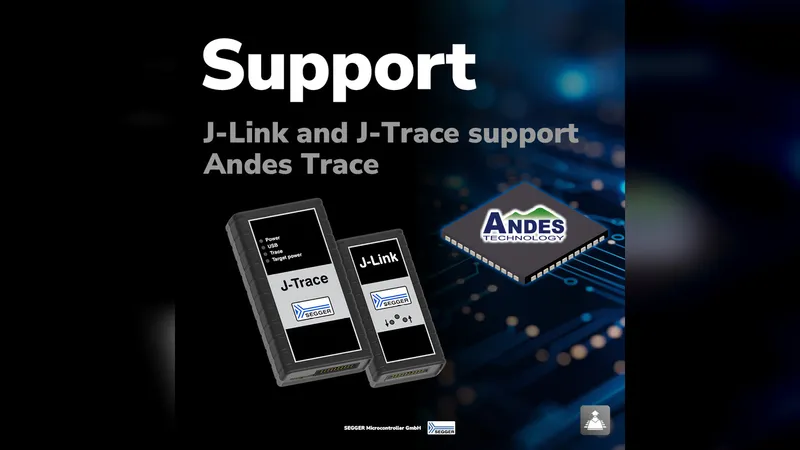
SEGGER J-Link and J-Trace Now Support Andes Trace: Why This Matters for RISC-V
21 Jul · 6 min
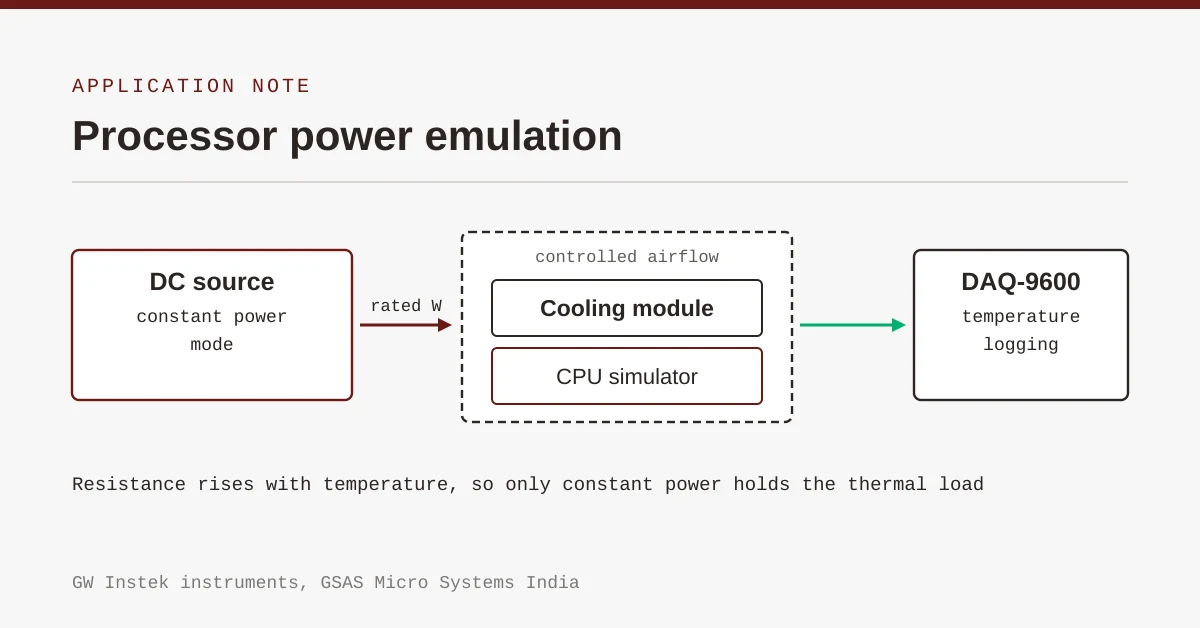
Emulating Processor Power for Thermal Testing: Why Constant Power
7 Oct · 7 min
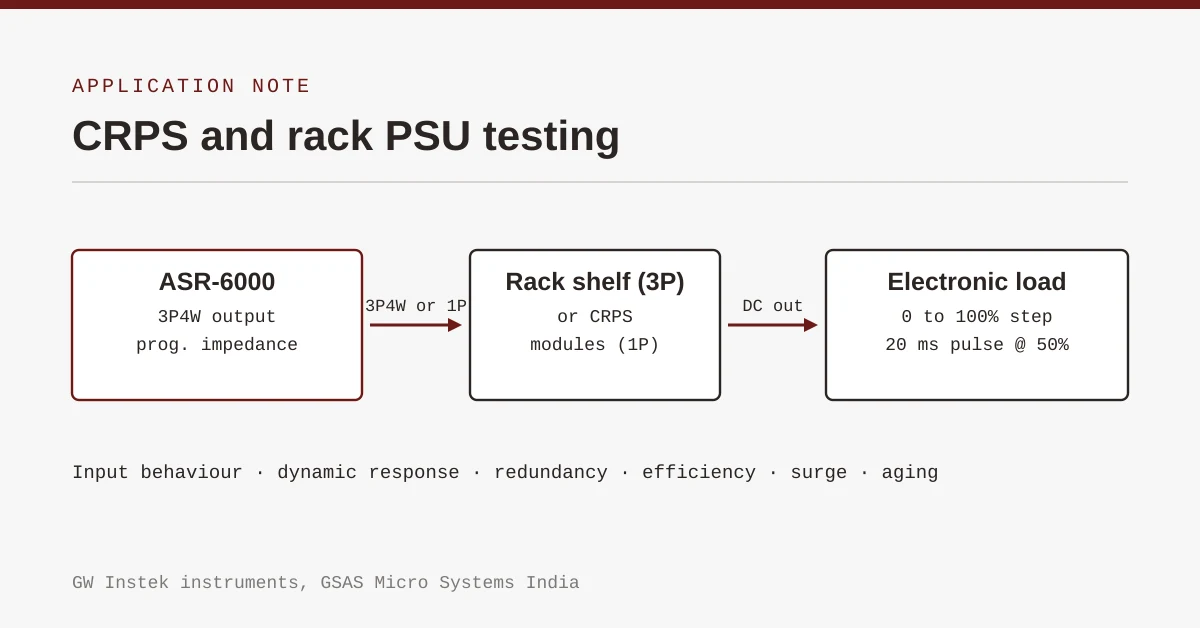
CRPS and Rack Power Supply Testing: The Six Tests That Matter
7 Oct · 7 min