Every production line that programs ICs must answer a fundamental question: do you program the chip before it goes on the board, or after? The answer shapes your production workflow, equipment investment, test fixture design, and throughput planning. Both approaches have clear strengths, and many production environments use both. Here is a practical comparison.
Offline Socket Programming: Program Before Assembly
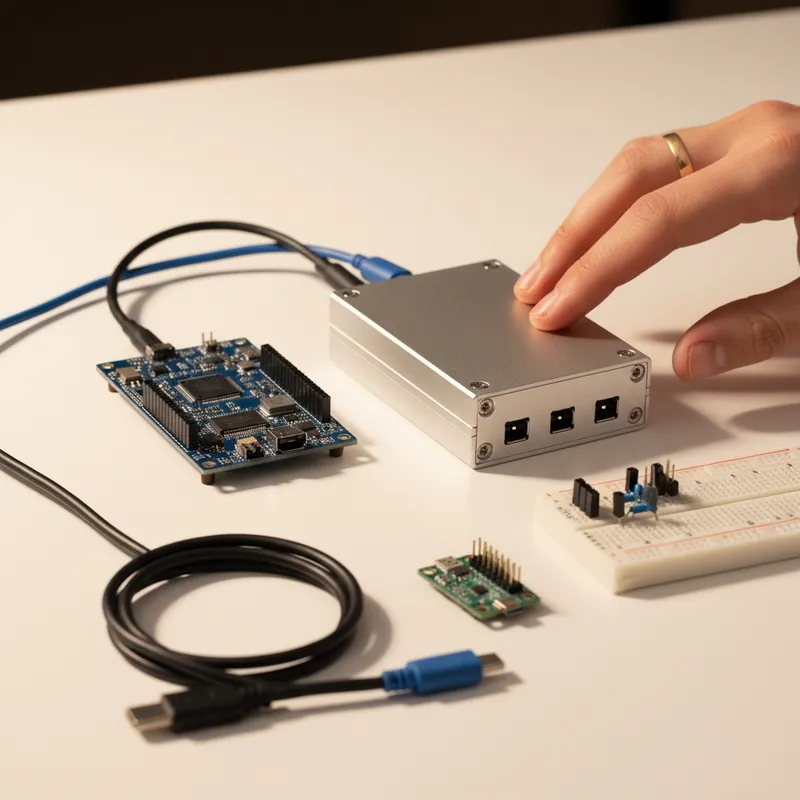
Offline (out-of-circuit) programming uses a universal programmer, like the Xeltek SuperPro 7500N, 6100N, or 610P, to program bare ICs in a ZIF socket before they are placed on the PCB by the SMT pick-and-place machine.
How it works: The IC is removed from its packaging (tape, tray, or tube), inserted into the programmer’s socket (with an adapter for SMD packages), programmed and verified, then returned to the SMT supply chain for board assembly.
Advantages:
- Every IC arrives at the SMT line pre-programmed and verified, no programming step on the assembled board
- No test fixture or programming header required on the PCB, saving board real estate
- Access to the full device, all pins are accessible in the socket, enabling operations that ISP cannot perform (programming security fuses, OTP bits, full device verification)
- One programmer handles hundreds of different device types with adapter changes, universal capability
- Failed programming does not waste a populated PCB, only the bare IC is at risk
Limitations:
- Requires handling bare ICs, which adds a production step and handling risk for fine-pitch BGA and WLCSP packages
- Socket adapters are needed for each package type (though Xeltek offers 1,500+ adapters)
- The IC must be programmed before assembly, post-assembly firmware updates require a different approach
In-System Programming: Program After Assembly
In-system programming (ISP) programs the IC while it is soldered on the target PCB, communicating through serial protocols (SPI, I2C, JTAG, UART, or vendor-specific interfaces) via a programming header or test points on the board.
How it works: The assembled PCB connects to an ISP programmer (such as the Xeltek SuperPro IS01 or IS416N) through an ISP cable or pogo-pin fixture. The programmer communicates with the target IC through the serial interface, writing firmware and verifying the result.
Advantages:
- No bare IC handling, the device is already soldered to the board
- Programming integrates into the board test sequence, program, then immediately run functional tests
- Supports field firmware updates using the same ISP interface
- No socket adapters needed, the programming header on the PCB provides the connection
- The board design determines the programming interface, which is typically already present for debug
Limitations:
- Requires a programming header or accessible test points on the PCB, consuming board area
- ISP speed is constrained by the serial interface bandwidth, typically slower than the parallel interfaces available in socket programming
- Not all device features are accessible via ISP, some security fuses, OTP areas, and device configuration registers require socket-level access
- Each board design needs its own ISP cable or fixture, less universal than a socket programmer
- A programming failure on an assembled board wastes the cost of all components on that board
The Technical Tradeoffs
| Factor | Offline (Socket) | In-System (ISP) |
|---|---|---|
| IC handling | Bare IC in socket | Soldered on PCB |
| Programming speed | Faster (parallel bus access) | Slower (serial interface) |
| Device access | Full pin access | Limited to ISP interface |
| Board area impact | None (no header needed) | Programming header required |
| Fixture cost | Socket adapter (universal) | Board-specific cable/fixture |
| Failure cost | Bare IC only | Populated PCB |
| Field update capability | No (device must be removed) | Yes (via ISP header) |
| Production integration | Separate pre-SMT step | Inline with board test |
When to Choose Each Approach
Choose offline socket programming when:
- You can program ICs before SMT assembly and your supply chain supports pre-programmed component handling
- The production BOM includes devices that are difficult to ISP (legacy EPROMs, PALs, devices without ISP support)
- Board area is at a premium and adding a programming header is undesirable
- You need to program security fuses, OTP bits, or configuration registers not accessible via ISP
- Your device mix is highly diverse and universal programmer coverage is more practical than device-specific ISP fixtures
Choose in-system programming when:
- The IC is already assembled on the board (rework, field updates, post-SMT programming)
- Programming is part of the board test sequence and combining steps improves production flow
- The product requires field firmware update capability through the ISP interface
- The IC package (fine-pitch BGA, WLCSP) makes bare IC handling in sockets impractical at volume
- The board design already includes a programming header for debug use during development
The Hybrid Strategy
Many production environments use both approaches in a complementary workflow:
- Pre-SMT socket programming: bulk firmware (bootloader, operating system, base firmware) is programmed onto flash memory and eMMC before assembly using a SuperPro 7500N
- Post-assembly ISP: board-specific configuration (serial numbers, calibration data, MAC addresses, product variant settings) is programmed via ISP after the board passes electrical test
This hybrid approach maximizes throughput (bulk data programmed offline at socket speed) while enabling board-specific customization inline with production test.
Applying This in Indian Manufacturing
Contract electronics manufacturers in Bengaluru and Pune handling multiple customer products often maintain both SuperPro desktop programmers (for pre-SMT programming of diverse device types across customer BOMs) and ISP fixtures (for post-assembly configuration per customer specification).
Automotive ECU manufacturers in Chennai and Hyderabad commonly pre-program flash memory with base firmware using socket programmers, then perform ECU-specific calibration and serialization via ISP at the end-of-line test station.
IoT device manufacturers in Mumbai and Delhi NCR producing gateway and sensor products increasingly favour ISP for production, the compact board designs already include SWD or JTAG headers for development, and these double as production programming interfaces.
Why Buy from GSAS
GSAS Micro Systems provides both Xeltek out-of-circuit socket programmers (SuperPro 610P, 6100N, 7500N) and ISP solutions (IS01, IS416N) as an authorized Xeltek partner since 2014. Our application engineers in Bengaluru, Hyderabad, Chennai, Pune, Mumbai, and Delhi NCR help production teams evaluate the right mix of socket and ISP programming for their specific workflow. We provide device compatibility verification, fixture design guidance, and throughput modelling for both approaches. Request a quote to discuss your production programming strategy.
Also appears in:
Interested in Xeltek tools?
Talk to our application engineers for personalized tool recommendations.
More from Xeltek
View all →
SuperPro 610P vs 6100N vs 7500N: Which Xeltek Programmer Is Right for You?
6 Apr · 3 min
Emulating Processor Power for Thermal Testing: Why Constant Power
7 Oct · 7 min
CRPS and Rack Power Supply Testing: The Six Tests That Matter
7 Oct · 7 min
GPU Power Board Testing: DC Input Verification Before Integration
7 Oct · 6 min