An impedance analyzer does everything an LCR meter does, and then goes further. While LCR meters measure the primary parameters of passive components (inductance, capacitance, resistance), an impedance analyzer provides the full complex impedance picture across a wide frequency range, including material characterisation parameters like permittivity and permeability that LCR meters do not typically measure. The Microtest 6632 Series bridges the gap between production-speed component testing and laboratory-grade impedance analysis.
Beyond LCR: What the 6632 Measures
The Microtest 6632 measures a comprehensive parameter set:
| Category | Parameters |
|---|---|
| Impedance | |Z|, |Y|, theta, X, R, G, B |
| Passive Components | L, C, D, Q, DCR, ESR |
| Material Properties | Relative permittivity (epsilon-r), relative permeability (mu-r) |
The material characterisation parameters, permittivity and permeability, are what distinguish the 6632 from standard LCR meters. These parameters are essential for:
- Ferrite core evaluation: measuring permeability vs. frequency to characterise core materials for transformer and inductor design
- Dielectric material analysis: measuring permittivity and loss tangent of PCB substrates, capacitor dielectrics, and insulating materials
- EMI filter design: characterising the impedance vs. frequency behaviour of EMI filter components to verify suppression performance at target frequencies
Frequency Range and Accuracy
The 6632 operates from DC/10 Hz to 50 MHz with ±0.08% basic accuracy. This frequency range covers:
- Power electronics (10 Hz to 1 MHz), transformer and inductor characterisation at switching frequencies
- General electronics (1 kHz to 10 MHz), passive component QC at operating frequencies
- RF and EMC (1 MHz to 50 MHz), filter and decoupling component characterisation at EMI-relevant frequencies
- Material research (full range), frequency-dependent permittivity and permeability studies
The 50 MHz upper limit is particularly relevant for EMC applications. EMI filter components and decoupling capacitors need to be characterised at the frequencies where they are expected to provide attenuation, typically in the 1 MHz to 50 MHz range. An inductor that measures 10 uH at 1 kHz may exhibit a self-resonant frequency at 15 MHz and behave as a capacitor above that frequency. The 6632 reveals this frequency-dependent behaviour through its sweep mode.
Production Speed: Sub-3 ms Measurement
Despite its analyser-grade capability, the 6632 measures in under 3 ms per reading. This speed enables integration into production test stations where impedance analysis is part of an automated test sequence. Component manufacturers in Pune and Chennai use the 6632 for 100% production testing of inductors, capacitors, and EMI filter assemblies without sacrificing throughput.
The BIN comparator with pass/fail classification and handler interface provides the production automation features expected in a manufacturing environment. Components are measured, compared against programmed limits at one or more frequencies, classified into tolerance bins, and sorted automatically.
List Sweep Mode
The list sweep mode measures impedance at a programmable sequence of frequencies in a single pass. This is the key feature for component characterisation: instead of measuring at a single frequency and inferring behaviour at other frequencies, the 6632 directly measures across the frequency range of interest.
Applications for list sweep mode:
- Self-resonant frequency (SRF) detection: inductors and capacitors exhibit SRF where the component transitions from inductive to capacitive behaviour (or vice versa). The sweep reveals the exact SRF point.
- Q factor vs. frequency: inductor quality factor varies with frequency, peaking at the optimal operating frequency and degrading at higher frequencies. The sweep characterises this Q profile.
- Impedance profile of EMI filters: the suppression performance of ferrite beads, common-mode chokes, and differential-mode filters varies with frequency. The sweep provides the complete impedance profile.
Applications in Indian Industry
Passive component manufacturing. India’s growing passive component industry, capacitor manufacturers, inductor winding operations, and ferrite core producers, needs impedance analysis for product development and quality control. The 6632 serves both: R&D engineers use sweep mode to characterise new designs, and production teams use single-frequency BIN sorting for quality inspection.
Magnetics design. Transformer and inductor designers in Bengaluru, Hyderabad, and Delhi NCR use the 6632 to characterise ferrite core materials, measure winding inductance and coupling at operating frequencies, and verify EMI filter attenuation. The permeability measurement capability is essential for core material selection and incoming inspection of ferrite materials from suppliers.
PCB material characterisation. High-frequency PCB designers need to know the dielectric constant and loss tangent of substrate materials at operating frequencies. The 6632’s permittivity measurement, combined with appropriate fixtures, provides this data for design rule calculation and material qualification.
Academic and research labs. Universities and research institutions across India studying electromagnetic materials, piezoelectric ceramics, and nanomaterials use impedance analysis for material property measurement. The 6632’s frequency range and accuracy serve these applications while remaining cost-effective compared to specialised research instruments.
Fixture and Correction
Accurate impedance measurement requires proper fixture compensation. The 6632 supports open/short/load correction that calibrates out fixture parasitics across the full frequency range. For production installations, dedicated fixtures with stable, repeatable connections are essential. For R&D characterisation, interchangeable fixture heads accommodate different component form factors, SMD, through-hole, axial, and custom test jigs.
Why Buy from GSAS
GSAS Micro Systems is an authorised Microtest partner in India, providing the 6632 Series Impedance Analyzer with INR invoicing, application engineering, and fixture selection guidance. Our team supports component manufacturers, magnetics designers, and R&D labs across Bengaluru, Hyderabad, Chennai, Pune, Mumbai, and Delhi NCR with demo units, measurement consultation, and production line integration. Contact GSAS to schedule a demo or discuss your impedance analysis requirements.
Also appears in:
Interested in Microtest tools?
Talk to our application engineers for personalized tool recommendations.
More from Microtest
View all →
Power Measurement for Server PSUs: Microtest 7140 Power Analyzer
7 Apr · 5 min
Wireless Charger QC Testing with the Microtest 9901
7 Apr · 5 min
Motor Stator Testing in EV Manufacturing: Microtest MT-6910 Series
7 Apr · 5 min
PCB Incoming Inspection with Multichannel LCR Testing
6 Apr · 5 min
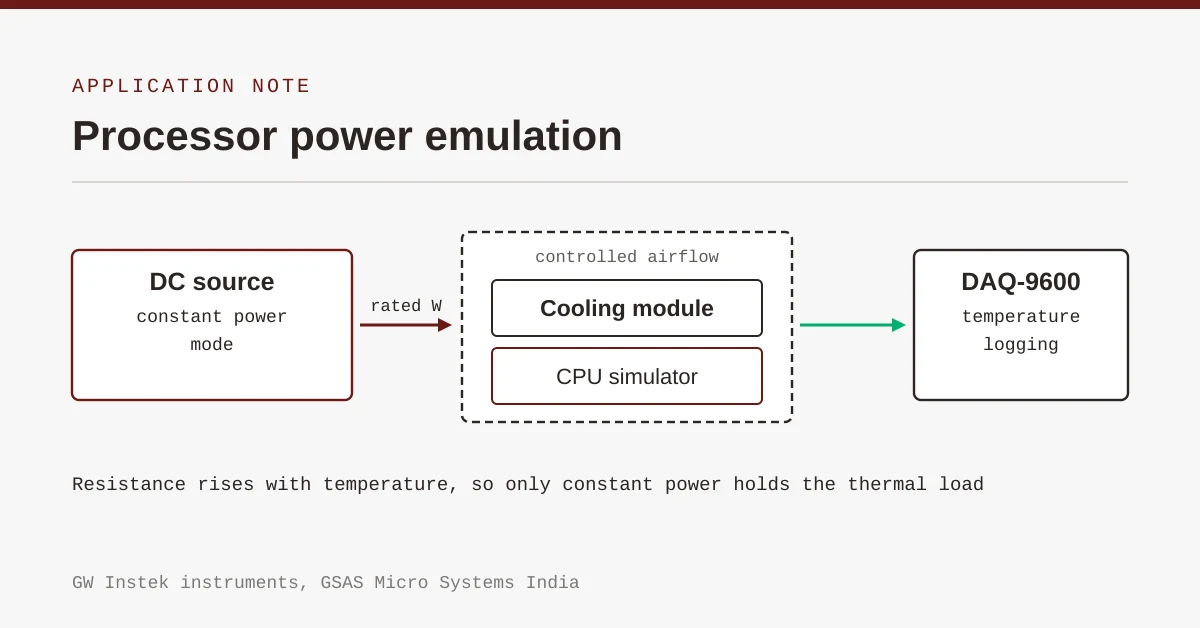
Emulating Processor Power for Thermal Testing: Why Constant Power
7 Oct · 7 min
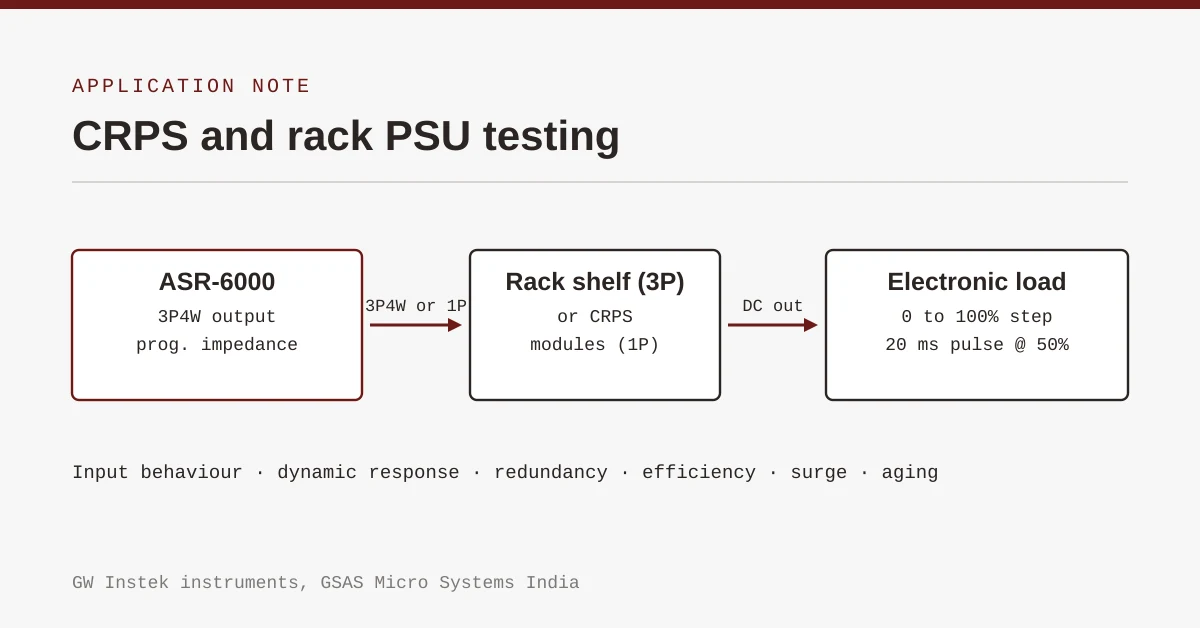
CRPS and Rack Power Supply Testing: The Six Tests That Matter
7 Oct · 7 min