
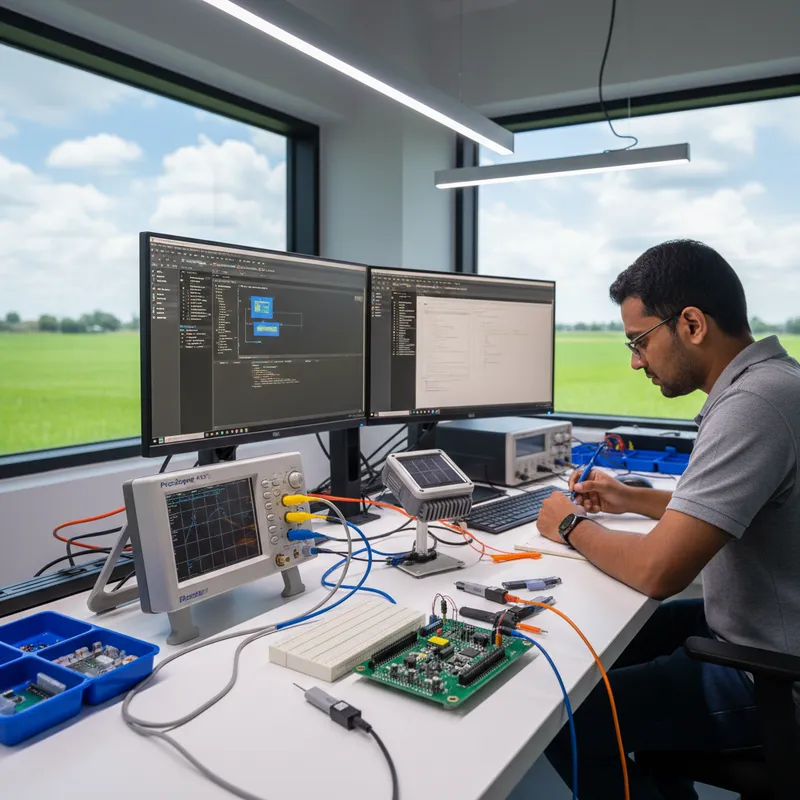
India’s agricultural IoT space has grown into a real engineering market, soil moisture monitoring, precision irrigation, greenhouse climate control, dairy automation, cold-chain monitoring, fishery aeration, and post-harvest grain storage validation. Indian agritech startups in Bengaluru, Hyderabad, Chennai, and Pune are building sensor products for these applications, and Indian agricultural universities and research stations are running the long-duration field studies that validate them. The instrumentation problem those teams hit is consistent: bench-grade laboratory precision instruments are too expensive for agritech R&D budgets, and the field-grade IoT sensors they are trying to build are too coarse to validate against themselves. You need something in between, laboratory-quality precision at a price that fits agritech research grants, with software that handles long-duration logging without babysitting. This post walks through the PicoLog and PicoScope instruments that fit Indian Krishi IoT work, the measurement problems they solve in agritech R&D, and why they are the right tool for a market where the end product ships at high volume but the R&D needs to be laboratory-rigorous.
GSAS Micro Systems is an authorized Indian engineering partner for Pico Technology, and we have been working with Indian agritech startups and agricultural research teams on data acquisition workflows that span multi-channel temperature measurement, soil sensor calibration, irrigation pump characterization, and thermal profiling of post-harvest processing equipment. The recurring observation is that Pico hardware lands in agritech R&D precisely because it is precision-grade but affordable, a combination the Indian agritech market genuinely needs.
The Indian Krishi IoT instrumentation problem
Indian smart agriculture R&D sits between three instrumentation worlds. Bench-grade laboratory instruments, high-accuracy multi-channel thermometers, 24-bit lab data loggers, precision current analyzers for pump motor characterization, deliver the rigor an agricultural research study needs but cost many lakhs of rupees per instrument, which does not fit agritech startup or university research budgets. Field-grade IoT sensors, capacitive soil moisture probes, DHT22 temperature modules, thermocouple-to-ADC breakout boards on a Raspberry Pi, cost little but cannot be used as the reference for their own validation. And industrial data loggers from traditional process-instrument companies are built for continuous plant monitoring, not the bench workflow agritech R&D needs.
Pico’s long-running PicoLog family fits the gap. The units are USB-powered, use precision analog front ends built to laboratory standards, ship with free PicoLog 6 software and cross-platform drivers, and cost substantially less than comparable benchtop instruments. For a Bengaluru agritech startup validating a new soil moisture sensor or an Indian agricultural research station running a long-term climate monitoring study, PicoLog delivers laboratory-quality measurement on a budget that actually fits.
The PicoLog family for agritech R&D
Five PicoLog instruments cover the core measurement problems in Indian smart agriculture R&D.
PicoLog TC-08, 8-channel thermocouple data logger, 20-bit resolution, USB-powered, PicoLog 6 software. Type K accuracy is quoted as ±(0.2% of reading + 0.5 °C) on the instrument datasheet. The TC-08 is the standard tool for greenhouse climate monitoring research, cold-storage temperature mapping, dairy fermentation profiling, and multi-point grain storage temperature studies. Eight independent thermocouple channels means a single unit can monitor a small experimental greenhouse or characterize a grain dryer’s thermal profile at eight spatial points simultaneously.
PicoLog PT-104, 4-channel PT100 / PT1000 precision temperature data logger, 24-bit resolution, 0.015 °C instrument accuracy. Where the TC-08 is the general-purpose thermocouple workhorse, the PT-104 is the high-accuracy reference. For an Indian agricultural research study calibrating field-deployed temperature loggers against a laboratory reference, the PT-104 with a calibrated PT100 probe is the reference measurement, the other instruments in the study trace back to it. The PT-104 is also the right tool for experiments where the temperature difference between measurement points matters more than the absolute value (a 0.1 °C gradient across a seed bed, for example) because the channel-to-channel consistency of a single PT-104 unit is better than the absolute accuracy.
PicoLog CM3, 3-channel AC current clamp data logger, 24-bit resolution, USB-powered. This is the instrument for irrigation pump monitoring, post-harvest dryer power profiling, dairy chiller compressor monitoring, and any measurement where you need to log AC current on one or several channels over hours or days. The CM3 pairs with Pico’s current clamp accessories, the TA325 flex clamp for three-phase measurement, the TA326 single-channel flex clamp, both switchable across 30 / 300 / 3000 A ranges, giving a single instrument the flexibility to handle small pump motors up through large grain-dryer heating element banks.
PicoLog ADC-20 and ADC-24, precision analog data loggers, 20-bit and 24-bit respectively, multiple single-ended and differential analog channels. This is the instrument for soil moisture sensor characterization, pH probe validation, conductivity sensor calibration, and any custom analog sensor work where you need to ingest a precision voltage or current signal from a sensor under test. The 24-bit ADC-24 gives 16 single-ended or 8 differential channels, enough to characterize multiple sensors simultaneously on a bench.
PicoScope 4444, 4 differential inputs, 20 MHz bandwidth, 14-bit resolution. Not strictly a data logger, but the right tool for the transient measurements agritech research sometimes needs: valve-actuation transients on a precision irrigation solenoid, pump motor inrush current characterization, or lightning-induced surge capture on a field-deployed sensor installation. Paired with the PicoConnect 442 probe accessory, the input is rated up to 1000 V CAT III for three-phase mains work.
Use cases across Indian Krishi R&D
Bengaluru agritech startup, soil moisture sensor characterization. A startup building a new capacitive soil moisture sensor product cannot use its own prototype as the reference. The team takes reference soil samples at known gravimetric moisture content (oven-dry method), installs prototype sensors, and uses a PicoLog ADC-24 to log the prototype sensor output against the reference simultaneously across multiple soil types, sandy, loamy, clay-heavy, organic-rich. The 24-bit ADC-24 resolves the small output differences that distinguish one soil type from another, and the PicoLog 6 software handles the multi-day logging sessions the study needs. The result is a calibration curve for the sensor product that traces back to a gravimetric reference, which is the only way to build a sensor product that actually works in Indian field soils.
Indian agricultural research station, field temperature logger calibration. A long-term climate monitoring study needs field-deployed temperature loggers at multiple locations. Those loggers need to be calibrated against a laboratory reference before deployment and re-calibrated annually. A PicoLog PT-104 with a calibrated PT100 probe sits on the calibration bench; field loggers under test go into a temperature-controlled environmental chamber, the PT-104 measures the chamber reference, and PicoLog 6 records both streams for post-processing to compute the field logger calibration. The PT-104’s 0.015 °C instrument accuracy makes it a genuine reference for field loggers whose accuracy is typically ±0.3 °C.
Pune dairy automation R&D, fermentation tank thermal uniformity. A dairy automation company wants to validate that a new fermentation tank design maintains temperature uniformity across the tank volume. A PicoLog TC-08 with eight Type K thermocouples distributed through the tank at known spatial points captures the multi-point temperature profile during a full fermentation cycle. The 20-bit resolution and ±(0.2% + 0.5 °C) accuracy are appropriate for the measurement, the question is “does temperature vary by more than 1 °C across the tank”, which the TC-08 resolves comfortably. The PicoLog 6 software handles the multi-hour logging session without intervention.
Hyderabad precision irrigation R&D, pump motor current characterization. A precision irrigation team needs to characterize the power draw of a new irrigation pump design under variable head and flow conditions. A PicoLog CM3 with a three-phase flex current clamp logs the pump’s three-phase current as the head pressure and flow rate vary across the full operating envelope. The 24-bit resolution gives enough margin to see small efficiency differences between pump geometries, and the logging session runs for the full test matrix without the operator needing to reset the instrument between data points.
Chennai post-harvest research, grain dryer thermal profiling. A research team profiling a new grain dryer design needs to know the thermal performance at multiple points in the drying chamber over a full drying cycle. A PicoLog TC-08 with eight thermocouples placed at inlet, outlet, and six intermediate chamber locations captures the full spatial-temporal temperature profile. The data feeds into the team’s dryer efficiency calculation and validation against their CFD model. Eight channels on a single USB-powered instrument with free logging software is exactly what the study needs.
The data flow: PicoLog 6, cloud, and pyPicoSDK
The acquisition hardware is only half the story. The other half is what you do with the data, and the Pico software story is genuinely strong for agritech R&D.
PicoLog 6 is the free data logging application, Windows, macOS, Linux. It handles multi-channel logging sessions from one second to multi-month durations, exports to CSV, and includes alarm and math-channel features. For most agritech R&D benches it is all the software the team needs.
PicoLog Cloud extends PicoLog 6 with automatic cloud upload. For a multi-site study, field temperature loggers at five research stations, PicoLog Cloud means the research team does not need to physically visit each site to collect data.
pyPicoSDK is the right path when the workflow needs to run headless on a Raspberry Pi or industrial PC at the field site. The same pyPicoSDK code works on the team’s Bengaluru lab bench during development and on the field Raspberry Pi during deployment.
Instrument selection for an Indian agritech R&D bench
A typical Indian agritech R&D bench setting out to build serious instrumentation capability needs one PicoLog TC-08 for general-purpose multi-channel thermocouple work, one PicoLog PT-104 as the laboratory reference for calibration work, one PicoLog CM3 for AC current logging on pumps and compressors, one PicoLog ADC-24 for custom analog sensor characterization, and one PicoScope 4444 for transient capture and higher-bandwidth investigation. That five-instrument bench covers virtually every measurement problem an Indian agritech R&D team will encounter during product development, sensor validation, and field-study calibration, at a budget that fits a typical startup or university research grant.
Further reading
- PicoLog TC-08 on picotech.com, 8-channel thermocouple logger product page
- PicoLog PT-104 on picotech.com, 4-channel PT100 high-accuracy logger
- Pico Technology partner page, full PicoLog and PicoScope range available in India from GSAS
- PicoLog TC-08 product page, Indian supply and engineering support
- PicoLog PT-104 product page, Indian supply and engineering support
- PicoLog ADC-20/ADC-24 product page, precision analog logging
- PicoLog for long-term industrial and environmental monitoring, companion post on multi-week logging workflows
- PicoLog for precision measurement, background on the PicoLog accuracy story
The takeaway for Indian agritech R&D
Indian smart agriculture R&D needs laboratory-quality instrumentation at agritech-startup prices. Pico Technology’s PicoLog family, TC-08 for thermocouples, PT-104 for high-accuracy PT100 reference, CM3 for AC current, ADC-24 for precision analog, together with the PicoScope 4444 for transients, is the combination Indian agritech startups and agricultural research teams reach for when bench-grade accuracy matters but the budget is an R&D grant rather than a process-plant capex line. The PicoLog 6 software, PicoLog Cloud, and pyPicoSDK stack handles everything from bench-top short studies to multi-month field deployments on a Raspberry Pi, without forcing the team to rebuild their analytics pipeline around a proprietary data format.
GSAS Micro Systems supports Indian agritech R&D teams and agricultural research institutions through Pico hardware supply, PicoLog bring-up, and on-site workflow design. Our engineering offices in Bengaluru, Hyderabad, Chennai, Pune, Mumbai, and Delhi NCR work with Indian agritech startups, agricultural universities, and research stations building the next generation of Krishi IoT instrumentation, with Pico Technology as the measurement backbone that makes the R&D rigorous.
Also appears in:
Interested in Pico Technology tools?
Talk to our application engineers for personalized tool recommendations.
More from Pico Technology
View all →
How to Buy an Oscilloscope in India (2026): USB vs Benchtop, Bit Depth, Bandwidth: A Buying Guide
5 Jun · 11 min
PicoScope 5000D vs 5000E: Native 16-Bit or FlexRes? A Buyer's Guide for Indian Labs
4 Jun · 11 min
PicoScope 5000E in India: The World's First 4-Channel 16-Bit USB Oscilloscope, Explained
4 Jun · 11 min
PicoScope 7 Goes Native Arm64: Apple Silicon, Snapdragon Windows and Arm Linux Test Benches in India
4 Jun · 11 min
Emulating Processor Power for Thermal Testing: Why Constant Power
7 Oct · 7 min
CRPS and Rack Power Supply Testing: The Six Tests That Matter
7 Oct · 7 min