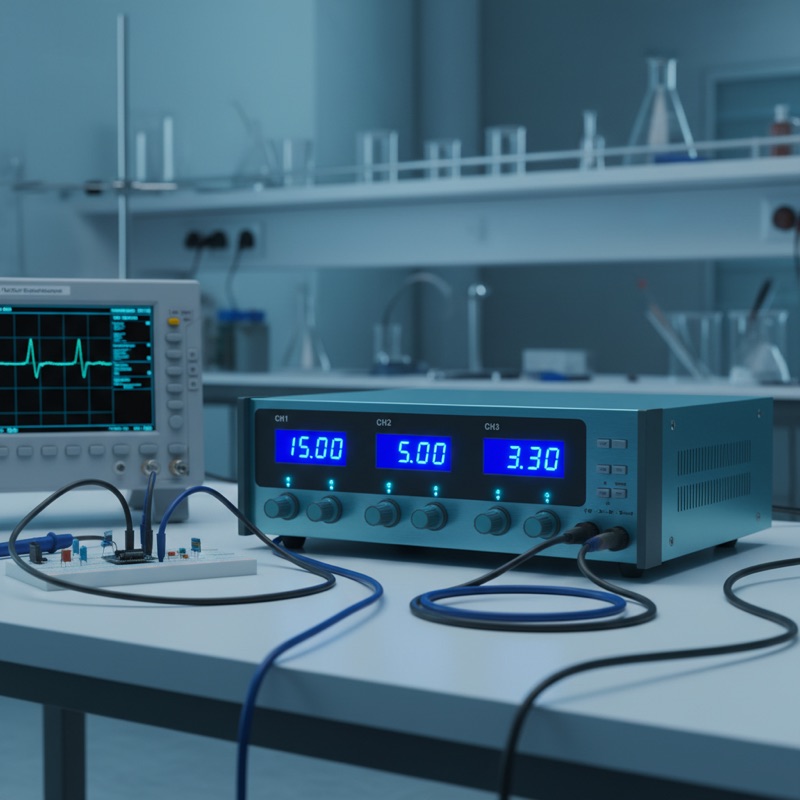
Production test and programming stations require precisely controlled, programmable power delivery. The device under test needs stable, repeatable supply voltages, and the test system needs visibility into how much current the device draws, when it draws it, and whether that draw falls within expected parameters. General-purpose bench power supplies can serve this role, but they often lack the programmability, protection features, and integration interfaces that production environments demand.
ProMik’s PSU2048 is a multi-purpose power supply unit designed specifically for integration into production programming and test systems, providing the combination of programmable control, monitoring, and protection that production applications require.
Four Independent Channels
The PSU2048 provides 4 independent channels, each capable of delivering power to separate sections of the device under test or to multiple devices simultaneously. Independent channels mean that each output operates with its own voltage setting, current limit, and protection parameters, no shared regulation loops that introduce crosstalk between channels.
This independence is essential for testing multi-rail devices where different voltage domains (core, I/O, analog, communication) must be powered sequentially or with specific timing relationships.
Voltage and Current Specifications
Each channel operates across a voltage range of 4 to 50V with up to 4A and 50W per output. This range covers the vast majority of embedded system power domains, from 5V microcontroller cores to 48V industrial bus voltages, from milliamp standby loads to multi-amp active-mode draws.
| Parameter | Specification |
|---|---|
| Channels | 4, independent |
| Voltage range | 4–50V per channel |
| Max current | 4A per channel |
| Max power | 50W per output |
| Host uplink | Ethernet |
Programmable Inrush Current Control
Inrush current at power-on is a common source of test failures and device stress in production. When a device with significant bulk capacitance is connected to a power supply, the initial current surge can trip overcurrent protection, cause voltage droop on adjacent channels, or, in worst cases, damage sensitive components.
The PSU2048 addresses this with a programmable inrush current limit and inrush current timer. Engineers can define the maximum allowable inrush current and the duration of the inrush window for each channel independently. This programmable control ensures that power-on sequences are repeatable and that protection thresholds are tuned to the specific requirements of each device under test, rather than relying on fixed limits that may be too aggressive or too permissive.
Short-Circuit Load Protection
Production environments expose equipment to mechanical wear, fixture degradation, and operator errors that can result in short-circuit conditions. The PSU2048 is short-circuit load protected on all channels, shutting down the affected output without disturbing other channels and without requiring manual reset of the entire power supply.
This per-channel isolation is a critical reliability feature for production stations that operate continuously across multiple shifts.
Load Current Monitoring and Traceability
Beyond simply delivering power, the PSU2048 provides load current monitoring on each channel. This measurement capability transforms the power supply from a passive source into an active diagnostic instrument. Production test sequences can read back the actual current draw at each stage, during programming, during functional test, during sleep-mode verification, and compare it against expected values.
These current measurements become part of the traceability record for each unit, enabling trend analysis across production lots and early detection of component or process drift before it manifests as yield loss.
Host Integration via Ethernet and DLL
The PSU2048 connects to the host system via an Ethernet uplink, enabling remote control and monitoring from any networked host. ProMik provides a DLL for customer host software integration, supporting environments such as LabVIEW, TestStand, and custom test executives.
This DLL-based integration means the PSU2048 slots into existing test architectures without requiring proprietary control software. Production teams that have already invested in LabVIEW or TestStand test sequences can add programmable power control by incorporating PSU2048 DLL calls into their existing code, no platform migration required.
Why This Matters for Indian Production Teams
As India’s electronics manufacturing capabilities expand, the infrastructure surrounding the production line, power delivery, measurement, traceability, must mature alongside. A programmable, monitored, protected power supply is not a luxury; it is a requirement for any production test station handling automotive, industrial, or safety-critical products where current consumption is a quality indicator.
GSAS Micro Systems provides the ProMik PSU2048 and the full range of ProMik production tools with local support across Bengaluru, Hyderabad, Chennai, Pune, Mumbai, Delhi NCR, and Visakhapatnam. Our engineers assist with system integration, DLL configuration, and production ramp, ensuring the PSU2048 is fully operational within your test architecture.
Also appears in:
Interested in ProMik tools?
Talk to our application engineers for personalized tool recommendations.
More from ProMik
View all →
Automotive ECU Programming and Traceability: Meeting IATF 16949 with ProMik
5 Apr · 7 min

Scaling Electronics Manufacturing in India: Programming Infrastructure for Growth
5 Apr · 7 min
FlashTask Pro: Production Programming Project Management with ProMik
5 Apr · 7 min
Gang Programmer vs Inline ISP: Choosing the Right Production Programming Approach
5 Apr · 7 min
Emulating Processor Power for Thermal Testing: Why Constant Power
7 Oct · 7 min
CRPS and Rack Power Supply Testing: The Six Tests That Matter
7 Oct · 7 min