
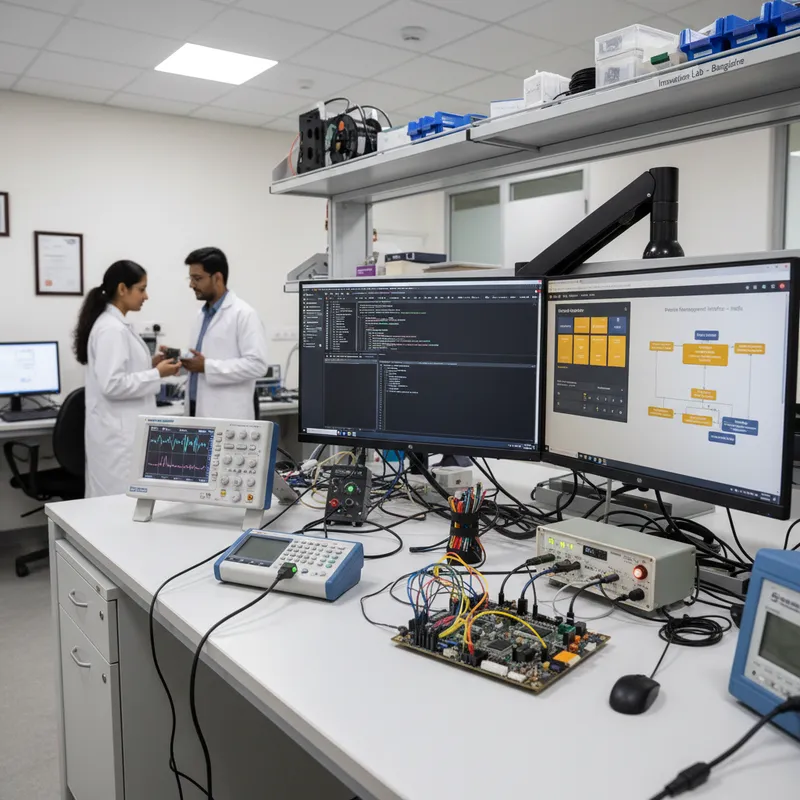
Walk into any Indian industrial site, solar installation, commercial HVAC plant room, or hospital equipment bay in 2026, and the pattern is the same: the installer pulls out a phone or a laptop, joins the device’s local network, opens a browser, and configures the equipment through a web UI served from the device itself. Proprietary vendor software, the Windows-only configuration tools that dominated embedded products through the 2010s, is losing ground fast, for simple reasons. An installer in the field does not want to install a driver, carry a specific laptop, or pay for a vendor licence. They want a browser. That shift is why SEGGER emWeb, the embedded HTTP and HTTPS server library that plugs into the rest of the SEGGER networking stack, is one of the most quietly important pieces in the Indian industrial embedded toolbox. This post walks through what emWeb provides, how Indian teams integrate it with emNet, emSSL, emFile, and emSecure, and the product categories where the “browser-accessible device UI” pattern is now the default. GSAS Micro Systems is an authorized Indian engineering partner for SEGGER Microcontroller GmbH.
Why an embedded web UI is the new default
The device-UI conversation has changed shape in the last decade. Through the 2000s and early 2010s, the standard pattern for configuring an industrial device was a vendor-specific serial or USB protocol, driven by a vendor-specific Windows application. That pattern was painful for installers, find the laptop, install the driver, locate the cable, hope the driver matches the operating system, but it was the only pattern that fit the RAM and flash budgets of the 8-bit and early 32-bit MCUs of the day.
By the mid-2020s, three things changed:
- Silicon. A modern Cortex-M4 or Cortex-M7 has the flash and RAM budget for a TCP/IP stack, a TLS library, and an HTTP server, a combination that would have been unthinkable on an 8051 in 2005. An STM32H7 or nRF7002 or i.MX RT1060 has enough headroom for a credible device UI.
- Connectivity. Every industrial product now ships with either Ethernet, Wi-Fi, or both. The local network the installer is on is the same network the device is on. No cable is required.
- Installer tolerance. The installers who commission Indian industrial equipment today, solar inverter technicians, HVAC commissioning engineers, smart-meter installers, building-automation integrators, expect a browser-based UI. A product that requires a Windows-only vendor tool is a product that loses the deal in the last 5% of the installation phase.
The practical implication is that every Indian industrial OEM shipping a new product line in 2026 is under pressure to ship a browser-accessible device UI, and the engineering question becomes “do we build one from scratch, glue nginx-derivative open-source components onto a Cortex-M, or buy a commercial-grade HTTP library with a support contract.” emWeb is the answer to the third option.
What emWeb actually provides
emWeb is a full HTTP/1.1 server library, with HTTPS support when paired with emSSL. The feature surface that Indian product teams care about:
- Static content serving. HTML, CSS, JavaScript, images, fonts, served either from a FAT32 file system on external flash via emFile or from a compiled-in resource table that lives in the firmware itself. The compiled-in path is the usual choice for smaller UIs where the asset bundle fits in a few hundred kilobytes.
- Dynamic content and templating. Server-side include directives, form POST handlers, URL parameter parsing, the traditional HTTP-server feature set, implemented in a form that fits on a Cortex-M without dragging in the weight of a PC-class web framework.
- REST API support. JSON request and response handling, route registration by URL pattern, and integration with application-level callbacks for configuration read/write endpoints, telemetry endpoints, and command endpoints. The modern pattern for a device UI is a thin JavaScript single-page app in the browser that hits a handful of REST endpoints on the device; emWeb is designed for exactly this pattern.
- WebSocket support. Live-update dashboards, real-time readings streaming from the device to the browser without polling, implemented via the WebSocket protocol upgrade path. Every modern HVAC or solar inverter dashboard uses WebSockets for the live sensor feed.
- HTTPS via emSSL. Pairing emWeb with emSSL gives full HTTPS server support, with certificate-based authentication and TLS 1.2 or TLS 1.3 ciphers. Any product that handles authentication credentials in the UI, which is every product, must serve the UI over HTTPS, and emWeb delivers that out of the box.
- Authentication. HTTP Basic and HTTP Digest are built in. For more sophisticated products, a custom cookie-based or JWT-based authentication layer can be registered against the URL routing, so the application code controls which endpoints require authentication and which are public (a small status page, for example, may be unauthenticated; configuration writes require a login).
- Royalty-free per-product commercial licence. Like the rest of the SEGGER middleware catalogue, emWeb ships under a per-product commercial licence with no per-unit royalty. The licence cost becomes a one-time engineering line, not a recurring BOM item.
- Commercial support contract. When a customer in a hospital network reports that the device’s web UI becomes unreachable after a TLS renegotiation under a specific load pattern, the path forward is a support call to an engineer at SEGGER, not a community forum thread. For industrial OEMs shipping into hospitals, utilities, and commercial buildings, this is the deciding factor.
The emWeb integration story: full stack
emWeb is not a standalone library. It sits on top of the rest of the SEGGER networking and file-system stack, and its full strength is visible only when the integration is considered end to end.
-
emWeb + emNet + embOS. This is the base networking combination, emNet is the TCP/IP stack, embOS is the RTOS, emWeb is the application-layer server. An HTTP request comes in on an Ethernet or Wi-Fi interface, lands in emNet’s socket buffers, is delivered to the emWeb task, is routed to an application handler, and the response goes back out the same way. This is a stable, well-supported combination that runs on every Cortex-M target SEGGER supports.
-
emWeb + emSSL. HTTPS support. emSSL wraps the underlying socket with TLS, and emWeb’s HTTP parser sees the decrypted stream. From the application’s perspective, an HTTPS connection is indistinguishable from an HTTP one except that the protocol scheme is
https://. The certificate and private key are provisioned at the factory, see the Flasher Secure provisioning pattern below. -
emWeb + emFile. The UI asset bundle, HTML, CSS, JS, images, is served from a FAT32 partition on external flash. This is important for one specific reason: the UI can be updated independently of the firmware. A product design team in Bengaluru can iterate on the UI, ship a new asset bundle over OTA, and the updated UI lands on the device without a full firmware update. This is the pattern every modern connected-device team wants, and emFile makes it tractable on a Cortex-M.
-
emWeb + emSecure. Signed firmware update through the web UI. The user, a field technician with appropriate authentication, uploads a new signed firmware image through a form in the web UI. The application handler on the device receives the binary, writes it to the inactive bank of the dual-bank flash layout, and the bootloader verifies the signature before activating the new image. The emSecure post for Cortex-M secure boot covers the verification side in detail.
-
Flasher Secure for factory provisioning. The TLS server certificate and the authentication credentials for the device’s admin account are provisioned at the Indian contract manufacturer via Flasher Secure and the Flasher Secure Server, following the same pattern covered in the Flasher Secure Indian EMS post. The CM operator never sees the plaintext credentials.
The result is a single coherent stack, HTTP server, TLS, file system, RTOS, TCP/IP, signed firmware update, secure factory provisioning, where every layer is a SEGGER library with commercial support. The alternative, gluing nginx-derivative open-source components, mbedTLS, lwIP, FreeRTOS, and a homebrew OTA flow into a single product, is achievable, but the integration cost and the ongoing maintenance burden dwarf the licence cost of the commercial stack.
Indian product categories where emWeb is the default
-
Solar inverter OEMs in Bengaluru, Pune, and Hyderabad: every residential and commercial string inverter shipping in India today has a browser-accessible configuration and monitoring UI for the installer and for ongoing O&M. The UI covers inverter configuration, grid parameters, MPPT tracking, production logs, and fault diagnostics. emWeb serves the UI; WebSockets stream the live production data; HTTPS protects the admin endpoints.
-
Chennai and Mumbai building-automation teams shipping HVAC controllers, chiller plant managers, and BMS edge gateways. The commissioning engineer uses a browser in the plant room to configure setpoints, schedules, and control loops; the facilities manager later uses the same UI from a laptop in the building office for day-to-day monitoring. A live dashboard over WebSockets shows current sensor readings and control outputs.
-
Pune and Chennai Tier-1 automotive suppliers shipping CAN-to-Ethernet gateway products for fleet maintenance and diagnostic bay equipment. The gateway exposes a web UI for configuration of CAN channels, DBC file upload, trace capture, and firmware update. The diagnostic technician uses a browser in the service bay; the fleet’s IT department uses the same UI for bulk configuration across many gateways.
-
Hyderabad and Bengaluru medical device teams shipping hospital-network-attached monitoring equipment. The device’s web UI serves a status page, no patient data on the page, only device health and configuration: for the hospital’s biomedical engineering team. HTTPS is mandatory; authentication is mandatory; audit logging of who accessed the page and when is part of the device-history-record expected under IEC 62304 and the CDSCO filing. The SystemView IEC 62304 post covers the runtime-evidence side that complements this.
-
Indian energy-meter OEMs exposing a local web UI on smart meters for installer commissioning and for utility field-service visits. The UI covers meter configuration, current readings, tamper logs, and the local communication parameters. For the related MODBUS side, the protocol the meter also needs to support for integration with existing SCADA systems, see the emModbus post on Indian industrial automation and energy metering.
-
Networking equipment, industrial switches, and IoT gateways: any product where the installer or the network administrator expects to manage the device through a browser. The category is broad and the pattern is consistent.
Why emWeb over a roll-your-own HTTP server
The temptation for any embedded team, especially an Indian team working against a tight project deadline, is to write “just enough” HTTP server code to serve a couple of endpoints and call it done. This is almost always a false economy. The reasons are predictable:
- HTTP parsing is harder than it looks. Malformed requests, chunked transfer encoding, header edge cases, URL encoding, and the security implications of each are all reasons professional HTTP servers are thousands of lines of code. A homegrown “just enough” parser fails the first time a modern browser sends a request with an unexpected header combination.
- HTTPS is much harder than it looks. TLS negotiation, certificate validation, cipher selection, and the ongoing process of retiring deprecated ciphers are all reasons open-source TLS libraries are hundreds of thousands of lines of code. Gluing one onto a homegrown HTTP server and keeping the glue working across TLS updates is a continuing engineering cost.
- WebSocket support adds another protocol on top. The upgrade handshake, the framing format, the ping/pong liveness protocol, all additional code to maintain.
- Maintenance across silicon generations. When the product line moves from STM32F4 to STM32H7 to nRF5340, a commercial library like emWeb moves with the silicon. A homegrown HTTP server moves only when someone on the embedded team has the bandwidth to port it.
- Regulatory traceability. For medical, automotive, and industrial-control categories under IEC 62304, ISO 26262, or IEC 61508, a commercial library with a documented change log, a support contract, and a third-party maintainer is easier to justify to an auditor than a homegrown implementation with no external validation.
emWeb is the pragmatic answer. It fits on a Cortex-M, it integrates with the rest of the SEGGER stack, it has a commercial support contract, and the licence cost is a one-time engineering line rather than a recurring BOM item.
Further reading
- SEGGER emWeb product page at segger.com
- SEGGER emNet product page at segger.com
- SEGGER emWeb at GSAS
- SEGGER emNet at GSAS
- SEGGER emSSL at GSAS
- SEGGER emFile at GSAS
- SEGGER emNet and emSSL for TLS 1.3 to AWS IoT Mumbai and Azure IoT Central India
- SEGGER emSecure-RSA and emSecure-ECDSA for secure boot on Cortex-M
- SEGGER emModbus for Indian industrial automation and energy metering
- SEGGER at GSAS
Working with GSAS on an emWeb rollout
A browser-accessible device UI is a product-level decision, not just a library import. The information architecture of the UI, the authentication model, the certificate-provisioning flow at the factory, the OTA path for UI asset updates, and the audit-logging expectations in regulated categories all need to be worked out before the first line of HTML is written. GSAS Micro Systems is an authorized Indian engineering partner for SEGGER Microcontroller GmbH, and our engineering team works with Indian OEMs on exactly these end-to-end rollouts, from architecture review to licence delivery to on-site bring-up. Teams across Bengaluru, Chennai, Hyderabad, Delhi NCR, Mumbai, and Pune reach us when the installer’s browser is the new deployment tool and the Windows-only legacy configuration utility has become a liability. The fix is a commercial-grade HTTP server, a tight integration with the rest of the networking stack, and a support contract that lasts the product’s lifetime.
Interested in SEGGER tools?
Talk to our application engineers for personalized tool recommendations.
More from SEGGER
View all →
Meet the GSAS Team at electronica India 2026, Stall H3.I45
15 Sept · 3 min
J-Link Is Now Validated by ST for StellarStudio
13 Sept · 2 min
An AI Agent That Drives the Debugger: SEGGER and Embedder Connect J-Link to the Loop
13 Sept · 6 min
SEGGER J-Link and J-Trace Now Support Andes Trace: Why This Matters for RISC-V
21 Jul · 6 min
Emulating Processor Power for Thermal Testing: Why Constant Power
7 Oct · 7 min
CRPS and Rack Power Supply Testing: The Six Tests That Matter
7 Oct · 7 min