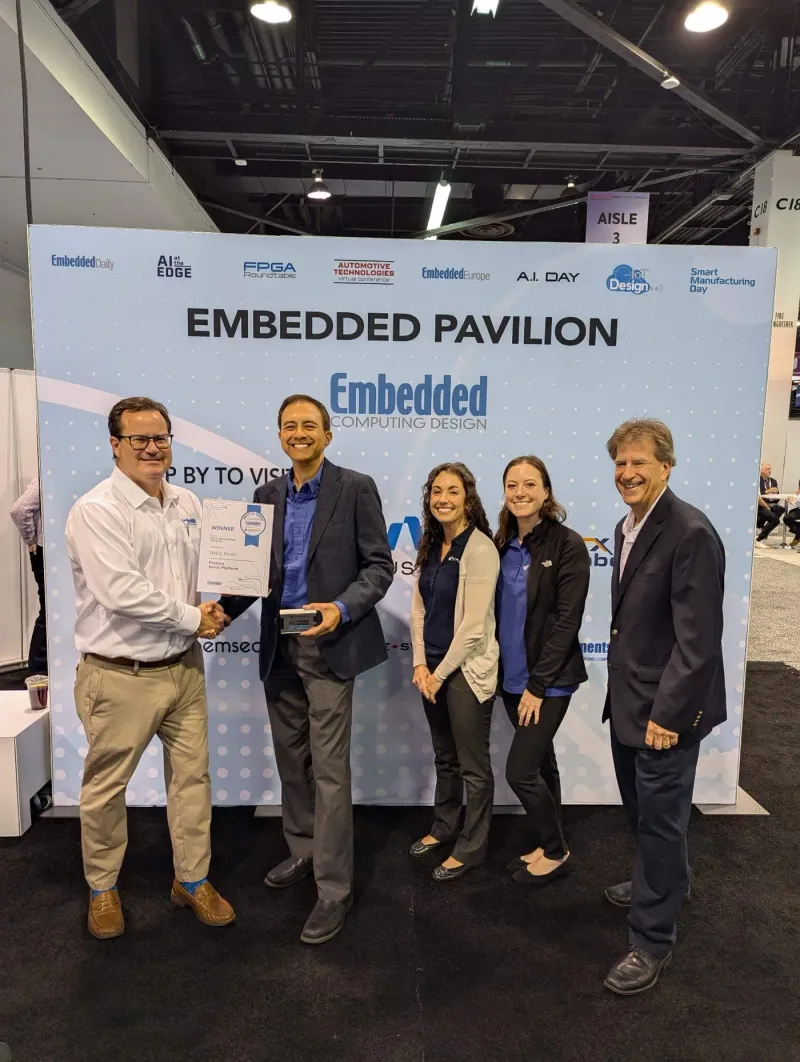
We are proud to share that our principal partner Total Phase received the Best in Show award in the Test & Measurement category at Embedded World North America 2025, judged by Embedded Computing Design. As Total Phase’s exclusive authorized partner in India, this recognition validates the calibre of instrumentation we bring to Indian engineering teams, and reinforces why GSAS chose to partner with Total Phase over a decade ago.
What Won the Award
The award recognized two demonstrations at Total Phase’s booth that showcase exactly the kind of innovation our customers in India benefit from:
Promira Serial Platform: Now an All-in-One I2C/SPI Tool
Total Phase demonstrated a dual-Promira setup where one Promira acted as an I2C master (actively driving bus transactions to a Wii Nunchuck controller via an Activity Board) while a second Promira ran the new I2C Analysis Application, passively monitoring the same bus in real time through Data Center Software.
This is significant for our Indian customers because it means the Promira can now replace both a host adapter (Aardvark) and a protocol analyzer (Beagle I2C/SPI) in a single instrument. For teams that previously needed to budget for two separate purchases, the Promira’s combined capability reduces capital expenditure while delivering higher performance, 80 MHz SPI, 3.4 MHz I2C High-Speed mode, and integrated level shifting from 0.9V to 3.45V.
The new analysis applications that earned the award include:
- I2C Analysis: passive bus monitoring at up to 5 MHz
- SPI Analysis Level 1: passive SPI capture at up to 24 MHz
- SPI Analysis Level 2: passive SPI capture at up to 40 MHz
These are firmware licenses that install on existing Promira hardware, so teams that already own a Promira through GSAS can add analysis capability without purchasing additional instruments.
Advanced Cable Tester v2
The booth also featured the Advanced Cable Tester v2 demonstrating USB Type-C cable testing with full pin continuity, DC resistance measurement, E-Marker verification, and signal integrity analysis with eye diagrams at up to 12.8 Gbps. For Indian cable manufacturers and quality inspection teams, the ACT v2 provides USB-IF and HDMI-level test coverage at a fraction of the cost of full compliance test systems.
What This Means for Indian Engineering Teams
Total Phase’s continued investment in making the Promira an all-in-one platform directly benefits the engineering teams that GSAS supports across India. Here is what changes for our customers:
- Lower instrument spend: Instead of budgeting separately for a host adapter and an analyzer, teams can start with a single Promira and add analysis licenses as their debugging needs grow.
- Simplified procurement: One instrument, one purchase order, one INR invoice from GSAS. No need to manage multiple vendor relationships for I2C/SPI tooling.
- Future-proof investment: The Promira’s FPGA-based architecture means new protocol capabilities (like the award-winning analysis applications) can be added via firmware, protecting the hardware investment as requirements evolve.
- eSPI readiness: For teams working on next-generation Intel and AMD platforms, the Promira’s eSPI analysis capability (up to 66 MHz) is available today.
Available from GSAS Now
Every product demonstrated at the award-winning booth is available from GSAS Micro Systems with INR invoicing, local demo units, and applications engineering support from our offices in Bengaluru, Chennai, Hyderabad, Delhi NCR, Mumbai, Pune, and Visakhapatnam. Whether you are evaluating the Promira as a replacement for your existing Aardvark and Beagle setup, or exploring the Advanced Cable Tester v2 for production cable qualification, our FAE team can arrange a hands-on demonstration at your facility.
Request a quote or book a demo to see the award-winning instruments in action.
Also appears in:
Interested in Total Phase tools?
Talk to our application engineers for personalized tool recommendations.
More from Total Phase
View all →
Aardvark vs Cheetah vs Promira: Total Phase Host Adapter Guide (India)
17 Jul · 6 min
Automated EV Charger Test Bench in India: GW Instek AC Source, DC Load and Battery Emulator
6 Jun · 16 min
Best Logic Analyzer in India (2026): A Vendor-Neutral Buying Guide for Embedded Teams
5 Jun · 10 min
Capturing I²C/SPI Data to Train Edge AI: A Protocol-Analyzer Workflow for Indian Embedded Teams
4 Jun · 9 min
Emulating Processor Power for Thermal Testing: Why Constant Power
7 Oct · 7 min
CRPS and Rack Power Supply Testing: The Six Tests That Matter
7 Oct · 7 min