“Which logic analyzer should we buy?” is one of the most common procurement questions Indian embedded teams send us at GSAS, and the honest answer almost never starts with a brand. It starts with the bus you are trying to see. A team chasing an intermittent I²C arbitration loss needs a fundamentally different instrument from a team validating a 16-signal SPI-plus-GPIO state machine on an ECU. Buy the wrong category and the tool sits in a drawer.
This is a vendor-neutral framework for choosing a USB logic analyzer in India in 2026. It walks the five decisions that actually decide fit, channel count, sample rate, protocol decoding, streaming versus buffer, and general-purpose versus dedicated protocol analyzer, and only then names the specific SKUs that map to each profile. Every number here is from the manufacturers’ official datasheets; nothing is invented, and where a spec is approximate we say so.
First: a logic analyzer is not an oscilloscope
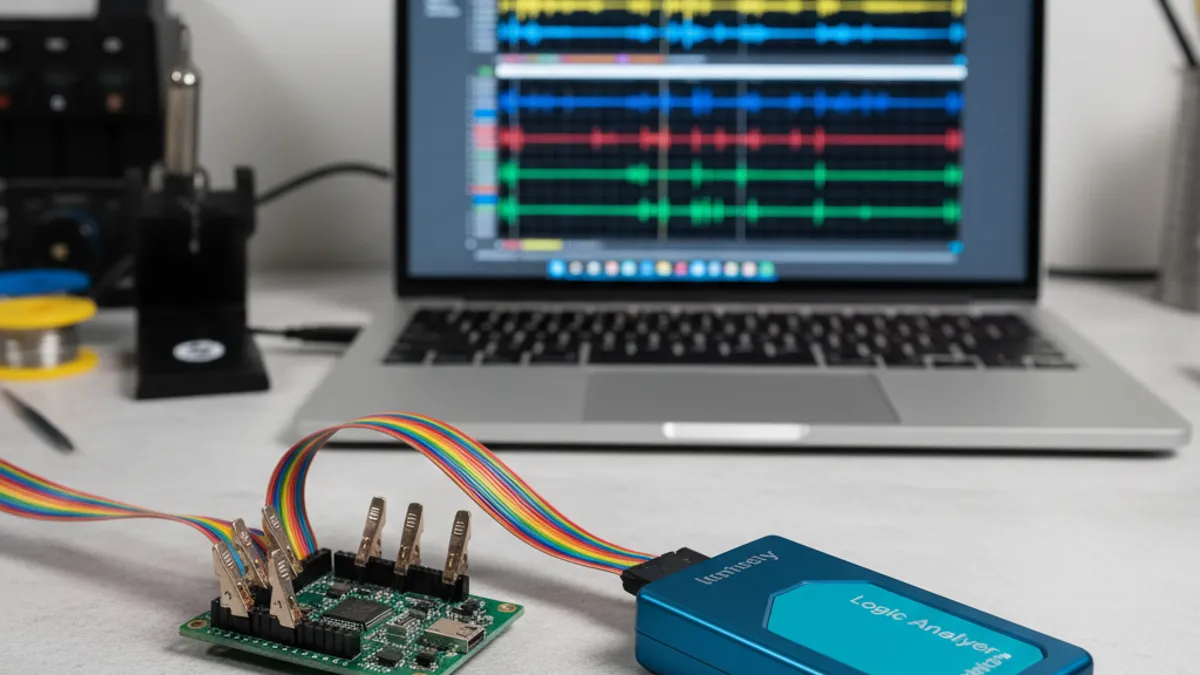
Before the buying decision, the category decision. A logic analyzer captures a signal as a stream of digital states, high or low, relative to a threshold, across many channels at once, and (on modern tools) decodes those states into protocol transactions. It is the right tool when you care about what the bus is saying and how many signals line up in time.
An oscilloscope captures the analog waveform, the actual voltage versus time, on a few channels with high vertical resolution. It is the right tool when you care about signal integrity: ringing, ripple, edge rates, brownouts.
If you need both at once, decode the I²C transaction and see the analog rail droop that caused the reset, on one trigger, that is the mixed-signal class. We cover that boundary in detail in Logic analyzer vs oscilloscope vs MSO (India 2026). This guide assumes you have decided the digital/protocol side is your problem, and now you are choosing among logic and protocol analyzers.
The five decisions that decide fit
1. Channel count: how many signals must align on one trigger
The instinct is to count the signals on the board and buy enough channels to cover them. That is the wrong arithmetic. Any analyzer can sample more signals than it has channels if you are willing to move probes between captures. The real question is: how many signals must you see on the same timebase, on the same trigger, to catch the bug?
- A single I²C bus plus a reset and an interrupt is three or four signals, 8 channels is comfortable.
- A SPI bus (clock, MOSI, MISO, chip-select) plus reset, rail-good, and a few GPIOs is seven or eight, you have eaten an 8-channel tool in one capture.
- A multi-rail ECU or SoC bring-up where two buses, several enables, and a state-machine output all have to align is past 8, you want 16.
A useful rule for Indian Tier-1 ECU teams and SoC bring-up groups: if you have ever wished the analyzer had two more channels, you will wish it again next week. Channel count is the one spec where buying up rarely gets regretted.
2. Sample rate: Nyquist for digital, and the honest caveat
Sample rate sets how finely the analyzer can place an edge in time. The rule of thumb is to sample at roughly 4× to 10× the fastest signal frequency you want to resolve cleanly, so that edges and narrow glitches are not aliased away.
For the everyday embedded buses, the math is forgiving:
| Bus | Typical max rate | Comfortable digital sample rate |
|---|---|---|
| I²C | 100 kHz – 1 MHz (up to 3.4 MHz HS) | A few MS/s is plenty |
| UART | up to a few Mbit/s | A few MS/s |
| CAN / CAN FD | 1 Mbit/s (CAN FD data phase faster) | Tens of MS/s |
| SPI | commonly up to ~10–50 MHz | 100–500 MS/s to resolve clean edges |
This is why a 100 MS/s tool handles I²C, UART, CAN, LIN, and SMBus comfortably, while fast SPI and glitch-hunting on tight timing margins are where the 500 MS/s class earns its place. More sample rate is not always more useful: past the point where you are resolving your fastest edge cleanly, extra MS/s mostly fills disk faster. Match the rate to your fastest bus, not to the biggest number on the box.
One honest caveat that the headline number hides: on many USB analyzers, the maximum sample rate is only available on a subset of channels, for example, the Saleae Logic Pro family reaches its top 500 MS/s digital rate on up to a few channels, and steps down as you enable more. Always read the per-channel-versus-rate table on the datasheet, not just the hero figure.
3. Protocol decoding: the spec that saves the most bench hours
Raw waveforms are not the deliverable; decoded transactions are. The single biggest productivity difference between tools is the quality and breadth of protocol decoding, how many protocols are built in, how the decode is presented, and how easy it is to add a custom analyzer for an in-house framing.
Two distinct approaches matter here, and they are not the same product:
- General-purpose logic analyzer + software decoders. The tool captures all channels as digital states; the host software decodes I²C, SPI, UART, CAN, and dozens more, and lets you write your own. This is flexible, one instrument, many protocols, and is the right default for teams that touch many different buses. The Saleae Logic 2 software ships with a large library of built-in analyzers plus community-contributed ones via its marketplace, and supports high-level analyzers (HLAs) you can script in Python.
- Dedicated protocol analyzer. A purpose-built instrument that monitors one bus family non-intrusively and decodes it at the protocol layer in real time, often with deeper, more accurate decode and long-duration capture than a general-purpose tool. This is the right tool when one bus is your whole problem and you need rock-solid, long-session monitoring, see decision 5.
If your team writes custom serial framings (a sensor with a proprietary register map, a bespoke inter-MCU protocol), the ability to author a custom decoder matters more than any channel-count or sample-rate spec. Budget for it.
4. Streaming vs buffer: the architecture decision that catches intermittent bugs
This is the spec that procurement most often misses, and the one that most often decides whether you actually catch the bug.
- Buffered (deep-memory) analyzers store the capture in on-board RAM, then transfer it. They give you a fixed window, large, but finite. When the buffer fills, capture stops. Great for a known, repeatable event you can trigger on.
- Streaming (USB-streamed) analyzers push samples to the host PC continuously, so capture length is limited by your disk and memory rather than a fixed on-board buffer. This is what you want for the intermittent failure that only appears once an hour, because you can leave the analyzer running for the whole session without the buffer cutting you off.
USB-streamed tools dominate the modern bench for exactly this reason. The Saleae Logic family streams over USB, with effective sample depth into the billions of samples bounded by host resources. On the dedicated side, the Total Phase Beagle I2C/SPI streams over High-speed USB with capture traces to more than 25 GB per the datasheet, built specifically to catch the event that only shows up over a long, patient monitoring session. If you are chasing “it locks up about once a day,” streaming is not a nice-to-have; it is the requirement.
5. General-purpose vs dedicated protocol analyzer
This is the decision most teams get wrong by treating both as interchangeable “logic analyzers.” They solve different problems:
- Choose a general-purpose USB logic analyzer when you touch many buses, want analog visibility on the same channels, need to see many signals aligned on one trigger, or write your own decoders. One tool, broad coverage.
- Choose a dedicated protocol analyzer when one bus family is your entire problem and you need non-intrusive, real-time, long-duration, protocol-layer-accurate monitoring, for example, validating an I²C/SPI subsystem in production test, or proving a bus stays clean over hours.
They are complementary, not competing. Plenty of Indian teams run a Saleae Logic on the bench for broad debug and a Total Phase Beagle on the production line for dedicated bus monitoring. The right answer is often “both, for different jobs.”
Mapping the decisions to real SKUs (available in India from GSAS)
With the framework set, here is how the decisions map to specific, currently-shipping instruments. Specs below are from the manufacturers’ official datasheets.
General-purpose USB logic analyzers: Saleae Logic family
| Logic 8 | Logic Pro 8 | Logic Pro 16 | |
|---|---|---|---|
| Digital channels | 8 | 8 | 16 |
| Analog channels | 8 (shared) | 8 (shared) | 16 (shared) |
| Max digital sample rate | 100 MS/s | 500 MS/s | 500 MS/s |
| Max analog sample rate | 10 MS/s | 50 MS/s | 50 MS/s |
| Digital bandwidth | 25 MHz | 100 MHz | 100 MHz |
| ADC resolution | 10-bit | 12-bit | 12-bit |
| Logic threshold | Fixed | Selectable +0.6 / +0.9 / +1.65 V | Selectable +0.6 / +0.9 / +1.65 V |
| Capture model | USB-streamed | USB-streamed | USB-streamed |
| Software / decoders | Logic 2, built-in + community + Python HLAs | Same | Same |
Specs from the official Saleae datasheets at downloads.saleae.com. Top digital sample rate on the Pro variants applies to a subset of channels and steps down as more channels are enabled, see the per-channel table on the datasheet.
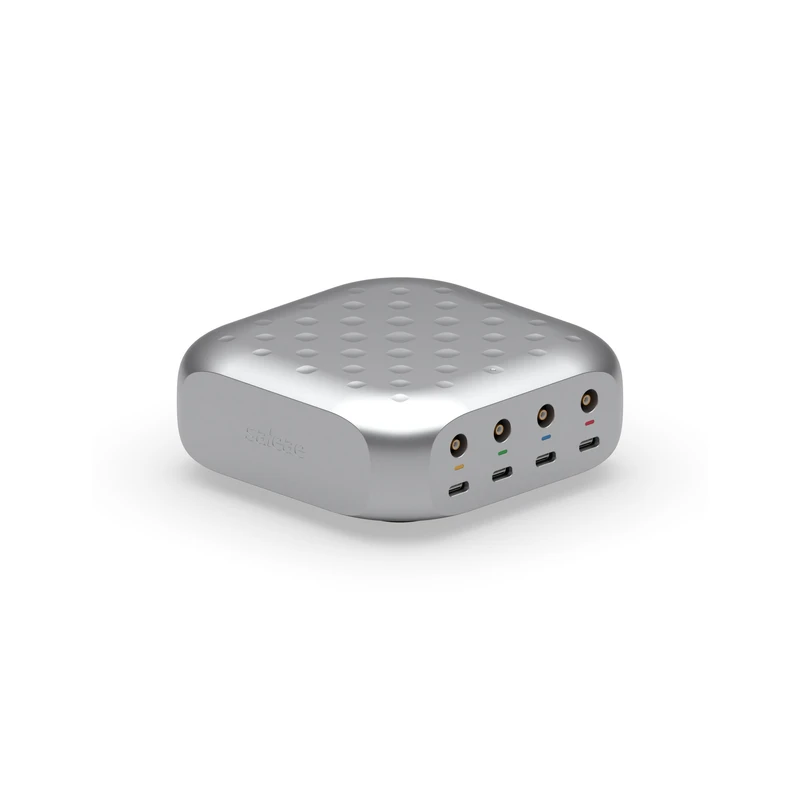
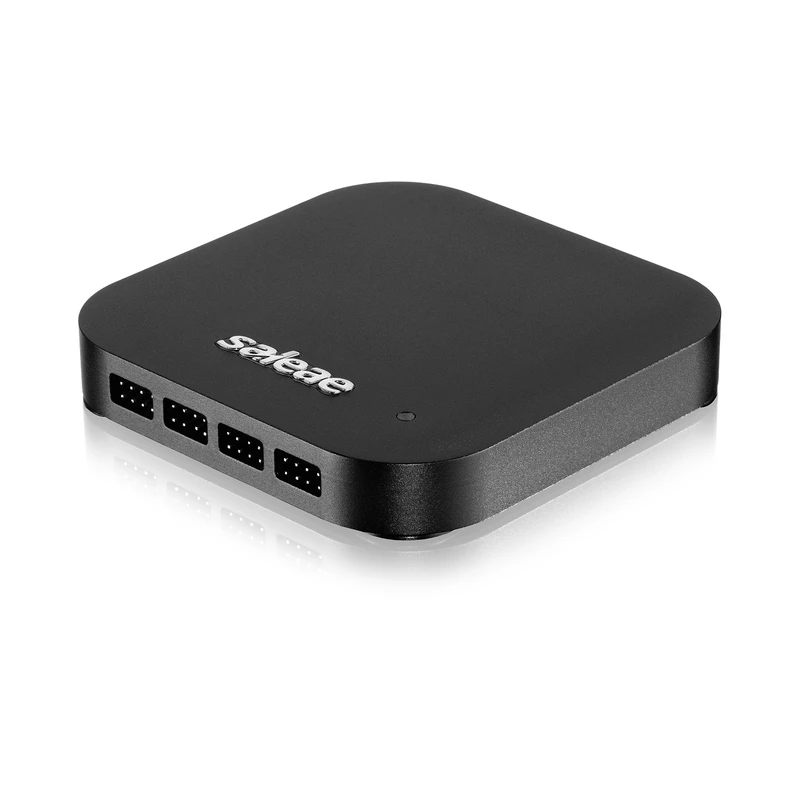
In plain terms: Logic 8 is the right starter, most buses, 8 channels, USB-streamed, the same decoding software, at the lowest entry point. Logic Pro 8 adds 500 MS/s digital, 12-bit/50 MS/s analog, and selectable thresholds that matter for modern 1.8 V and 1.2 V SoC signaling. Logic Pro 16 is the pick the moment you need to see more than 8 signals on one trigger. We unpack that three-way choice in the Saleae Logic buying guide for Indian teams.
If your real problem is analog precision and longer captures rather than channel count, Saleae’s Logic MSO line (a USB mixed-signal oscilloscope, e.g. the Logic MSO 4×200) is a different class, covered in Logic analyzer vs oscilloscope vs MSO.
Dedicated protocol analyzers: Total Phase Beagle family
When one serial bus is your whole problem, a dedicated monitor decodes it more accurately and for longer than a general-purpose tool. The Total Phase Beagle I2C/SPI is the workhorse here:
| Spec | Total Phase Beagle I2C/SPI |
|---|---|
| I²C monitoring | Up to 4 MHz (SMBus supported) |
| SPI monitoring | Up to 24 MHz |
| MDIO monitoring | Up to 2.5 MHz (Clause 22 & 45) |
| Timing resolution | 20 ns bit-level |
| Capture | USB-streamed, traces to >25 GB |
| Software / API | Data Center software; C, C#, Python, .NET, VB.Net, LabVIEW |
Specs from the official Total Phase Beagle I2C/SPI datasheet at totalphase.com.
The Beagle is non-intrusive: it taps the bus passively and watches traffic without participating in it, which is exactly what you want for production-line monitoring and for catching the intermittent event that only appears over a long session. Total Phase’s wider family (including the high-speed Beagle USB 5000 v2 for USB protocol analysis and the Promira platform) is on the GSAS Total Phase engineering partner page.
A quick decision shortlist
- Hobbyist, education, or one engineer’s first analyzer, mostly I²C/UART/SPI: Saleae Logic 8. 8 channels, USB-streamed, full decoding software.
- Serious mixed-signal debug, modern SoC voltage rails, 8 signals or fewer at once: Saleae Logic Pro 8. Selectable thresholds and 12-bit analog are the deciders.
- Multi-rail / multi-bus boards where more than 8 signals must align on one trigger: Saleae Logic Pro 16.
- One serial bus is your whole problem; you need non-intrusive, long-duration, protocol-accurate monitoring (incl. production test): Total Phase Beagle I2C/SPI.
- Chasing an intermittent failure that appears once an hour: insist on a streaming architecture, not a fixed buffer, both families above stream over USB.
Frequently asked questions
What is the difference between a logic analyzer and a protocol analyzer? A general-purpose logic analyzer captures many channels as raw digital states and decodes a wide range of protocols in software, flexible across buses. A dedicated protocol analyzer monitors one bus family non-intrusively and decodes it at the protocol layer in real time, usually with deeper accuracy and longer capture for that one bus. Many teams own both.
How many channels do I need? Count not the signals on the board, but how many must align on the same trigger to catch the bug. Three or four signals fit 8 channels comfortably; once SPI plus enables and GPIOs push past 8, choose 16. If you have ever wished for two more channels, buy 16.
Is streaming better than a deep buffer? For intermittent bugs, yes, streaming over USB lets you capture for as long as your disk allows, so a once-an-hour failure can be caught in a single session. A deep buffer is fine for a known, repeatable event you can trigger on, but it stops when full.
Do I need analog channels on a logic analyzer? Only if signal integrity is part of your problem, ripple, droop, edge shape. If you only care about the digital states and protocol decode, you do not. If you need decode and the analog waveform on one trigger, look at the mixed-signal (MSO) class instead.
Can I buy these logic analyzers in India with GST invoicing and local support? Yes. GSAS Micro Systems is an authorized engineering partner in India for both Saleae and Total Phase, with demo units, application engineering, GST-compliant quotations, and post-sales support.
What GSAS does
If you are choosing among USB logic analyzers and dedicated protocol analyzers, a GSAS field application engineer will come to your bench in Bengaluru, Hyderabad, Chennai, Pune, Mumbai, or Delhi NCR and capture your live signal on the candidate tools before you raise a purchase order. You see the decode running on your own hardware, not on a slide, and we do not bill pre-sales engineering.
Request a quote for India pricing and lead time, or contact us for a bench visit. For the full lineups, see the GSAS Saleae engineering partner page and the GSAS Total Phase engineering partner page.
Sources
- Saleae Logic 8, Logic Pro 8, and Logic Pro 16 datasheets, downloads.saleae.com (channels, sample rates, bandwidth, ADC resolution, thresholds).
- Total Phase Beagle I2C/SPI Protocol Analyzer datasheet, totalphase.com (I²C/SPI/MDIO monitoring rates, 20 ns timing resolution, >25 GB USB-streamed capture, software API).
- Saleae Logic 2 software documentation, saleae.com (built-in and community protocol analyzers, Python high-level analyzers).
Also appears in:
Interested in Saleae tools?
Talk to our application engineers for personalized tool recommendations.
More from Saleae
View all →
Saleae Logic MSO: Standard or Pro? The India Buying Decision
17 Jul · 6 min
AI Data Centers in India: Test, Measurement & Memory Boom
4 Jun · 14 min
Logic Analyzer vs Oscilloscope vs MSO: When You Actually Need Analog Channels (Saleae Logic MSO)
4 Jun · 10 min
Debugging Automotive CAN, CAN-FD and LIN with Saleae Logic 2: A Bench Workflow for Indian ECU Teams
4 Jun · 12 min
Emulating Processor Power for Thermal Testing: Why Constant Power
7 Oct · 7 min
CRPS and Rack Power Supply Testing: The Six Tests That Matter
7 Oct · 7 min