In short
Self-verifying EDA AI agents are Siemens' Fuse EDA AI agents that validate each decision against Siemens' deterministic, physics-based EDA engines while they run, rather than only checking the final result. Siemens announced them with NVIDIA at DAC in July 2026, as the third step after the Fuse EDA AI system (DAC, June 2025) and the Fuse EDA AI Agent (NVIDIA GTC, March 2026). Siemens says the capabilities will arrive in forthcoming releases of its EDA portfolio.
On 29 July 2026 Siemens EDA published Self-verifying, long-running EDA AI agents that engineers can trust, following its DAC announcement of 26 July with NVIDIA. The idea is simple to state and hard to build: an AI agent working on a chip or a board should have each decision checked against the physics as it goes, not only when it hands back a result. This post summarises what Siemens announced for semiconductor and PCB teams in India. The product statements and figures below come from Siemens, linked under References.
Why EDA needs agents that check themselves
Siemens starts from the economics of the work. Tapeout dates are fixed, silicon is expensive and the window for catching an error is short. An agent that runs a long, multi-tool flow unattended is only useful if engineers can trust what it did along the way, so Siemens argues that every agent decision has to be validated against the design’s physics at every step.
Siemens frames its AI-native EDA strategy as three pillars:
- Faster engines: GPU acceleration plus machine learning and reinforcement learning inside the tools.
- Smarter execution: EDA AI agents that orchestrate workflows across several tools.
- Trusted outcomes: continuous validation against Siemens’ physics-based EDA engines.
The July announcement is about the second and third pillars.
Twelve months, three milestones
Siemens presents the work as three steps, each a prerequisite for the next.
1. Domain grounding: Fuse EDA AI system (DAC, June 2025)
Siemens’ view is that general-purpose AI frameworks fall short in EDA. They lack domain knowledge, cannot read, modify or write native EDA data formats, do not fit EDA design environments, and are a poor match for companies that must protect design IP. The Fuse EDA AI system was Siemens’ answer:
- a multimodal EDA data lake;
- a retrieval-augmented generation (RAG) framework tuned to Siemens’ tool portfolio;
- flexible deployment with bring-your-own-model support;
- enterprise security with granular access controls.
2. Orchestration: Fuse EDA AI Agent (NVIDIA GTC, March 2026)
Real EDA flows cross dozens of specialised tools, formats and vendors. The Fuse EDA AI Agent, launched at NVIDIA GTC in March 2026, adds one orchestration layer on a scalable Model Context Protocol (MCP) architecture. Siemens lists coverage of RTL generation, digital verification, custom and analog design, place-and-route, physical sign-off, high-level synthesis, design for test, hardware-assisted emulation and PCB design.
3. Trusted outcomes: self-verifying, long-running agents (DAC, July 2026)
At DAC 2026 Siemens announced self-verifying, long-running EDA AI agents for semiconductor and PCB design, built with NVIDIA AI infrastructure and software. Siemens’ stated aims are better quality of results, faster time to results, more reliable tool calling and better token efficiency. The press release adds that Fuse is now integrated into Intelligence Center X, Siemens’ environment for creating and orchestrating agents across design, manufacturing and supply chain.
The five-layer stack
Siemens describes five capabilities, with physics-based validation at the top:
| Layer | Technology | Role, as Siemens describes it |
|---|---|---|
| Physics-based truth | Siemens EDA engines | Deterministic, signoff-quality engines that define ground truth for every agent decision |
| Self-verification and optimisation | NVIDIA NeMo Gym | Self-verifying workflows that learn from real design conditions to improve quality, speed and token efficiency |
| Governance and security | NVIDIA OpenShell | Governance, security and auditability for the agents |
| Reasoning and efficiency | NVIDIA Nemotron models and NeMo Switchyard | Lower-cost multi-tool agent workflows with strong reasoning and tool use |
| Compute foundation | NVIDIA accelerated computing and CUDA-X libraries | Runs both the AI reasoning and the EDA engines; Siemens says signoff-quality results arrive in hours instead of days |
At DAC, Tiffany Jansen (Tiff in Tech) recorded two show-floor sessions with the Siemens and NVIDIA team: a strategic overview with Amit Gupta and Timothy Costa, and a technical deep dive with Niranjan Sitapure and Joshua Mabry. Siemens published the recording:
Building the AI-native electronic design flow: live from DAC with Tiff in Tech
Siemens Software video, 1 h 10 min. Click to load from YouTube.
The point of putting Siemens’ own engines at the top is that the language model never has the last word. An agent can propose, but the result is checked by the same deterministic engines engineers already sign off with, such as Calibre for physical verification and Questa One for digital verification.
Siemens’ worked example: overnight library characterization
Siemens illustrates the approach with library characterization: generating and verifying Liberty files across process, voltage and temperature corners. Siemens says this has traditionally taken several full-time engineers, weeks of runtime and constant manual attention. The press release ties the agentic workflow to the Solido Characterization Suite; see our Solido page for the characterization tools themselves.
In Siemens’ example, the engineer asks the agent to characterize the libraries across all PVT corners, verify the results, fix problems and resolve issues without asking, because the engineer will be away. Skill files guide automated debugging, so the agent works through failures instead of handing them back. Siemens reports:
| Stage | Before | With the agent (Siemens figures) |
|---|---|---|
| Configuration setup | Hours | Minutes |
| Pipecleaning | Days | Hours |
| Full flow | Weeks | Days |
| Token cost | Baseline | About 5X to 10X lower from NeMo Switchyard and Nemotron, plus a further 25% from NeMo Gym-based optimisation of Agent Skills and MCP tools |
Siemens sums this up as a more than 10X faster autonomous characterization workflow. These are Siemens’ figures for its own example, not GSAS measurements, and results on your libraries will depend on the cells, corners and compute available.
Siemens and NVIDIA published a short demo of the workflow:
Siemens and NVIDIA: self-verifying, long-running agentic characterization workflow demo
Siemens Software video, 3 min 7 s. Click to load from YouTube.
What it means for teams in India
For chip and PCB teams in India that run long, multi-tool flows such as library characterization, verification regressions, DRC debug or SI/PI sweeps, three points stand out.
- Trust is the adoption gate. Agents that are checked against signoff engines are easier to defend to a design review than a chatbot’s suggestion.
- Data control matters. Siemens describes bring-your-own-model support, on-premises deployment and air-gapped operation for Fuse. For Indian defence, aerospace and strategic electronics programmes where design data cannot leave the site, that decides whether an evaluation can happen at all.
- Availability is staged. Siemens says the expanded capabilities will arrive in forthcoming releases of its AI-native EDA portfolio. It gives no dates, so plan evaluations around the tools you can run today.
The same approach now reaches board-level verification. Siemens’ HyperLynx Agentic Toolkit, announced in November 2026, applies physics-validated agents to signal and power integrity.
How GSAS can help
GSAS is a value added distributor/reseller and engineering partner for Siemens EDA in India, with application engineers in Bengaluru, Hyderabad, Chennai, Pune, Mumbai and Delhi NCR. We can confirm what is available today for Fuse EDA AI, Solido, Questa One and Calibre, register your interest in the agentic releases with Siemens, and help you pick a first workflow to pilot. Talk to our Siemens EDA team.
Frequently asked questions
What are self-verifying EDA AI agents?
They are Siemens’ Fuse EDA AI agents extended so that every decision an agent takes is checked against Siemens’ deterministic, signoff-quality EDA engines during the run, not only at the end. Siemens announced them with NVIDIA at DAC in July 2026 for semiconductor and PCB design.
Why does Siemens say generic AI frameworks are not enough for EDA?
Siemens says generic frameworks lack EDA domain knowledge, cannot read, modify or write native EDA data formats, do not fit EDA design environments, and are poorly suited to the security needs of companies protecting design IP. Fuse EDA AI addresses these with a multimodal EDA data lake, a RAG framework tuned to Siemens tools, bring-your-own-model deployment and granular access controls.
Which NVIDIA technologies are part of the stack?
Siemens lists NVIDIA NeMo Gym for self-verification and optimisation, NVIDIA OpenShell for governance and security, Nemotron models with NeMo Switchyard for reasoning and token efficiency, and NVIDIA accelerated computing with CUDA-X libraries as the compute foundation. Siemens’ own EDA engines sit at the top as the physics-based ground truth.
What results does Siemens report for agentic library characterization?
In Siemens’ example, configuration setup fell from hours to minutes, pipecleaning from days to hours and the full flow from weeks to days, for a workflow Siemens describes as more than 10X faster. Siemens also reports a roughly 5X to 10X token cost reduction from NeMo Switchyard and Nemotron models, plus a further 25% from NeMo Gym-based optimisation. These are Siemens figures, not GSAS measurements.
When will these capabilities be available?
Siemens’ July 2026 announcement says the expanded AI-driven EDA capabilities will be available in forthcoming releases of its AI-native EDA portfolio. It does not give dates. GSAS can confirm current availability for your tools and register interest with Siemens.
Can Indian teams with air-gapped design environments use Fuse EDA AI?
Siemens describes Fuse EDA AI with bring-your-own-model support, on-premises or cloud deployment and centralised data handling inside air-gapped compute environments, with role-based access controls and audit trails. GSAS can help Indian defence, aerospace and semiconductor teams check fit against their security requirements.
References
- Siemens EDA, Custom IC blog: Self-verifying, long-running EDA AI agents that engineers can trust, Emma-Jane Crozier, 29 July 2026 (source for the three pillars, the three milestones, the five-layer stack, the characterization example and its figures, both embedded Siemens videos and the feature image)
- Siemens press release: Siemens advances self-verifying agentic AI workflows for semiconductor and PCB design, 26 July 2026 (Intelligence Center X integration, Solido Characterization Suite, availability)
- Siemens: Fuse EDA AI system and Fuse EDA AI Agent
- At GSAS: Fuse EDA AI, Solido, Questa One, Calibre and the Siemens EDA partner page
Also appears in:
Interested in Siemens EDA tools?
Talk to our application engineers for personalized tool recommendations.
More from Siemens EDA
View all →
Emulation vs FPGA Prototyping vs Simulation for SoC Teams
13 Nov · 8 min
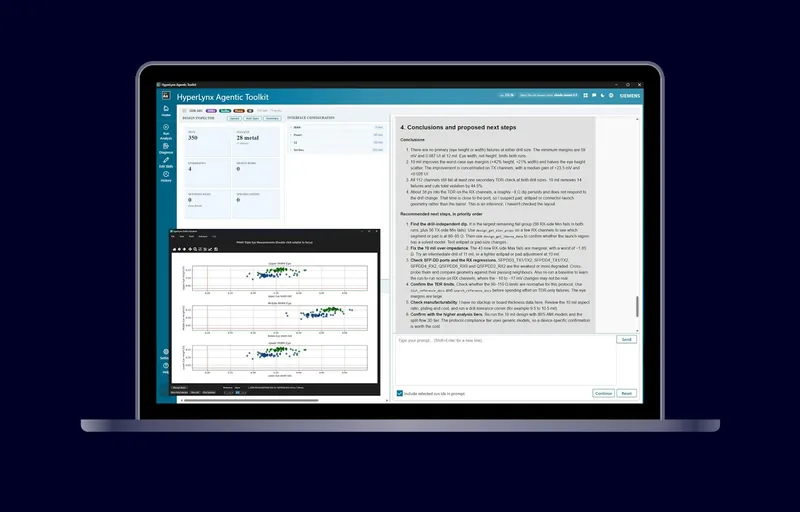
HyperLynx Agentic Toolkit: What It Means for India
13 Nov · 7 min

Siemens EDA Customer Results: 10 Published Case Studies
13 Nov · 8 min
GSAS EDA Insights: A Free Five-Part PCB Design Webinar Series with Siemens Xpedition
9 Nov · 5 min
Choosing Debug and Trace Tools for Indian Automotive Tier-1s
13 Nov · 11 min
GW Instek LCR-7000 and GPM-8340: New in India for 2026
13 Nov · 6 min