In short
The HyperLynx Agentic Toolkit, announced by Siemens on 10 November 2026, combines domain-specific AI agents with HyperLynx signal and power integrity simulation. An orchestration agent coordinates SerDes, DDR, SI and PI agents from goals set in natural language. Siemens plans early availability to select customers in the fourth quarter of 2026, with general availability to follow.
On 10 November 2026 Siemens announced the HyperLynx Agentic Toolkit, which it calls “a new agentic AI solution that helps electronic systems engineers automate complex verification workflows, investigate simulation results and make faster, more informed design decisions.” Siemens’ headline describes it as “physics-validated agentic AI”. This post summarises the announcement for signal integrity (SI) and power integrity (PI) teams in India. Every product statement below comes from Siemens’ press release and Siemens’ own blog post on the toolkit, both linked under References.
What Siemens announced
The toolkit is built on HyperLynx, Siemens’ PCB signal and power integrity platform. It combines domain-specific AI agents with HyperLynx physics-based SI and PI simulation.
- Natural-language goals. Engineers define verification objectives in natural language.
- An orchestration agent coordinates specialised agents for SerDes, DDR, signal integrity and power integrity analysis.
- What the agents do. Per Siemens, they can execute simulation tasks, extract relevant parameters, investigate results and evaluate performance against design margins.
- Analysis tasks. Siemens lists simulation analysis, specification research, trend identification and investigation of potential failure causes.
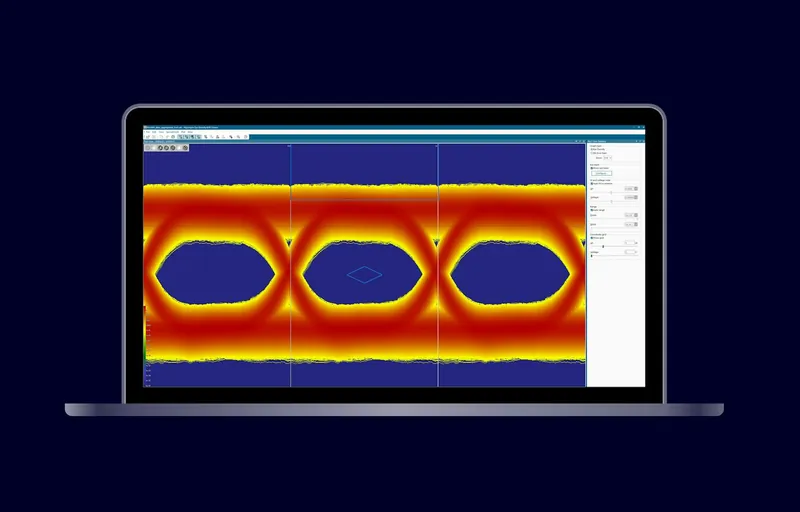
Siemens’ introduction video for the toolkit:
Introducing: HyperLynx Agentic Toolkit
Siemens Software video, 4 min 34 s. Click to load from YouTube.
The problem Siemens is targeting
Siemens frames the announcement around high-speed boards. As operating speeds move into 112G and 224G, it says teams under schedule pressure and short of senior verification experts end up over-constraining designs early and under-verifying at the end, so signal integrity failures surface late and trigger re-spins.
Siemens says it is “grounding results in physics-based simulation”. Matt Bromley, Head of Electronic Board Systems at Siemens, put it this way:
“Electronic systems teams are being asked to verify faster, more complex designs on tighter schedules and AI is a powerful lever. But in signal and power integrity, a result you can’t trust is worse than no result at all. That’s why we built the HyperLynx Agentic Toolkit to enable automated workflows built on proven, physics-based simulation. Engineers get the speed of agentic AI and the confidence to act on what it finds.”
The release also quotes research from Lifecycle Insights. According to Chad Jackson, its CEO and chief analyst, 80 percent of organizations in that research have active AI efforts in analysis and verification, and the top-ranked barrier, named by 60 percent, is the reliability and quality of AI output. A further, unattributed quote in the release adds that most respondents expect gains of 10 to 25 percent. These are Lifecycle Insights figures as quoted by Siemens, not GSAS measurements.
Inside the toolkit: the four agents
Siemens’ Electronic Systems Design blog of 9 November 2026 adds detail the press release leaves out. Siemens says the toolkit is meant to act like a co-pilot that diagnoses problems and recommends fixes, that engineers interact with it in natural language, and that it is designed to work with AI platforms including Fuse, Claude and OpenAI. The four specialised agents, as Siemens describes them:
| Agent | What Siemens says it does |
|---|---|
| SerDes Agent | Automated, scalable compliance analysis across more than 400 standard protocols and variants |
| DDR Agent | Analysis of completed DDR interfaces: signal quality, timing and skew, and crosstalk, across all signals and groups |
| SI Agent | General-purpose signal quality, crosstalk and delay analysis, with quick and detailed modes |
| PI Agent | DC and AC power integrity analysis for all supply voltages, plus automated AC decoupling capacitor optimisation |
Siemens also demonstrates the DDR Agent on a DDR5 impedance mismatch, taking the engineer from batch simulation and interactive scatter plots to a root-cause diagnosis and a design correction:
Solving a DDR5 impedance mismatch with the HyperLynx Agentic Toolkit
Siemens Software video, 2 min 12 s. Click to load from YouTube.
The five-step agentic workflow
Siemens breaks the toolkit’s work into five steps:
- Inspect and query. Inspect the PCB database, flag potential design issues, extract key parameters and prompt the user towards next steps.
- Automate and scale. Set up and run complex analyses across large channel counts.
- Visualise results. Present large simulation datasets so trends and outliers across hundreds of channels are visible.
- Data mining and diagnosis. Find the root causes of failures using agentic data mining combined with SI/PI application and design knowledge.
- Recommend. Suggest the next investigative steps and potential fixes.
Siemens’ SerDes example: 112 channels
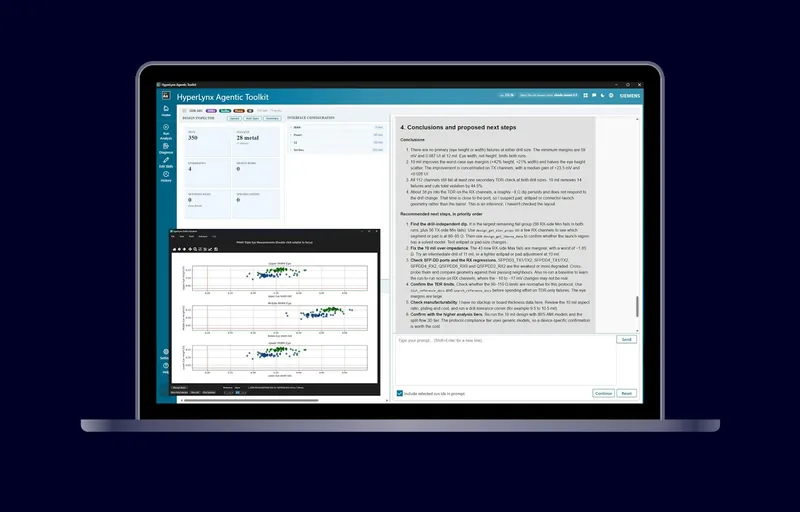
In the blog, Siemens shows the SerDes Agent acting as the central orchestrator: it identifies poorly performing channels and correlates design factors to find the areas that hurt signal integrity. Engineers can ask engineering questions directly, and Siemens’ example is which via drill size gives more eye margin on a design, and why.
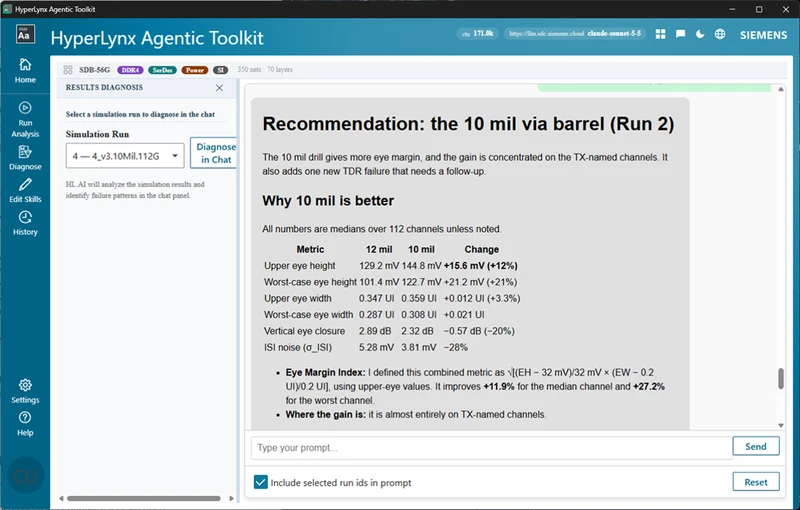
Siemens’ test case asked the SerDes Agent to compare two design alternatives with 112 channels, quantify which is better, find the root cause of the failing channels and fix them. Siemens reports that this work “used to take 3-4 weeks” and now runs across all channels in 2 hours and 20 minutes. Siemens adds that the methodology was verified on demanding real-world architectures, with full post-layout verification across all nets. These are Siemens figures from its own example, not GSAS measurements, and results on your boards will depend on the design and the setup.
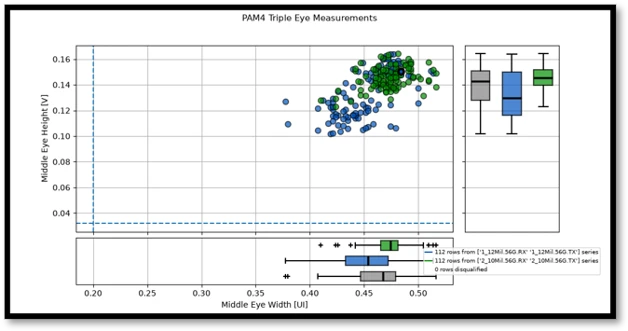
Siemens’ point is that at these speeds a single misplaced ground via or a wrong dielectric constant can decide whether a board passes first time or goes into weeks of debug, and that the value is in finding such an issue quickly, explaining it, and fixing it at the source.
Siemens also says it is working with Lighthouse partners who have deep HyperLynx and automated analysis experience.
Where it fits in Siemens’ AI portfolio
Siemens says the HyperLynx Agentic Toolkit follows the Questa One Agentic Toolkit and builds on Fuse EDA AI Agent and Intelligence Center X. For the wider picture of how Siemens validates agent decisions against its EDA engines, see our summary of Siemens’ self-verifying EDA AI agents.
Availability
Siemens states that the toolkit “is planned for early availability to select customers in the fourth quarter of 2026, with general availability to follow.” It is not generally available today, and the release does not give pricing, licensing terms or a general availability date.
What Indian SI/PI teams can do now
- Register interest. Early availability is for select customers. GSAS can register your team’s interest with Siemens.
- Work in HyperLynx today. The toolkit is built on HyperLynx, which is available now. See the HyperLynx product page for the analysis family.
- Join the GSAS session on AI in PCB design. Part 1 of our EDA Insights series, AI in PCB Design: What Works Today and How Reliable It Is, on Thursday 3 December 2026, looks at where AI sits in the PCB flow today, with the AI features in Siemens Xpedition run live on an edge AI board designed for the series.
GSAS supports Siemens EDA customers with application engineers in Bengaluru, Hyderabad, Chennai, Pune, Mumbai and Delhi NCR. Talk to us about HyperLynx or the toolkit.
Frequently asked questions
What is the HyperLynx Agentic Toolkit?
Siemens describes it as a new agentic AI solution for electronic systems verification. Built on HyperLynx, it combines domain-specific AI agents with physics-based signal and power integrity simulation, and lets engineers define verification objectives in natural language.
Which agents does the toolkit include?
Siemens says an orchestration agent coordinates specialised agents for SerDes, DDR, signal integrity and power integrity analysis. The agents can execute simulation tasks, extract relevant parameters, investigate results and evaluate performance against design margins.
When will the HyperLynx Agentic Toolkit be available?
Siemens states it is planned for early availability to select customers in the fourth quarter of 2026, with general availability to follow. It is not generally available yet.
Can teams in India get early access?
Siemens plans early availability for select customers. GSAS, an authorized Siemens EDA partner in India, can register your team’s interest with Siemens.
What does each HyperLynx agent do?
Per Siemens’ 9 November 2026 blog: the SerDes Agent automates compliance analysis across more than 400 standard protocols and variants; the DDR Agent analyses completed DDR interfaces for signal quality, timing and skew, and crosstalk across all signals and groups; the SI Agent runs general signal quality, crosstalk and delay analysis in quick or detailed modes; and the PI Agent runs DC and AC power integrity analysis for all supply voltages, with automated AC decoupling capacitor optimisation.
Which AI models does the HyperLynx Agentic Toolkit work with?
Siemens says the toolkit is designed to work with AI platforms including Fuse, Claude and OpenAI.
How much time does Siemens say the toolkit saves?
In Siemens’ own example, comparing two design alternatives across 112 SerDes channels, finding the root cause of failing channels and fixing them previously took 3 to 4 weeks and now takes 2 hours 20 minutes with the SerDes Agent. That is a Siemens figure from a single example, not a GSAS measurement.
How does it relate to Fuse EDA AI Agent and the Questa One Agentic Toolkit?
Siemens says the HyperLynx Agentic Toolkit follows the Questa One Agentic Toolkit and builds on Fuse EDA AI Agent and Intelligence Center X, as part of its domain-specific agentic AI approach across EDA.
References
- Siemens press release: Siemens’ HyperLynx brings physics-validated agentic AI to electronic systems verification (10 November 2026)
- Siemens EDA, Electronic Systems Design blog: The HyperLynx Agentic Toolkit: agentic AI for electronic systems verification, Sajeda Tamimi, 9 November 2026 (source for the four-agent detail, the five-step workflow, the 112-channel SerDes example, both screenshots and both embedded Siemens videos)
- HyperLynx, Fuse EDA AI and the Siemens EDA partner page at GSAS
Also appears in:
Interested in Siemens EDA tools?
Talk to our application engineers for personalized tool recommendations.
More from Siemens EDA
View all →
Emulation vs FPGA Prototyping vs Simulation for SoC Teams
13 Nov · 8 min

Siemens EDA Customer Results: 10 Published Case Studies
13 Nov · 8 min
Siemens Self-Verifying EDA AI Agents: What It Means for India
13 Nov · 7 min
GSAS EDA Insights: A Free Five-Part PCB Design Webinar Series with Siemens Xpedition
9 Nov · 5 min
Choosing Debug and Trace Tools for Indian Automotive Tier-1s
13 Nov · 11 min
GW Instek LCR-7000 and GPM-8340: New in India for 2026
13 Nov · 6 min