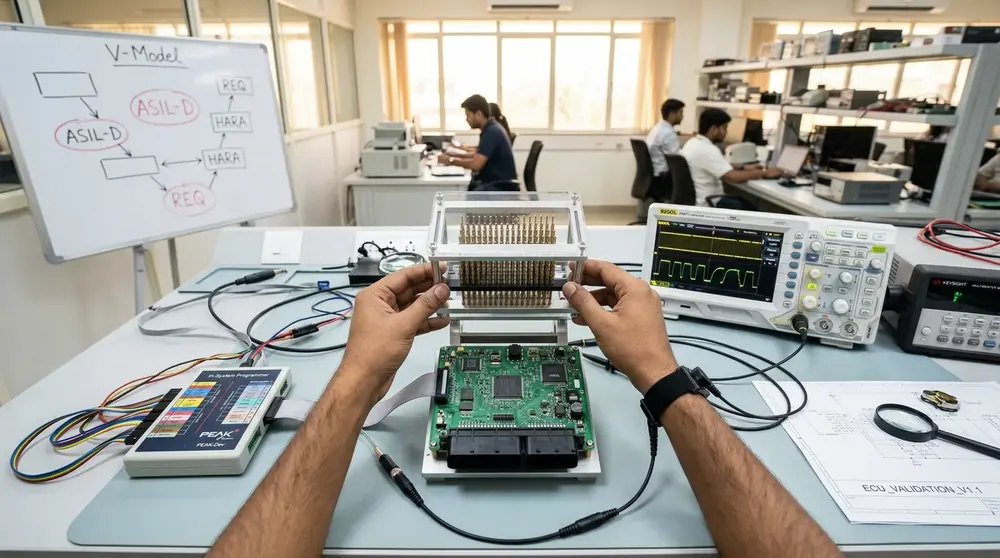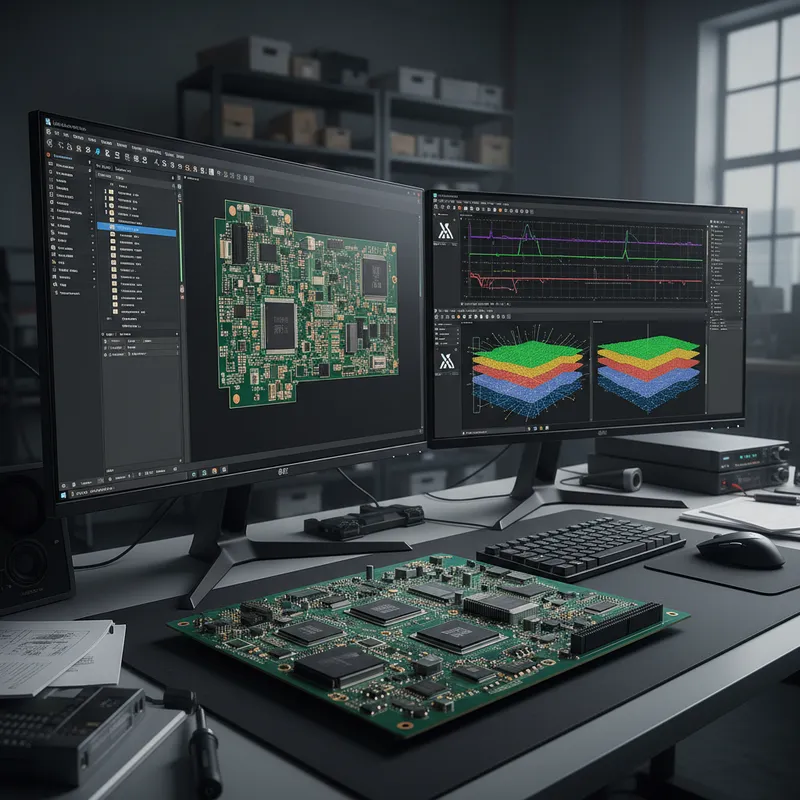
Altium Designer unified PCB design environment showing schematic-to-layout-to-3D workflow on a multi-board complex system design

Altium Designer: 6 Reasons to Switch Design Tools

GSAS Engineering · · 1 min read

ALTIUM DESIGNER®: 6 REASONS TO SWITCH DESIGN TOOLS

With Altium Designer, no design is out of your reach! Whether you’re designing a single PCB or a complex system with multiple circuit boards. Altium Designer’s powerful single application provides you with a no-compromise experience for every step of your design journey.

Join us for a live webinar to take a peek at Altium’s PCB design solution. See for yourself why PCB Designers are switching to Altium Designer.

Timing

Thursday, 13th August 2020 | 11:00 AM to 12:00 PM

THIS DEMO WILL SHOWCASE THE FOLLOWING:
    • How Templates, Design Reuse, and our Unified Design environment can help you create new designs fast.
    • How new panels can support your search and decision for components.
    • How easy it is to speed up your design process with interactive routing and powerful ECAD/MCAD 3D features.
    • Why integrated functions for creating parts lists, documentation, and output data can save you time every day.

REGISTER NOW

LEARN MORE ABOUT ALTIUM DESIGNER

Six reasons Indian teams move from Altium to Siemens Xpedition

The “switch to Altium” framing is one half of the conversation. The other half, Indian teams that started on Altium and moved to Siemens Xpedition as their boards and engineering organisations grew, comes up just as often in GSAS’s pre-sales conversations. The recurring drivers:

  1. Multi-board systems: when a programme spans 3+ boards interconnected via rigid-flex, backplane, or harness, the single-design-database model in Xpedition Enterprise becomes the productivity unlock.
  2. HyperLynx SI/PI sign-off: high-speed designs (DDR4/5, PCIe Gen4+, 28G+ SerDes) need pre-layout topology exploration, post-layout post-route verification, and channel simulation. The native HyperLynx integration in Xpedition is tighter than any third-party SI plug-in into Altium.
  3. Valor NPI cloud DFM: Xpedition Standard ships with 12 cloud DFM runs/year against fabricator-specific process rules, catching manufacturability issues before fab release. Indian fabricators participate in the Valor ecosystem.
  4. Geographically distributed teams: Xpedition’s design-database model handles multiple designers working concurrently on the same database from Bengaluru / Hyderabad / Chennai / Pune offices, with check-in/check-out semantics built in.
  5. Token-based licensing: pay only for the advanced capability used (rigid-flex, SI add-ons, advanced packaging) rather than buying a flagship-tier seat for every designer.
  6. Advanced packaging via Xpedition Package Designer: for teams crossing into 2.5D/3D IC, SiP, or chiplet substrate work, Xpedition has a coherent packaging flow Altium does not address.

GSAS Micro Systems is an authorized engineering partner in India. For the canonical comparison, see Altium Designer vs Siemens Xpedition Standard for Indian PCB teams.

Compare with Xpedition Standard → | Talk to GSAS about a migration evaluation

Also appears in:

Need embedded development tools?

Talk to our application engineers for personalized tool recommendations.
Stay in the Loop

Get monthly compliance updates, product insights, and engineering best practices delivered to your inbox.

Related Articles

Side by side comparison of a 10BASE-T1S multidrop mixing segment, one balanced pair with four nodes on short stubs and a termination at each end, against a point to point star of four separate links into switch ports, from GSAS Micro Systems India
Automotive Ethernet Automotive & Mobility

10BASE-T1S and PLCA: Multidrop Ethernet Explained

10BASE-T1S is the one member of the T1 single-pair Ethernet family that keeps a shared medium, and PLCA is the reconciliation sublayer that stops the nodes on it from colliding. This article covers what IEEE 802.3cg standardises, how the beacon and transmit opportunities schedule a cycle, the node count and segment length figures the OPEN Alliance interoperability test suite works to, and the failure modes that put a segment quietly back into contention while every link still looks up. Written by the GSAS Micro Systems engineering team in India for teams bringing up multidrop segments on the bench.

29 Aug 2026 · 12 min read
Two test paths leaving the same device under test, one into a conformance suite that returns a passed report and one into a partner node that surfaces a field defect, showing why an ECU can clear a published suite and still fail in a vehicle, from GSAS Micro Systems India
Automotive Ethernet Automotive & Mobility

Automotive Ethernet Conformance: TC8 and Testing Above It

Summarising TC8 as a layer 1 to layer 4 suite is wrong in both directions. The public OPEN Alliance ECU test documents run from transmitter distortion up to a SOME/IP chapter with its own standardised test stub, and they contain exactly one time synchronisation test case. This is what those documents enumerate, chapter by chapter, what genuinely lives above their boundary, why a passing ECU can still fail against a partner node, and how much pre-compliance work a Tier-1 in India can honestly do in-house before a test house visit. Written by the GSAS Micro Systems engineering team in India.

29 Aug 2026 · 12 min read
DoIP handshake sequence between tester and DoIP entity: vehicle identification, TCP connect, routing activation request and the accept-or-reject response code with its denial causes, then diagnostic messages, from GSAS Micro Systems India
Automotive Ethernet Automotive & Mobility

DoIP Routing Activation Failures: The Response Code Table

A DoIP routing activation denial is one byte, and that byte names the cause exactly. This article puts every published response code in one table, cross-checked across the AUTOSAR Classic Platform DoIP specification, the Wireshark dissector and two open-source client libraries, then gives the order a DoIP entity applies its checks so you can read a denial backwards to the configuration value that produced it. Written by the GSAS Micro Systems engineering team in India for diagnostics and validation benches in Bengaluru, Pune, Chennai and Hyderabad.

29 Aug 2026 · 13 min read