Ask any embedded team in India what slows down their regression testing, and hardware availability is near the top of the list. A CI pipeline that needs a flashed, powered, connected target board for every test run is a pipeline that is only as fast, and only as parallel, as the number of boards on the rack. SEGGER’s Ozone-Sim removes that constraint for a large share of regression testing by running Arm and RISC-V firmware entirely in software.
The hardware-availability bottleneck
Most Indian firmware teams share a familiar setup: a handful of evaluation boards, shared across a growing team, wired into a CI runner that queues test jobs one board at a time. Add a second product line, or a second variant of the same board, and the queue gets longer, not the coverage. Boards also fail, need recalibration, or sit in someone’s desk drawer mid-debug, and every one of those states blocks the pipeline rather than a single engineer.
None of that is a software problem, which is exactly why it survives so many attempts to fix it in code. The fix is removing hardware from the loop for the tests that do not actually need it.
The simulator-in-CI pattern
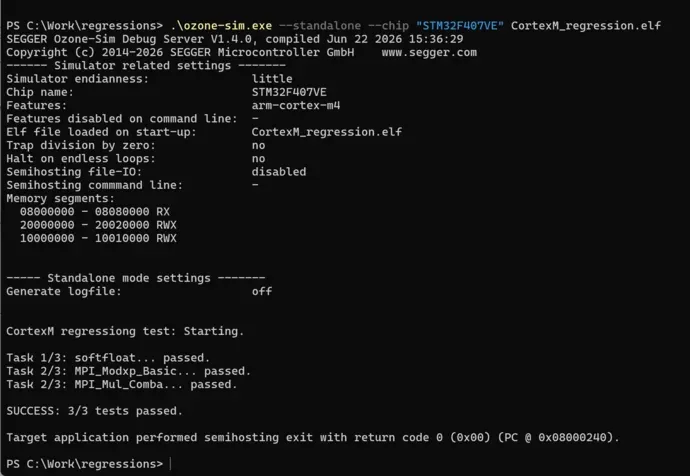
Ozone-Sim addresses this with a standalone command-line simulator, a mode built specifically for headless, automated testing, distinct from the interactive Ozone debugging component. A CI runner with no J-Link and no target board can still invoke Ozone-Sim directly, load a compiled Arm or RISC-V executable, and run it to completion at hundreds of millions of instructions per second, up to 700 million instructions per second on an AMD Ryzen 9, according to SEGGER.
What makes that useful for CI rather than just fast is built-in semihosting. The simulated firmware can read configuration or test vectors as input and write debug output, logs and results to files, without any physical I/O. In practice, that means a CI job can:
- Pass test parameters to the simulated firmware on the command line.
- Let the firmware run its test routine inside Ozone-Sim.
- Read back structured logs and results written through semihosting.
- Gate the build on pass/fail, exactly as a unit-test runner would.
That is the same discipline software teams already apply to unit tests, now available for embedded firmware without a board in the pipeline.
Where Ozone-Sim fits next to QEMU and Renode
Most teams building hardware-free CI already know the two open-source names in this space: QEMU and Renode. They are worth understanding, because Ozone-Sim complements rather than replaces them.
QEMU is the ubiquitous choice for full-system Linux emulation across architectures, and it is excellent for OS and kernel bring-up. For bare-metal microcontroller firmware, though, its peripheral models are often stub-only and its timing is not cycle-accurate, so it confirms that code executes on the right instruction set, not how it behaves against real hardware. Renode, from Antmicro, is more embedded-focused: it models CPUs, peripherals, and even external devices, and it is strong at multi-node and networked-system simulation in CI.
Ozone-Sim sits in a different spot. It is a commercial instruction set simulator whose strengths are raw execution speed (up to 700 million instructions per second on an AMD Ryzen 9, per SEGGER) and being the same debugger, Ozone, that engineers already use on real J-Link and J-Trace hardware. That continuity matters in CI: the profiling, coverage, and backtrace views are identical whether a test ran in simulation or on a board, and a GDB server lets the simulator slot into existing pipelines. It does not try to model peripheral electrical behavior, so for those tests you still reach for hardware, which is the next section.
A worked example: a regression run
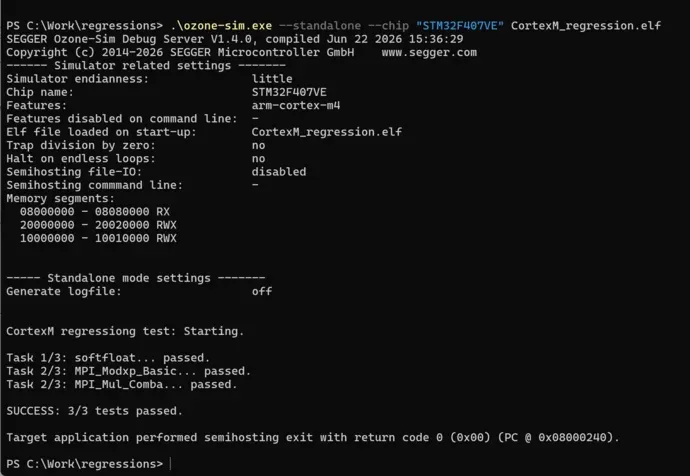
A typical regression job looks like this: on every commit, the build server compiles the firmware, invokes the Ozone-Sim standalone simulator against the resulting executable, and passes in a test configuration through semihosting, for example, which test suite to run and what input vectors to use. The firmware executes its self-test routine inside the simulator, and semihosting writes the pass/fail result and any diagnostic output to a log file the CI job reads back. The whole cycle, compile, simulate, collect results, typically finishes faster than flashing and resetting a physical board, and it scales horizontally: a build server can run many Ozone-Sim instances in parallel, something a fixed rack of test boards cannot do.
Where hardware-in-the-loop still matters
Simulation is not a replacement for every test, and no serious embedded team treats it as one. Ozone-Sim validates application logic, RTOS behavior, driver state machines and algorithmic correctness quickly and repeatably, but it does not exercise real peripheral timing, board-level electrical behavior, or interaction with actual sensors and actuators. For that class of test, a physical debug and trace setup, such as J-Link PRO for JTAG/SWD debugging or J-Trace PRO for instruction trace, still belongs in the loop.
The practical pattern most teams settle on is a split pipeline: Ozone-Sim runs the broad regression suite on every commit, cheaply and in parallel, while a smaller, curated set of hardware-in-the-loop tests runs on the physical rack, less often but where it counts. That combination catches more regressions, faster, than either approach alone.
The split comes down to what a test actually depends on:
| Test depends on | Run it in | Why |
|---|---|---|
| Application logic, RTOS behavior, algorithmic correctness | Ozone-Sim simulation | Fast and parallel, runs on every commit with no board contention |
| Driver state machines, protocol decoding on synthetic input | Ozone-Sim simulation | Deterministic and repeatable without hardware |
| Real peripheral timing, ISR latency, DMA, clock trees | Hardware-in-the-loop (J-Link / J-Trace PRO) | Instruction-level simulation does not reproduce these faithfully |
| Board-level electrical behavior, real sensors and actuators | Hardware-in-the-loop | Only physical hardware exercises the analog and electrical path |
Setting up hardware-free CI in India with GSAS
Standing up this pipeline is integration work: licensing Ozone-Sim correctly, scripting the standalone simulator into an existing build system, deciding which tests move to simulation and which stay hardware-in-the-loop, and wiring semihosting output into a CI dashboard a team actually looks at. That is the kind of engineering support GSAS Micro Systems, SEGGER’s engineering partner in India, provides through field application engineers based in Bengaluru, Hyderabad, Chennai, Pune, Mumbai and Delhi NCR. For the full picture of what Ozone-Sim does and how it works inside Ozone, see our deep dive on hardware-free embedded simulation.
If your team is evaluating Ozone-Sim for CI/CD, our FAEs in Bengaluru, Hyderabad, Chennai, Pune, Mumbai and Delhi NCR can help scope the integration. Request a quote or talk to GSAS.
Source: SEGGER, Ozone-Sim product page (segger.com/products/development-tools/ozone-j-link-debugger/technology/ozone-sim/) and SEGGER press release, June 2026.
Also appears in:
Interested in SEGGER tools?
Talk to our application engineers for personalized tool recommendations.
More from SEGGER
View all →
Meet the GSAS Team at electronica India 2026, Stall H3.I45
15 Sept · 3 min
J-Link Is Now Validated by ST for StellarStudio
13 Sept · 2 min
An AI Agent That Drives the Debugger: SEGGER and Embedder Connect J-Link to the Loop
13 Sept · 6 min
SEGGER J-Link and J-Trace Now Support Andes Trace: Why This Matters for RISC-V
21 Jul · 6 min
Emulating Processor Power for Thermal Testing: Why Constant Power
7 Oct · 7 min
CRPS and Rack Power Supply Testing: The Six Tests That Matter
7 Oct · 7 min