Different Tools for Different Problems
The market for electrical power measurement instruments includes several categories, precision power analyzers, source-measure units (SMUs), current probes with oscilloscopes, and specialized DC energy analyzers like the Joulescope. Each category was designed for a specific measurement problem, and understanding the differences is essential for choosing the right instrument for embedded device power profiling.
This comparison focuses on the characteristics that matter for embedded systems power measurement: dynamic range, sample rate, burden voltage, automation capability, and cost.
Bench Power Analyzers
Traditional bench power analyzers (from manufacturers like Yokogawa, Keysight, Hioki) are designed for AC and DC power measurement of electrical equipment, power supplies, motor drives, inverters, transformers. They excel at high-accuracy measurement of voltage, current, and power factor across a wide frequency range, with calibration-grade accuracy traceable to national standards.
Strengths for embedded power measurement:
- High accuracy (0.02% to 0.1% of reading for premium models)
- Wide voltage and current ranges
- True power measurement including power factor (relevant for AC-powered devices)
- Multiple input channels for simultaneous measurement of multiple power rails
Limitations for embedded power measurement:
- Dynamic range: A typical power analyzer’s lowest current range is 5 mA or 10 mA full-scale. At this range, the resolution is in the microamp range, orders of magnitude too coarse for nanoamp sleep current measurement. The instrument cannot see the difference between 500 nA and 5 uA sleep current, yet that difference determines whether the battery lasts 5 years or 6 months.
- Sample rate: Most power analyzers sample at 100 kHz to 1 MHz. While adequate for many measurements, this is below the 2 Msps of the Joulescope JS220 and may miss the fastest transients in embedded device power profiles.
- Burden voltage: Power analyzers are designed for high-power measurement where a few hundred millivolts of burden voltage is negligible. For a coin cell device at 2.5 V, this burden voltage is significant.
- Cost: Premium bench power analyzers cost several lakhs of rupees, a significant investment for a startup or small product team.
- Form factor: These are large bench instruments, typically 19” rack-width, that require dedicated bench space.
Source-Measure Units (SMUs)
SMUs (Keithley 2400 series, Keysight B2900 series) combine a precision voltage/current source with a precision measurement instrument. They can simultaneously source a controlled voltage (or current) and measure the resulting current (or voltage) with high accuracy. They are the standard instrument for semiconductor characterization and I-V curve tracing.
Strengths for embedded power measurement:
- Excellent low-current resolution (pA to nA for premium models)
- Controlled voltage source eliminates the need for a separate power supply
- I-V characterization capability for component-level testing
- Programmable via SCPI, Python, and MATLAB
Limitations for embedded power measurement:
- Sample rate: SMUs are fundamentally low-speed instruments. Most models achieve 1,000 to 10,000 readings per second at best. At 10,000 readings/second, a BLE advertisement (2 ms duration) gets 20 samples, barely enough to resolve the event, and completely inadequate to capture sub-phase detail within the event.
- Autoranging speed: When an SMU switches current ranges (from nanoamp to milliamp), the settling time is typically 1 to 10 milliseconds. During this settling period, the measurement is invalid. For a device that transitions from 500 nA sleep to 10 mA transmit in microseconds, the SMU misses the transition entirely and may produce erroneous readings during the settling period.
- Cost: Precision SMUs cost lakhs of rupees, comparable to or exceeding premium power analyzers.
- Workflow: SMUs are designed for parametric characterization, sweeping a voltage and measuring current at each point. They are not optimized for continuous long-duration capture of a free-running device.
The Joulescope’s Enwavify autoranging switches in 1 microsecond with zero gaps, at a 2 Msps continuous sample rate. The device’s transitions are captured with full fidelity regardless of speed.
Oscilloscope + Current Probe
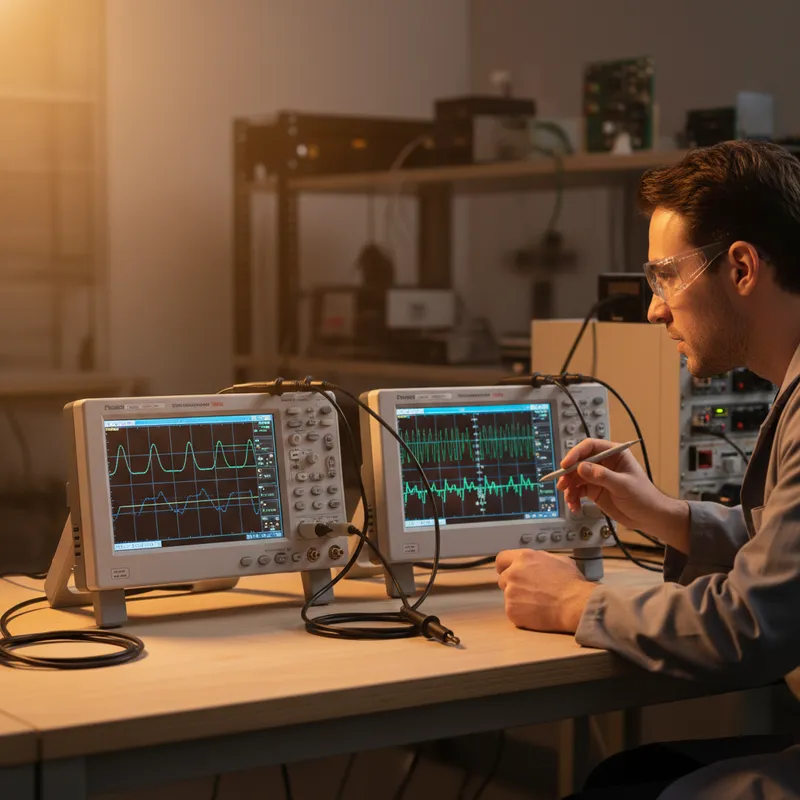
An oscilloscope with a current probe (AC/DC current clamp or a shunt resistor with differential probe) is a common approach to visualizing current waveforms. The oscilloscope provides high sample rate (GHz for modern digital scopes) and excellent time resolution.
Strengths:
- Very high sample rate and bandwidth
- Time-correlated measurement with other signals (GPIO toggles, communication bus activity)
- Already available in most labs
Limitations:
- Dynamic range: A shunt resistor sized for milliamp measurement (1 to 10 ohms) produces millivolts at nanoamp currents, buried in the oscilloscope’s noise floor. A shunt sized for nanoamp measurement (10 kohms to 1 Mohm) drops volts at milliamp currents, making the measurement useless for the active state and perturbing the device severely. Current probes (Hall effect or Rogowski) have a minimum detectable current of tens of microamps to milliamps.
- No energy integration: The oscilloscope captures current waveforms but does not integrate them. Computing energy per event requires post-processing, exporting the data, multiplying current by voltage sample-by-sample, and integrating numerically.
- Limited capture depth: Oscilloscopes are designed for capturing short events at high speed. Capturing a 15-minute duty cycle at high sample rate requires massive memory depth or segmented acquisition, which most mid-range scopes do not support.
Joulescope JS220: Purpose-Built for the Problem
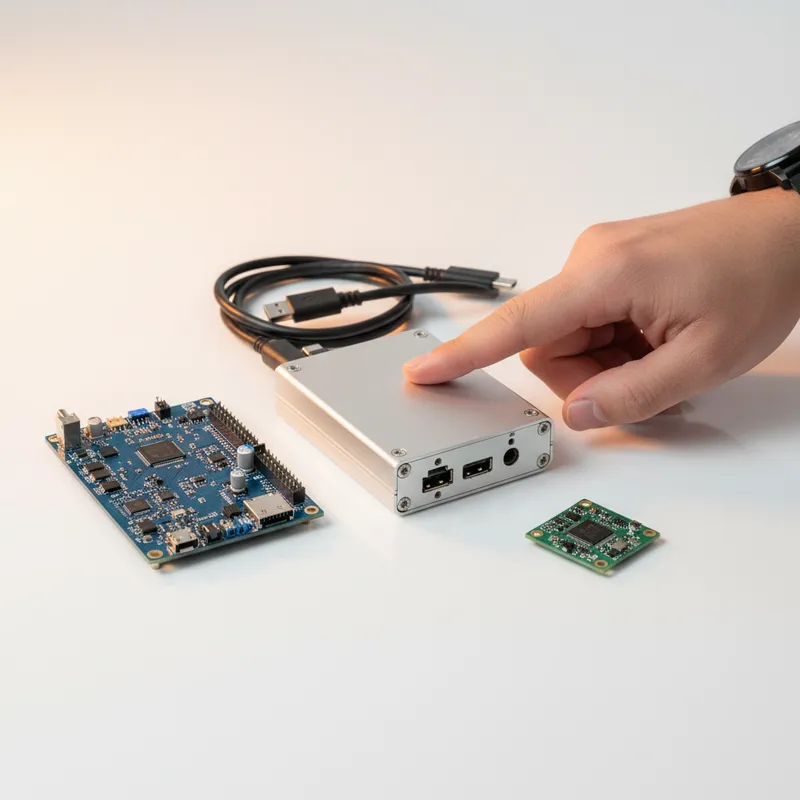
The Joulescope JS220 is not a replacement for any of these instruments. It is designed for a specific measurement problem that none of them solve well: continuous, high-dynamic-range, low-burden-voltage measurement of DC current and voltage for battery-powered embedded devices.
| Parameter | Joulescope JS220 | Bench Power Analyzer | SMU | Oscilloscope + Shunt |
|---|---|---|---|---|
| Current range | 0.5 nA to 10 A | 5 mA to 50 A | 1 pA to 3 A | 10 uA to 10 A |
| Sample rate | 2 Msps | 100 kHz to 1 MHz | 1 to 10 ksps | 1 Gsps+ |
| Autoranging | 1 us, no gaps | 10-100 ms | 1-10 ms | N/A (fixed shunt) |
| Burden voltage | 20 mV max | 100-500 mV | <1 mV | Shunt-dependent |
| Energy integration | Native, real-time | Yes | No | Post-processing |
| Capture duration | Unlimited | Varies | Limited | Memory-limited |
| Python API | Yes | SCPI/VISA | SCPI/VISA | SCPI/VISA |
| Form factor | Palm-sized, USB | 19” rack | Bench | Bench |
Selecting the Right Instrument
For Indian embedded product teams measuring battery-powered device power consumption, the Joulescope is the instrument that fills the gap between the DMM (too slow, too narrow dynamic range) and the oscilloscope (no low-current resolution, no energy integration). It complements existing lab instruments rather than replacing them.
Why Buy Joulescope From GSAS
GSAS provides Joulescope instruments with INR invoicing and evaluation units from offices in Bengaluru, Hyderabad, Chennai, Pune, Mumbai, and Delhi NCR. We help engineering teams evaluate the Joulescope against their current measurement setup to quantify the improvement.
Contact sales@gsasindia.com or call +91 80 6590 1783.
Also appears in:
Interested in Joulescope tools?
Talk to our application engineers for personalized tool recommendations.
More from Joulescope
View all →
Battery Discharge Profiling for Coin Cell Devices: From CR2032 to 10-Year Life
5 Apr · 7 min
BLE Power Profiling: Measuring Bluetooth Low Energy Current With Joulescope
5 Apr · 7 min
Energy Harvesting and Power Measurement: Designing Self-Powered IoT Devices
5 Apr · 7 min

IoT Battery Life Testing: A Practical Methodology for Indian Product Teams
5 Apr · 7 min
Emulating Processor Power for Thermal Testing: Why Constant Power
7 Oct · 7 min
CRPS and Rack Power Supply Testing: The Six Tests That Matter
7 Oct · 7 min