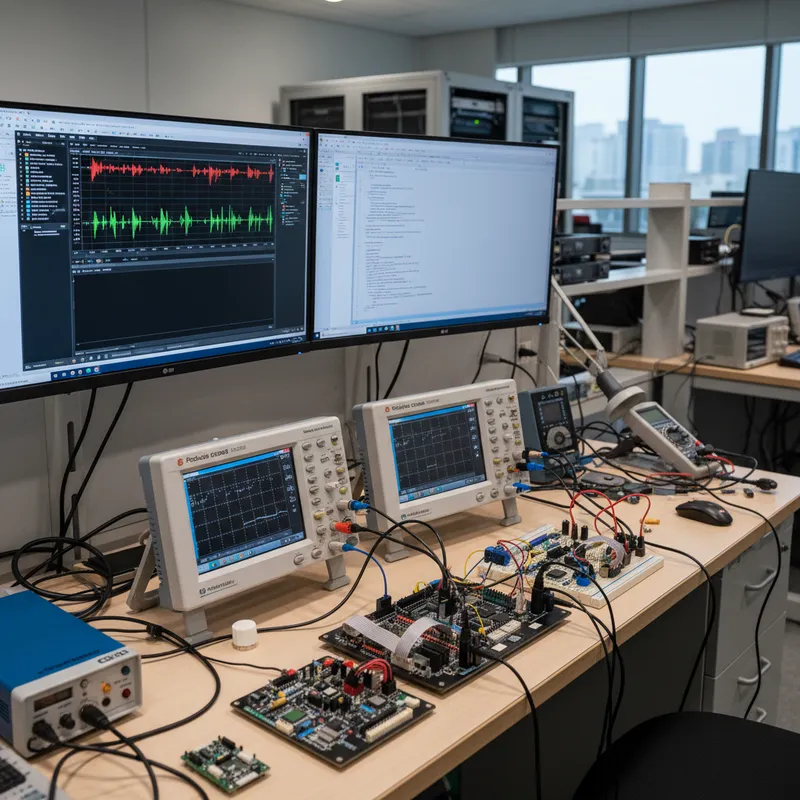
Two Tektronix Scopes, Two Different PicoScope Answers
Tektronix sits on almost every Indian engineer’s shortlist. It is the brand everyone learned on, the one with the deepest Indian service footprint, and the default benchtop in most established R&D labs. When a team in Bengaluru, Hyderabad, Chennai, Pune, Mumbai, or Delhi NCR starts evaluating oscilloscopes, Tektronix is almost always in the comparison.
But “Tektronix” covers a wide range. The TBS2000B is the entry benchtop, a budget-conscious choice for classrooms, repair benches, and teams that want a known brand without a premium spend. The MSO24 is a completely different animal, a step-up mixed-signal platform targeted at serious embedded, power, and signal integrity work.
PicoScope competes with both, but the comparison is not the same. This post walks through what an Indian team should actually pick for each scenario.
Tektronix TBS2000B vs PicoScope: The Entry Benchtop Shootout
The TBS2000B is Tektronix’s entry-level benchtop oscilloscope. It covers 70 MHz, 100 MHz, and 200 MHz options with 2 or 4 analog channels, 1 GS/s sample rate, and up to 5 Mpoints of record length. The built-in 9-inch display, front panel knobs, and standalone operation make it a natural pick for shared benches and training environments.
The PicoScope equivalents at this tier are the PicoScope 2000B family and the PicoScope 3000D FlexRes family. Both cover the same 70-200 MHz bandwidth range over USB.
Where PicoScope Wins at the TBS2000B Tier
- Buffer memory: PicoScope 3000D FlexRes offers up to 512 MS standard on several variants. The TBS2000B tops out at roughly 5 Mpoints. That is roughly two orders of magnitude more capture depth per acquisition on the PicoScope at standard configuration.
- Free serial decoders: PicoScope 7 software ships with 40+ serial protocol decoders standard, CAN, LIN, I2C, SPI, UART, I2S, 1-Wire, and more. Tektronix typically sells serial decode as a separate option bundle.
- FlexRes hardware resolution: the PicoScope 3000D FlexRes can switch between 8-bit and 12-bit hardware modes. The TBS2000B is 8-bit only.
- Portable PC-based workflow: the same PicoScope that works on a Bengaluru design bench travels to a Pune customer site and a Chennai supplier audit in a laptop bag.
- Cross-platform software: PicoScope 7 runs on Windows, macOS, and Linux.
Where the TBS2000B Wins
- Standalone operation: no PC required. Power it up, probe the signal, read the screen. This matters in labs with shared benches where engineers rotate.
- Large front panel with physical knobs: for users trained on traditional benchtop controls, the tactile experience is familiar and fast.
- 9-inch integrated display: a dedicated screen you do not have to plug a laptop into.
- Brand familiarity in Indian R&D procurement: Tektronix has a long history in India and purchasing teams know how to specify it.
The Honest Answer at This Tier
If your procurement criterion is “known benchtop brand under a set budget” and your engineers insist on a standalone box, the TBS2000B is a solid choice. If your criterion is “best measurement capability for the spend” and your team is comfortable with a laptop-driven workflow, the PicoScope 2000B or 3000D FlexRes wins on memory, decoder coverage, and resolution, typically at a lower total landed cost in INR.
Tektronix MSO24 vs PicoScope 6000E: The High-End Shootout
The MSO24 is a different conversation. It is a 4-channel (or 2-channel) mixed-signal oscilloscope with a 12-bit ADC, 16 digital channels on MSO variants, a large touchscreen, and TekScope analysis software. Bandwidth tiers span 200 MHz up through 1 GHz, with Tektronix’s 2 GHz and 6 GHz higher-end options available in the wider MSO2 Series and MSO5/6 platforms for the applications that need them.
For Indian teams that need high-end mixed-signal plus real protocol decode, the choice against PicoScope becomes the PicoScope 6000E.
Where PicoScope 6000E Wins at the MSO24 Tier
- Buffer memory: PicoScope 6000E offers up to 4 GS standard memory on the top configurations. Tektronix MSO24 base memory is shallower, typically in the tens of Mpoints standard, with deeper memory as an upgrade option.
- Analog channel count: PicoScope 6000E is available in 4-channel and 8-channel configurations. MSO24 is 2 or 4 channels.
- FlexRes resolution: PicoScope 6000E is hardware-switchable between 8-bit, 10-bit, and 12-bit.
- Serial decoders included: PicoScope 7 ships with 40+ decoders standard. Tektronix serial decode is typically a paid option bundle.
- Software platform reach: PicoScope 7 runs on Windows, macOS, and Linux natively. TekScope is primarily a Windows application per Tektronix’s published OS support.
- Portable form factor: USB 3.0 desktop unit versus full benchtop enclosure.
Where the MSO24 Wins
- Standalone benchtop with large touchscreen UI: no PC to maintain, no laptop to connect. The scope is a complete instrument.
- 12-bit ADC standard across the range: a real architectural advantage if your team never wants to think about resolution modes.
- TekScope analysis software: mature, well-known in Indian labs, with strong waveform analysis features.
- Tektronix Indian service network: long-established with calibration, repair, and training partners across metro locations.
- Brand recognition in defence and telecom procurement: in labs with long Tektronix histories, inertia is real.
The Honest Answer at This Tier
For a new Indian design house or a team building a high-performance lab from scratch, the PicoScope 6000E is the technically stronger pick on buffer memory, channel count, resolution flexibility, decoder coverage, and total cost of ownership. For teams with deep Tektronix standardization, existing TekScope workflows, and a preference for standalone benchtop instruments, the MSO24 is a coherent continuation of that environment.
Software Platform Comparison
| Capability | PicoScope 7 | TekScope |
|---|---|---|
| Operating systems | Windows, macOS, Linux | Windows (primary) |
| Serial protocol decoders included | 40+ standard | Varies by model and option |
| Deep-memory waveform streaming | Native to PicoScope architecture | Available on select models |
| Scripting and automation | pyPicoSDK Python SDK, C/C++, LabVIEW, MATLAB | TekScope supports remote control; Python wrappers available |
For teams building automated test frameworks with pytest or continuous streaming acquisition pipelines, the pyPicoSDK Python ecosystem is a meaningful advantage.
Where Tektronix Still Wins: the Honest Section
PicoScope content can read like it is one-sided. It is worth saying clearly where Tektronix is the right call.
- Established Indian R&D labs that have standardized on Tektronix over years of engineer-training, calibration cycles, and procurement frameworks have legitimate reasons to stay.
- Production test stations that need standalone instruments with no PC dependency are simpler to maintain with a benchtop.
- Teams that prefer physical knobs and touchscreen UIs on the bench have a workflow reason to pick Tektronix that no USB scope solves.
- Service and calibration footprint: Tektronix has one of the deepest Indian service networks in test and measurement.
PicoScope is winning in newer Indian design houses, startups, and teams where laptop-based workflow, deep memory, and decoder coverage matter more than front-panel UI. The shift is real but it is not universal.
Further Reading
- PicoScope 6000E product page
- PicoScope 5000D FlexRes product page
- PicoScope 3406E product page
- PicoScope 2405A product page
- PicoScope 7 software
- Pico Technology partner page
- PicoScope vs benchtop oscilloscope comparison
- PicoScope vs Keysight at 200 MHz in India
- PicoScope automotive diagnostics guide
- PicoScope power electronics guide
Evaluate at GSAS
GSAS Micro Systems is an authorized engineering partner for Pico Technology. We stock the full PicoScope 2000B, 3000D, 3000E, 4000A, 5000D, and 6000E families with INR invoicing and GST-compliant documentation.
If you are evaluating a Tektronix TBS2000B or MSO24 today, book a side-by-side hands-on evaluation at our offices in Bengaluru, Hyderabad, Chennai, Pune, Mumbai, or Delhi NCR. Bring your own signals and your own measurement scripts, see which platform fits your team before you commit.
Also appears in:
Interested in Pico Technology tools?
Talk to our application engineers for personalized tool recommendations.
More from Pico Technology
View all →
How to Buy an Oscilloscope in India (2026): USB vs Benchtop, Bit Depth, Bandwidth: A Buying Guide
5 Jun · 11 min
PicoScope 5000D vs 5000E: Native 16-Bit or FlexRes? A Buyer's Guide for Indian Labs
4 Jun · 11 min
PicoScope 5000E in India: The World's First 4-Channel 16-Bit USB Oscilloscope, Explained
4 Jun · 11 min
PicoScope 7 Goes Native Arm64: Apple Silicon, Snapdragon Windows and Arm Linux Test Benches in India
4 Jun · 11 min
Emulating Processor Power for Thermal Testing: Why Constant Power
7 Oct · 7 min
CRPS and Rack Power Supply Testing: The Six Tests That Matter
7 Oct · 7 min