Why Indian Workshops and Tier-1 Validation Labs Need Better Automotive Measurement
Walk into a progressive Indian workshop in Pune, Chennai, or Bengaluru: or into a Tier-1 supplier validation lab in the Chakan or Hosur belts, and the same story repeats. An intermittent misfire that only shows up above 3000 rpm. A driveline whine that the customer feels but the dealer cannot replicate. A CAN bus fault that the diagnostic tool reports once and then disappears. These are the problems that a code reader cannot solve. They need an oscilloscope.
The challenge for an Indian workshop engineer is that a benchtop oscilloscope does not travel well. A typical service bay has no bench space, the lift is already occupied, and the vehicle has to come down in twenty minutes. A portable, USB-based PicoScope running on a laptop, with differential probes, current clamps, and a 3-axis accelerometer in the same toolkit case, changes the economics of diagnostic work.
This post walks through how to use the PicoScope 4000 Series automotive scopes: 4225A, 4425A, 4823, along with the PicoBNC+ smart probe ecosystem and the PicoDiagnostics NVH software, for the core diagnostic workflows Indian automotive engineers actually face.
The PicoScope 4000 Automotive Family
Pico Technology’s automotive line is a focused family built around the service and validation use case, not the bench.
PicoScope 4225A: a 2-channel scope. The smallest format, appropriate for a technician doing single-signal work (crank sensor, coil primary, O2 sensor).
PicoScope 4425A: a 4-channel scope. The most common configuration for Indian Tier-1 validation teams, because four channels let you probe the CAN high/low pair plus the trigger source plus a reference simultaneously. Same front-end performance as the 4225A but doubled channel count.
PicoScope 4823: an 8-channel scope. Built for the cases where you need to capture a multi-phase signal or monitor several ECU lines at once. Useful for powertrain and ADAS module validation where the fault surface spans several signals.
All three scopes share the PicoScope 7 Automotive software, the same guided-test library, and the same PicoBNC+ smart-probe ecosystem. Choose channel count based on the work, not the feature set.
See the PicoScope 4000 Series product page for the current models and the broader Pico Technology partner page for the full automotive portfolio.
PicoBNC+: Smart Probes That Configure Themselves
The single biggest productivity improvement in Pico’s automotive line is PicoBNC+. A PicoBNC+ probe carries an ID chip that tells the PicoScope 7 Automotive software exactly what it is, a 60 A current clamp, a 2000 A current clamp, a differential high-voltage probe, an ignition pickup, a CAN breakout, and the software auto-configures the channel.
In practice, an Indian workshop technician who plugs in a PicoBNC+ current clamp does not have to remember the attenuation ratio or the coupling. The channel range, scaling, and units are set automatically. Power-up and get to work.
For a service bay under time pressure this matters more than it sounds. Setup errors, “I forgot to set the probe attenuation to 10x”, are one of the most common sources of wrong diagnoses in scope-based work. PicoBNC+ eliminates them.
The Guided-Tests Library: 160+ Tests, Step-by-Step
Pico Technology maintains a public automotive guided-tests library at picoauto.com/library/automotive-guided-tests with more than 160 step-by-step tests. Each test covers a specific component, alternator, fuel injector, crank sensor, ignition coil, O2 sensor, CAN bus, and so on, with the probe setup, the expected waveform, and the typical failure patterns.
For Indian workshops this is the fastest route to scope literacy. An engineer who has never done a coil-on-plug primary analysis can open the guided test, follow the probe diagram, acquire the waveform, and compare it against the reference. The library is free, public, and regularly updated.
Combined with PicoScope 7 Automotive’s waveform library, which lets the technician save known-good waveforms for a specific vehicle model and compare future diagnostics against them, a workshop can build its own local database of Indian-market vehicle signatures over time.
Core Diagnostic Workflows
CAN, CAN FD, LIN, and FlexRay Decode
Modern Indian vehicles, major Indian passenger and commercial OEMs alongside two-wheeler and EV brands like Bajaj, TVS, Ola, Ather: all run CAN and CAN FD on their powertrain networks, with LIN on body and comfort systems. Some premium platforms use FlexRay. When a fault appears as a DTC that refers to “communication loss with module X”, the scope is the right tool.
PicoScope 7 Automotive includes serial bus decoders for CAN, CAN FD, LIN, and FlexRay. Connect to CAN high and CAN low with a differential probe or a CAN breakout, trigger on a specific arbitration ID, and watch the bus traffic in real time. When the fault happens, the decoder captures the exact frame, ID, DLC, data bytes, CRC, and the engineer can see whether the fault is a dropped frame, a bit error, or a physical-layer issue (wrong voltage, excessive ringing, missing termination).
For a deeper treatment of automotive serial bus workflows, see PicoScope automotive diagnostics with CAN, LIN, and FlexRay.
Crank and Cam Sensor Signal Analysis
Crank sensor waveforms are the most commonly scoped signal in automotive diagnostics. A PicoScope 4225A or 4425A on the crank signal line shows the pulse train generated as the reluctor wheel passes the sensor. The guided test walks through what a healthy hall-effect or variable-reluctance signal should look like; a degraded bearing, a chipped tooth on the reluctor wheel, or a failing sensor shows up as an amplitude or timing anomaly that a DTC scanner will never see.
Fuel Pump Current Profile
An in-tank fuel pump draws current in a characteristic pattern, inrush, steady commutation ripple, and a settling curve. A worn brush, a failing bearing, or a clogged filter changes the shape of that current profile. Clamp a PicoBNC+ current probe on the pump feed, capture a few seconds of the current waveform, and compare against the guided-test reference. This workflow catches problems days or weeks before the pump fails outright, useful for fleet operators running commercial vehicles in Delhi NCR and Mumbai.
Alternator Ripple and Voltage Regulator
A healthy alternator shows a small, symmetric ripple on the DC output. A failing diode in the rectifier bridge shows a characteristic asymmetric ripple. A failing voltage regulator shows a drifting DC baseline. PicoScope’s math channel can take the FFT of the alternator output and display the ripple frequency directly, if the ripple is not at the expected multiple of engine rpm, the diagnosis points to a rectifier diode.
Coil-on-Plug Primary Waveform
Primary-side coil analysis is the fastest way to find a weak coil or a worn plug without pulling hardware. Clamp a PicoBNC+ ignition probe on the primary lead, scope the primary waveform, and compare against the reference. The dwell time, the peak voltage, the burn line, and the ringing tail each tell a different story about coil health and combustion quality.
NVH: Localizing Driveline Vibration with PicoDiagnostics
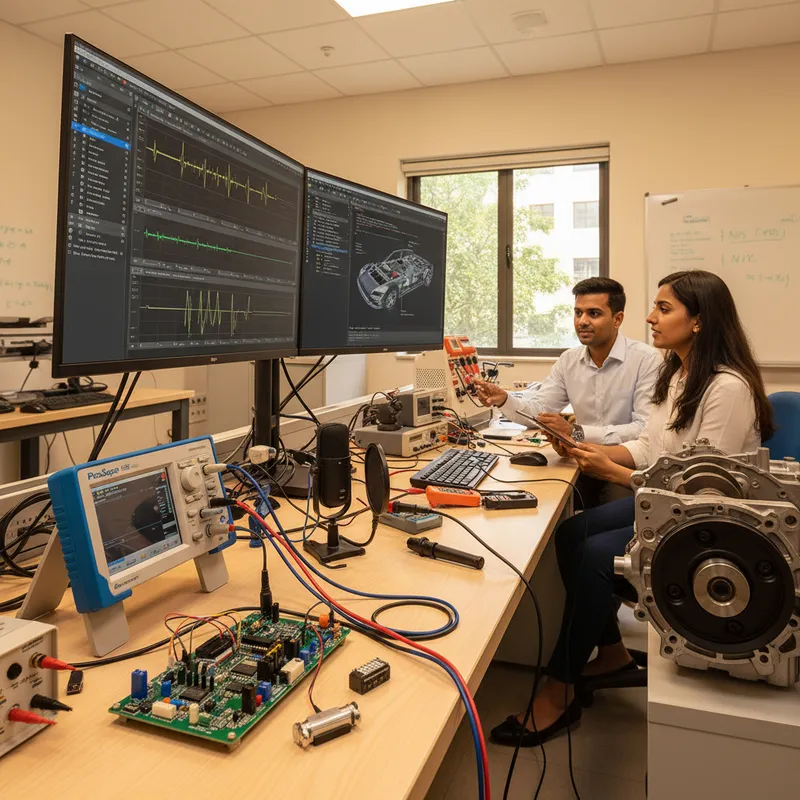
Noise, Vibration, and Harshness (NVH) is the application area where PicoScope displaces equipment costing many times more. The NVH kit pairs a PicoScope 4425A with a 3-axis accelerometer and the PicoDiagnostics NVH software. The accelerometer mounts to the driver’s seat rail, the transmission housing, or a suspect wheel hub. PicoDiagnostics simultaneously captures the vehicle speed (from the OBD-II CAN bus), engine rpm, and the acceleration signal.
The software then runs an FFT on the acceleration data and plots the vibration amplitude against engine rpm and vehicle speed. Because PicoDiagnostics knows the typical gear ratios, final drive ratios, and wheel sizes, it can map the vibration frequency back to a specific source, the engine at first order, the propshaft, the differential, an individual wheel, or the tyres. For Indian commercial vehicle operators dealing with driveline complaints, this is the difference between replacing the right part once and replacing three wrong parts in sequence.
A microphone-based variant of the same kit captures cabin noise against rpm, useful for diagnosing accessory drive whine, belt noise, and exhaust drone.
Why PC-Based Is Right for Indian Workshops
A benchtop scope is a fine instrument in a room with bench space, a stable AC outlet, and a technician who stays in one place. An Indian workshop is usually none of those things. The PC-based PicoScope, a laptop, a USB-powered scope, and a toolkit of PicoBNC+ probes, fits into a case the size of a large briefcase. It travels between service bays, between the workshop and the customer’s vehicle, and between validation lab and test track. The same instrument supports the technician doing a drivability complaint and the Tier-1 validation engineer doing a production sign-off.
No bench footprint, no separate display, no proprietary probe format, and no lock-in. Add a 12V adapter and the same setup runs from the vehicle’s own battery during a road test.
Instrument Recommendation
For a general-purpose Indian workshop: PicoScope 4425A with the NVH kit and the PicoBNC+ automotive starter probe set. Four channels cover the vast majority of guided tests; the NVH kit adds a high-value capability the competition usually cannot match.
For a Tier-1 validation lab doing multi-ECU work: PicoScope 4823 for the channel count, combined with the PicoBNC+ differential high-voltage probes for hybrid and EV work, and the full guided-tests library as a team training asset.
For a mobile diagnostics specialist: PicoScope 4225A as the travel scope, plus the NVH kit as an option for driveline complaints.
Contact our team at /partners/pico-technology for a local demo at our Bengaluru, Pune, Hyderabad, or Delhi NCR offices.
Further Reading
- Pico Technology, Automotive guided-tests library (160+ tests)
- Pico Technology, PicoDiagnostics NVH software
- Pico Technology, PicoBNC+ smart probe overview
- GSAS, PicoScope automotive diagnostics with CAN, LIN, and FlexRay
- GSAS, PicoScope 4000A Series
- GSAS, PicoScope 4444 differential oscilloscope
- GSAS, Automotive solutions for Indian OEMs and Tier-1s
- GSAS, Pico Technology partner page
Also appears in:
Interested in Pico Technology tools?
Talk to our application engineers for personalized tool recommendations.
More from Pico Technology
View all →
How to Buy an Oscilloscope in India (2026): USB vs Benchtop, Bit Depth, Bandwidth: A Buying Guide
5 Jun · 11 min
PicoScope 5000D vs 5000E: Native 16-Bit or FlexRes? A Buyer's Guide for Indian Labs
4 Jun · 11 min
PicoScope 5000E in India: The World's First 4-Channel 16-Bit USB Oscilloscope, Explained
4 Jun · 11 min
PicoScope 7 Goes Native Arm64: Apple Silicon, Snapdragon Windows and Arm Linux Test Benches in India
4 Jun · 11 min
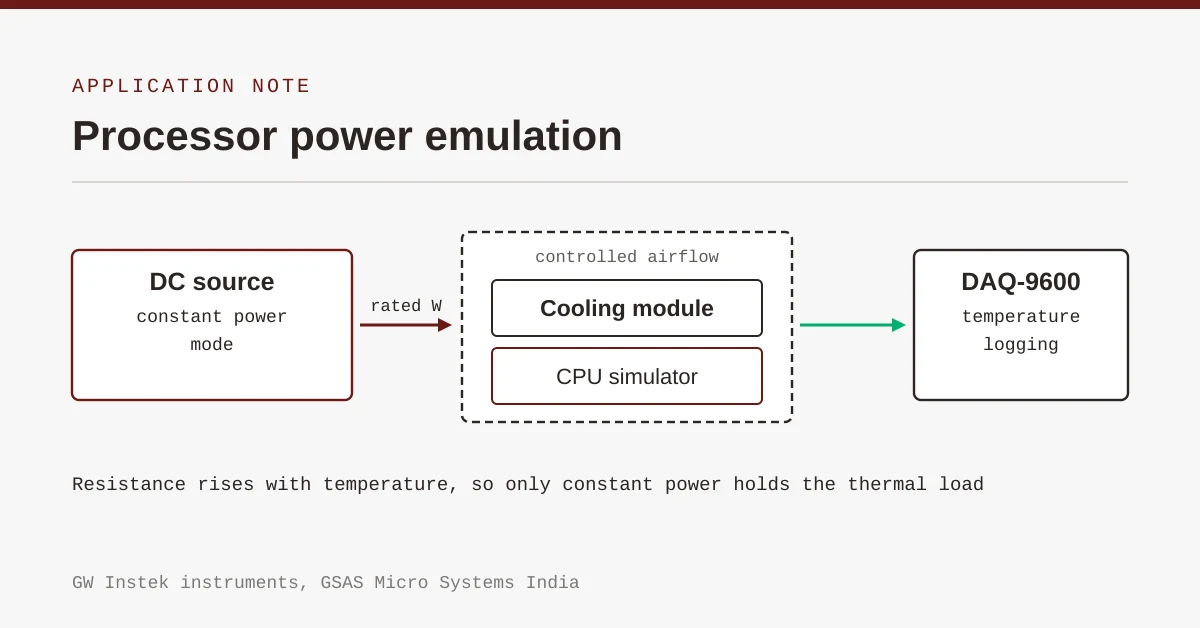
Emulating Processor Power for Thermal Testing: Why Constant Power
7 Oct · 7 min
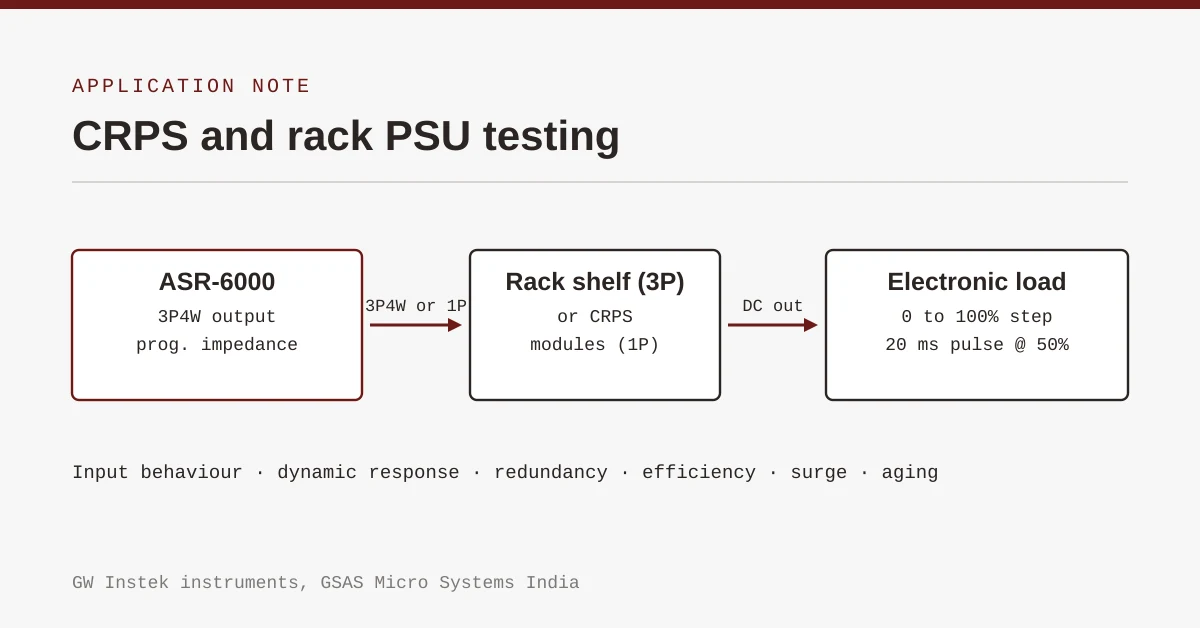
CRPS and Rack Power Supply Testing: The Six Tests That Matter
7 Oct · 7 min