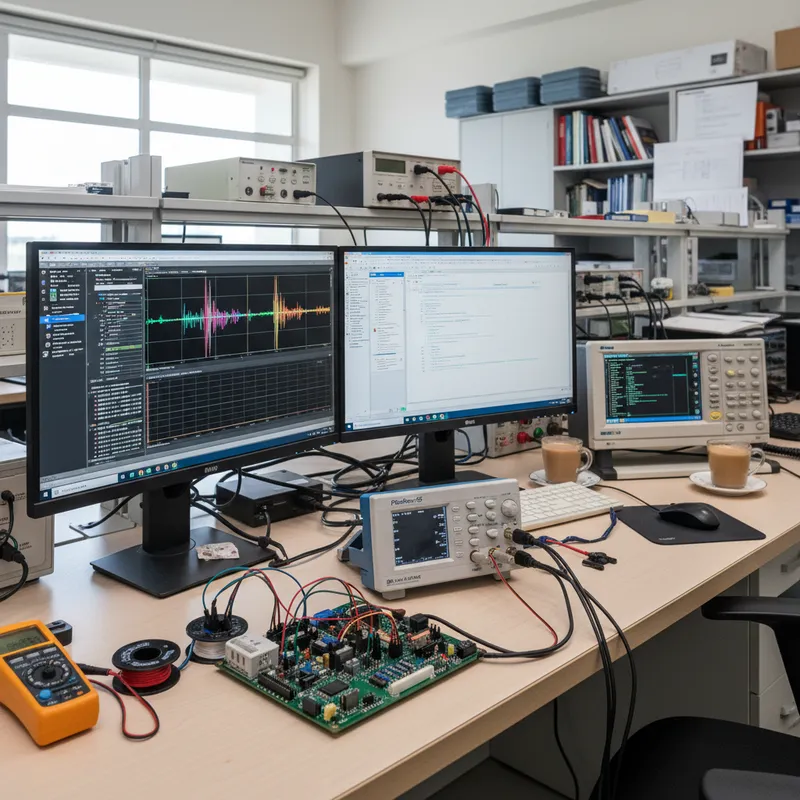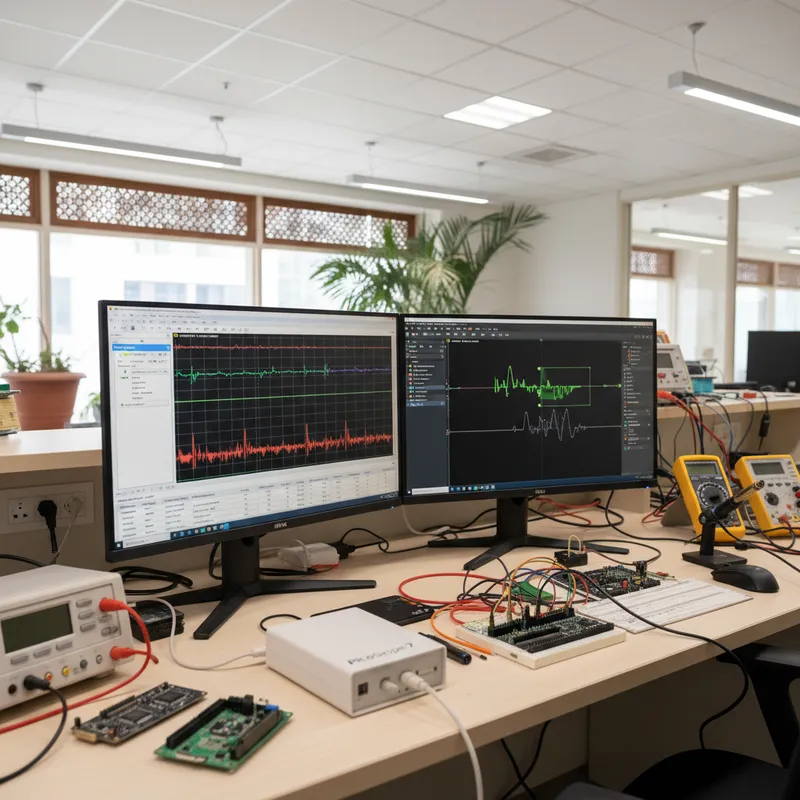
The R&S Challenger Story
Rohde & Schwarz is the brand Indian engineers respect. In defence electronics, telecom R&D, and established corporate labs across Bengaluru, Hyderabad, Chennai, Pune, Mumbai, and Delhi NCR, R&S has a reputation for German-engineered instruments that quietly do the job for a decade. The RTB2000 is their mid-range benchtop oscilloscope family. The RTM3000 is the step-up. Both are popular choices in Indian labs that standardize on premium European test gear.
The challenger is the PicoScope 6000E, a USB 3.0 oscilloscope from Pico Technology that offers bandwidth in the same 500 MHz to 1 GHz tier, FlexRes hardware resolution switching, up to 4 GS of buffer memory, 8 analog channels on the top models, and 40+ serial protocol decoders included standard in PicoScope 7 software.
This post is the comparison an Indian defence or telecom R&D lead should run before the next oscilloscope purchase.
The Two R&S Families
Rohde & Schwarz RTB2000
The RTB2000 is R&S’s mid-range benchtop oscilloscope. It covers 70 MHz, 100 MHz, 200 MHz, and 300 MHz bandwidth options with 4 analog channels, a 10-bit ADC (a differentiator that R&S markets heavily compared to the 8-bit competition), a capacitive touchscreen, and around 20 MS of standard memory. Mixed-signal and arbitrary waveform generator options are available as upgrades. R&S positions it as the entry point for serious R&D work.
Rohde & Schwarz RTM3000
The RTM3000 is the step-up benchtop. Bandwidth options span 100 MHz, 200 MHz, 350 MHz, 500 MHz, and 1 GHz with 4 analog channels, a 10-bit ADC, a larger touchscreen, around 40 MS of standard memory, and more advanced analysis options. It targets teams that need higher bandwidth, deeper analysis features, and a more capable trigger system than the RTB2000.
Both families are engineered to R&S’s typical build quality, this is not a budget story, it is a premium instrument story.
PicoScope 6000E Positioning
The PicoScope 6000E is a USB 3.0 oscilloscope family with 4 or 8 analog channels, 500 MHz / 1 GHz / up to 2 GHz bandwidth options, up to 5 GS/s sample rate, up to 4 GS standard buffer memory, FlexRes hardware switchable between 8-bit, 10-bit, and 12-bit modes, 16 digital MSO channels on MSO variants, and PicoScope 7 software on Windows, macOS, and Linux with 40+ serial protocol decoders included.
It is not a benchtop. It is a desktop front-end that drives the engineer’s host PC.
Spec-by-Spec Comparison
Vertical Resolution
- R&S RTB2000: 10-bit ADC standard.
- R&S RTM3000: 10-bit ADC standard.
- PicoScope 6000E: FlexRes hardware switchable between 8-bit, 10-bit, and 12-bit modes.
R&S made a smart architectural choice years ago, shipping 10-bit ADCs standard when most of the competition was still 8-bit. It remains a real advantage for precision measurement work. The PicoScope 6000E answers with FlexRes: if you want pure speed you run 8-bit, if you want to match R&S you run 10-bit, and if you want more dynamic range than either R&S can offer you run 12-bit. The flexibility is the whole point.
Buffer Memory: the Widest Gap
- R&S RTB2000: approximately 20 MS standard.
- R&S RTM3000: approximately 40 MS standard.
- PicoScope 6000E: up to 4 GS standard on the top configurations.
This is where the comparison stops being subtle. The PicoScope 6000E standard buffer is roughly two orders of magnitude deeper than either R&S family at their standard configurations. At 5 GS/s sample rate, 4 GS captures roughly 800 ms of continuous data at full resolution. At 40 MS, the RTM3000 captures roughly 8 ms at the same rate.
For power electronics switching transient analysis, for signal integrity long-record eye diagrams, for serial protocol decode across extended transactions, for EMC dwell captures, and for intermittent fault hunting, deep memory is the capability that determines whether your engineer catches the event.
Bandwidth and Channels
- R&S RTB2000: 70 MHz to 300 MHz, 4 analog channels, optional 16-channel MSO.
- R&S RTM3000: 100 MHz to 1 GHz, 4 analog channels, optional 16-channel MSO.
- PicoScope 6000E: 500 MHz to 2 GHz, 4 or 8 analog channels, 16-channel MSO on MSO variants.
At the 1 GHz tier the PicoScope 6000E and the RTM3000 both land. The PicoScope extends higher to 2 GHz and adds the 8-channel configuration, which no RTB2000 or RTM3000 variant offers.
Sample Rate
- R&S RTB2000: up to 2.5 GS/s.
- R&S RTM3000: up to 5 GS/s.
- PicoScope 6000E: up to 5 GS/s.
PicoScope 6000E and RTM3000 are peers. The RTB2000 is a tier below.
Serial Protocol Decoders
- R&S RTB2000 / RTM3000: decoders for CAN, LIN, I2C, SPI, UART, and so on are typically paid options. Each serial protocol bundle is priced as an upgrade.
- PicoScope 6000E with PicoScope 7: 40+ decoders included standard, CAN, CAN FD, LIN, FlexRay, I2C, SPI, UART, I2S, 1-Wire, USB, Ethernet, ARINC 429, and many more, all in the base price.
For Indian defence programs that need MIL-STD-1553 (check availability per platform), avionics protocols, and automotive-heritage decoders, the PicoScope “everything included” model removes an entire procurement line item.
Software Platform
- PicoScope 7 (for the 6000E): Windows, macOS, and Linux. Free lifetime updates. Scripting via pyPicoSDK, C/C++, LabVIEW, and MATLAB.
- Rohde & Schwarz: desktop analysis software and remote control interfaces are available; platform support is more traditional.
For labs automating measurement runs on Linux workstations or integrating with Python test frameworks, PicoScope has the more modern software ecosystem.
Form Factor
- R&S RTB2000 / RTM3000: full benchtop enclosures with integrated touchscreens and physical front panel knobs. This is the traditional instrument experience.
- PicoScope 6000E: compact USB 3.0 desktop unit driven by the host PC.
Pros and Cons Summary
PicoScope 6000E: Strengths
- Up to 4 GS standard buffer memory, orders of magnitude deeper than either R&S family.
- 4 or 8 analog channel configurations.
- FlexRes hardware 8/10/12-bit mode switching.
- 40+ serial protocol decoders included standard with PicoScope 7.
- Cross-platform software on Windows, macOS, and Linux.
- Free lifetime software updates.
- Materially lower total cost of ownership when decoder and memory upgrades are factored in.
PicoScope 6000E: Trade-offs
- Requires a host PC, not a standalone bench instrument.
- No built-in touchscreen UI.
- Less historical brand recognition in Indian defence and telecom procurement departments that have standardized on R&S.
Rohde & Schwarz RTB2000 / RTM3000: Strengths
- Standalone benchtop operation with no PC dependency.
- 10-bit ADC standard, a real precision advantage compared to 8-bit competition.
- Large capacitive touchscreen with physical knobs on every model.
- German engineering and build quality.
- Strong brand recognition in Indian defence, aerospace, and telecom R&D.
- Established Indian service and calibration footprint.
Rohde & Schwarz RTB2000 / RTM3000: Trade-offs
- Shallower standard buffer memory, orders of magnitude less than PicoScope 6000E at standard configuration.
- Maximum 4 analog channels, no 8-channel option in these families.
- Most serial protocol decoders are priced as paid options on top of the instrument.
- Total cost of ownership rises quickly when decoders, memory upgrades, and MSO are added.
The Indian Context: Defence, Telecom, and the Challenger
Indian defence electronics programs, Tier-1 telecom R&D, and established corporate R&D labs have historically defaulted to Rohde & Schwarz. The reasons are real: German instrument quality, a long-term service relationship, and procurement frameworks that already list R&S as a standard vendor. None of that disappears overnight.
PicoScope is the modern challenger. The architecture is different, the economics are different, and the measurement capability is competitive on the dimensions that matter most to the actual work: deep memory for long signal captures, free decoders for every serial protocol used in automotive, industrial, and avionics work, and FlexRes for precision measurement modes.
For a brand-new lab being built in 2026, the PicoScope 6000E is the harder-to-dismiss option. For an existing lab already standardized on R&S with budget tied to that standardization, the inertia is legitimate, but the next side-by-side evaluation should still be run.
Indian Use Cases
- Defence electronics signal integrity: PicoScope 6000E deep memory plus FlexRes 12-bit mode, see our signal integrity measurement guide.
- Power electronics for traction inverters: deep buffer for switching transient capture, 8 analog channels for multi-rail monitoring, our power electronics guide goes deeper.
- Avionics and automotive protocol decode: CAN FD, FlexRay, and more, our automotive diagnostics guide shows real captures.
- EMC pre-compliance: long dwell captures with deep memory, see our EMC pre-compliance guide.
Further Reading
- PicoScope 6000E product page
- Pico Technology partner page
- PicoScope 6000E deep dive, high-bandwidth USB oscilloscope
- PicoScope 7 software
- PicoScope vs Keysight at 200 MHz in India
- PicoScope vs benchtop oscilloscope comparison
- PicoScope power electronics guide
- PicoScope signal integrity measurement guide
Book a Side-by-Side Evaluation at GSAS
GSAS Micro Systems is an authorized engineering partner for Pico Technology. We stock the full PicoScope 6000E family with INR invoicing, GST-compliant documentation, and local application engineering support.
If your team is evaluating Rohde & Schwarz RTB2000 or RTM3000 today, book a hands-on side-by-side at our Bengaluru office, or at Hyderabad, Chennai, Pune, Mumbai, or Delhi NCR. Bring your own signals and your own measurement requirements and see the deep-memory, free-decoder, FlexRes workflow on real hardware before the procurement decision.
Also appears in:
Interested in Pico Technology tools?
Talk to our application engineers for personalized tool recommendations.
More from Pico Technology
View all →
How to Buy an Oscilloscope in India (2026): USB vs Benchtop, Bit Depth, Bandwidth: A Buying Guide
5 Jun · 11 min
PicoScope 5000D vs 5000E: Native 16-Bit or FlexRes? A Buyer's Guide for Indian Labs
4 Jun · 11 min
PicoScope 5000E in India: The World's First 4-Channel 16-Bit USB Oscilloscope, Explained
4 Jun · 11 min
PicoScope 7 Goes Native Arm64: Apple Silicon, Snapdragon Windows and Arm Linux Test Benches in India
4 Jun · 11 min
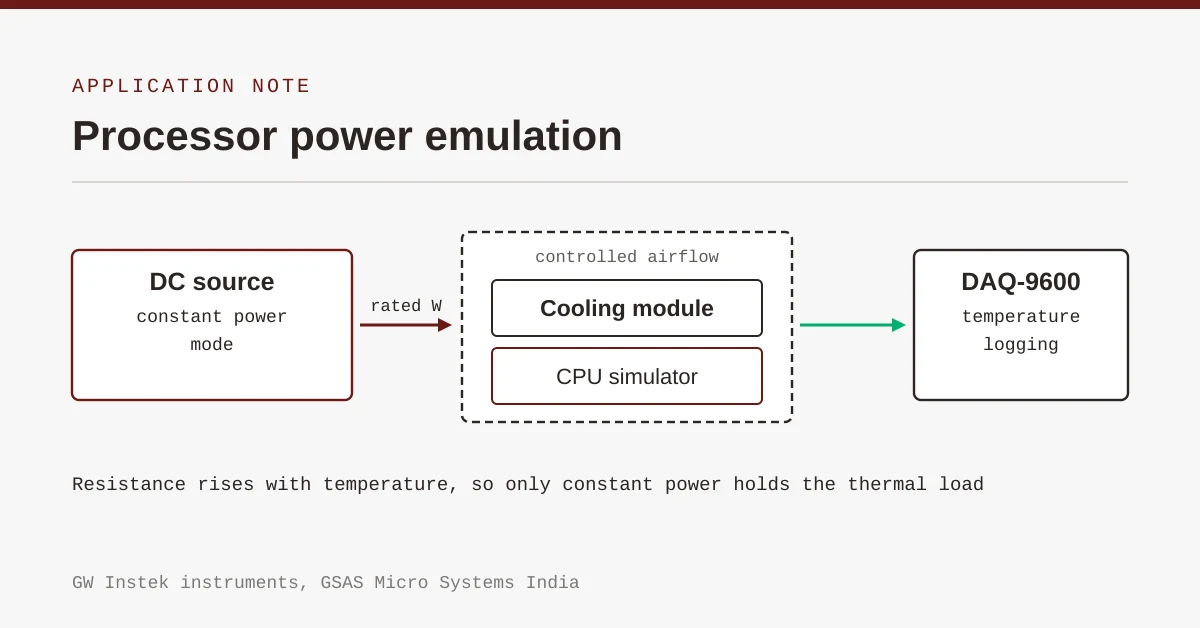
Emulating Processor Power for Thermal Testing: Why Constant Power
7 Oct · 7 min
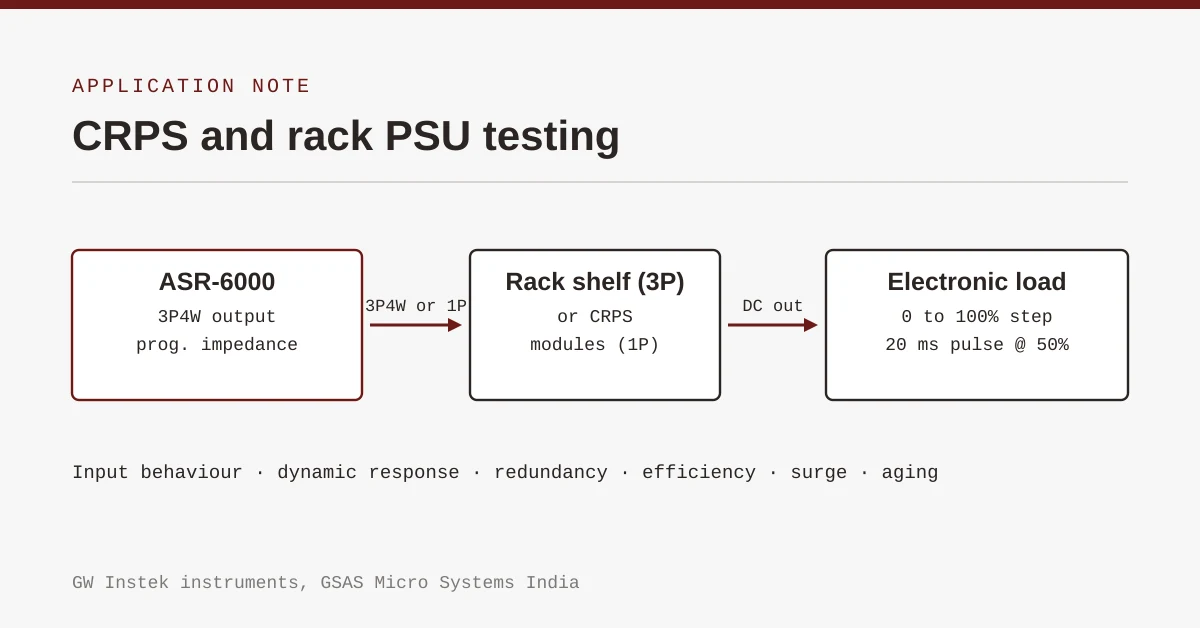
CRPS and Rack Power Supply Testing: The Six Tests That Matter
7 Oct · 7 min