India’s Quiet Signal-Integrity Problem
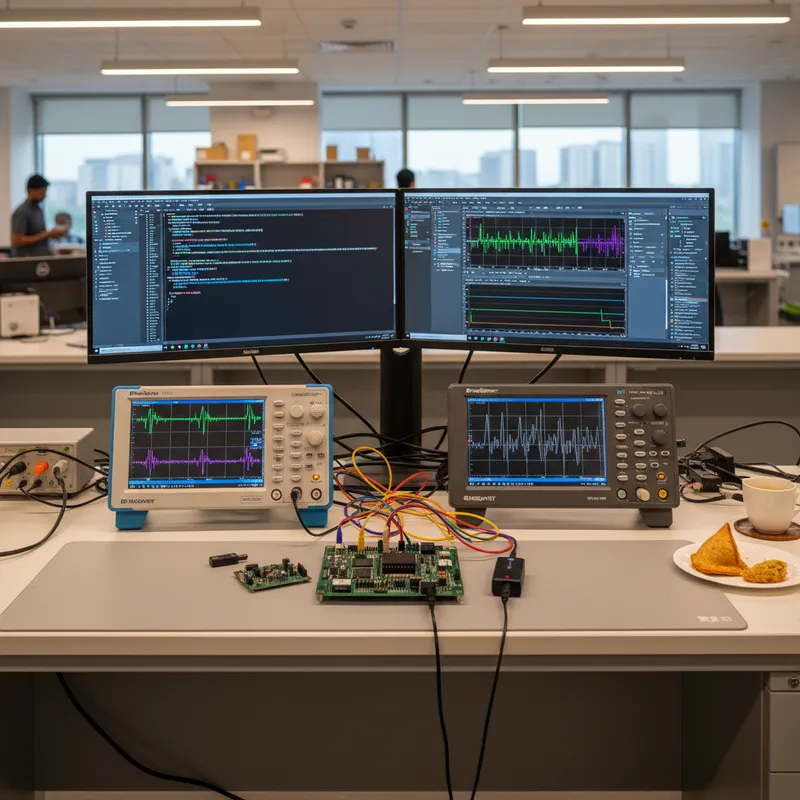
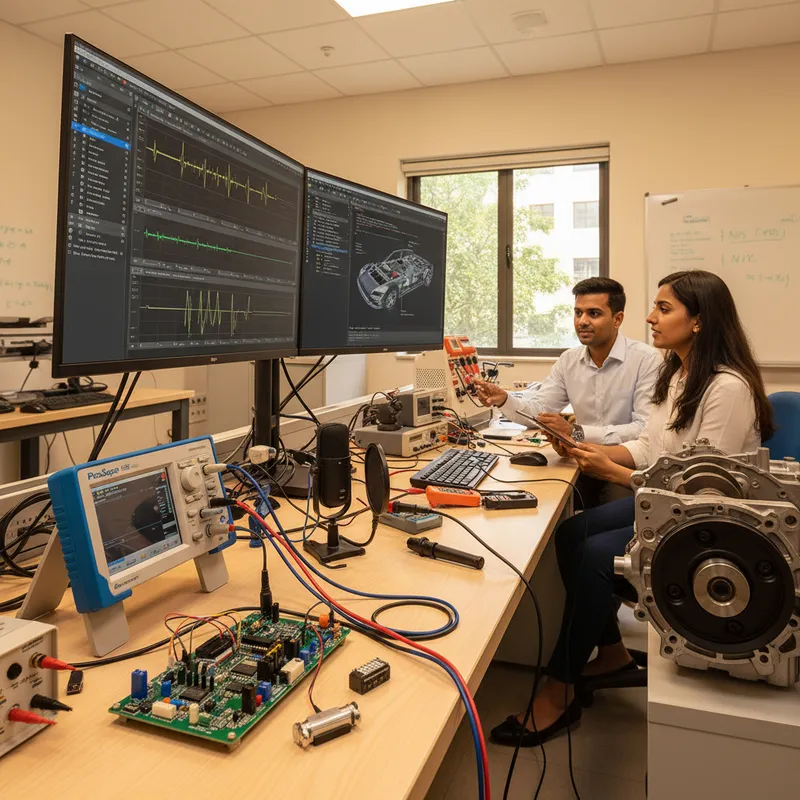
India’s semiconductor and high-speed board design scene is larger than it looks. There are SoC teams in Bengaluru working on networking silicon, IoT modems, and automotive application processors. There are Tier-1 ECU groups in Pune and Chennai pushing PCIe Gen 4 into central compute controllers. There are fabless startups in Hyderabad and Bengaluru doing board bring-up on FPGA evaluation platforms at 28G/56G lane rates. And there is a fast-growing Industry-4.0 field-device community in Mumbai and Delhi NCR bringing Ethernet-APL online for the process-control market.
All of these teams share one quiet problem: signal integrity measurement. Once a serial interface gets past USB 2.0 high-speed (480 Mbps) or SGMII (1.25 Gbps), the measurement instrument stops being a convenience and starts being a gating dependency. Benchtop scopes at the required bandwidth-memory-jitter specification are expensive enough that an Indian startup or a lean ECU group cannot justify one; the team either flies the DUT to the OEM’s SI lab in Europe or the US, or they ship blind and hope the compliance house finds it.
Neither of those is a good outcome. This post walks through the PicoScope approach to USB 3.x, PCIe, DDR, and Ethernet-APL signal integrity, where the PicoScope 6000E fits, where the PicoScope 9400A SXRTO takes over, and how PicoVNA 108 complements both.
Why Benchtop Scopes Struggle with SI Work
Signal integrity is the one measurement application where deep memory at high bandwidth is non-negotiable. A USB 3.0 eye diagram at a reliable BER (bit error rate) target needs hundreds of thousands of unit intervals in the eye, a few hundred microseconds of data at multi-GSa/s. A PCIe Gen 4 compliance eye wants similar or greater coverage. DDR write-level eye diagrams need millions of captures to find the setup/hold margin cliff.
A typical benchtop real-time scope at 1 GHz has maybe a few megasamples of memory per channel. At 5 GSa/s that is a few hundred microseconds total, and most of that budget is eaten by trigger holdoff and segment headers. Upgrade the memory and the cost curve bends sharply. This is the specific cost structure PicoScope is designed around, deep memory comes as standard, not as an upgrade.
For lane rates above 5 or 10 Gbps, PCIe Gen 4/5, 25/50/100G Ethernet SerDes, USB 3.2 Gen 2x2, real-time scopes become either impossibly expensive or physically impossible, and the instrument of choice becomes a sampling oscilloscope.
PicoScope 6000E: USB 2.0 HS, Mid-Range PCIe Debug, DDR Debug
The PicoScope 6000E is the first-stop instrument for the mid-range SI bench.
USB 2.0 high-speed compliance (480 Mbps): A 1 GHz PicoScope 6000E has the bandwidth to capture a USB 2.0 high-speed signal cleanly. PicoScope 7 includes a serial decoder for USB and for most of the common embedded serial interfaces. Combined with deep memory, the 6000E is a competent USB 2.0 compliance screening tool.
PCIe Gen 1/2 board debug: Lane rates of 2.5 and 5 Gbps are within reach of a 1 GHz or 3 GHz PicoScope 6000E as a board-debug tool. This is not PCIe Gen 4/5 compliance, it is the earlier work of getting a board to train up to a link, finding clock-recovery issues, and localizing a bad trace. The 6000E is well-suited here and substantially cheaper than a benchtop equivalent.
DDR read/write waveform inspection: A 3 GHz PicoScope 6000E (the 6428E-D) has the bandwidth to capture DDR3 and slower-rate DDR4 signals for debug work. Not for compliance; for “why does the memory controller hang at bring-up” work, which is where most board teams actually need a scope.
Deep memory for eye accumulation: The 6000E’s memory depth is what distinguishes it here. Build a software eye diagram in MATLAB or pyPicoSDK by capturing tens or hundreds of millions of unit intervals and overlaying them, and you have a poor-man’s BER-contour-free eye that answers 80% of the board-debug questions for a fraction of the cost of a full compliance scope.
PicoScope 9400A SXRTO: PCIe Gen 4/5, 25/100G Ethernet, High-End SI
For lane rates above 10 Gbps the instrument of choice is a sampling oscilloscope. Real-time scopes at these rates are six- or seven-figure purchases with correspondingly serious service and calibration infrastructure. Sampling oscilloscopes, which rely on equivalent-time sampling of a repetitive signal, get to the same bandwidth at a small fraction of the cost, with a small fraction of the footprint.
Pico Technology’s sampling oscilloscope line is the PicoScope 9400A SXRTO series. SXRTO, Sampler-eXtended Real-Time Oscilloscope, is Pico’s term for the architecture that uses repetitive equivalent-time sampling to reach bandwidths that a real-time architecture cannot touch. The 9400A series reaches up to 33 GHz analog bandwidth on current models.
What 33 GHz Analog Bandwidth Enables
At 33 GHz the 9400A can acquire eye diagrams for:
- PCIe Gen 4 (16 GT/s) and PCIe Gen 5 (32 GT/s) at the Indian board-level compliance and debug point
- USB 3.2 Gen 2x2 (20 Gbps)
- 25G and 100G Ethernet SerDes (NRZ; PAM4 work usually wants higher bandwidth)
- DDR5 write-level eye diagrams at current generation rates
For an Indian SoC team doing PCIe Gen 4 compliance pre-screening in Bengaluru, or an ECU group in Chennai validating a central-compute platform’s PCIe link, the 9400A is the instrument that replaces a trip to a European compliance lab.
Eye Diagram Workflow: What Actually Matters
An eye diagram is not a pretty picture, it is a statistical summary of the signal at the sampling point. The measurements that matter for compliance and debug are:
- Total jitter (TJ): the full horizontal width of the eye at a specific BER level (e.g., 1e-12)
- Random jitter (RJ): the Gaussian, unbounded component
- Deterministic jitter (DJ): the bounded component, further split into periodic (PJ), duty-cycle distortion (DCD), and inter-symbol interference (ISI)
- BER contour: the outline of the eye at a specified error rate
- Crossing level and height: vertical measurements that relate to the receiver’s slicer margin
PicoScope 9400A’s software computes all of these. The 6000E does not do it natively, for mid-range work the engineer accumulates the eye in pyPicoSDK or MATLAB post-processing.
De-Embedding Fixtures with PicoVNA
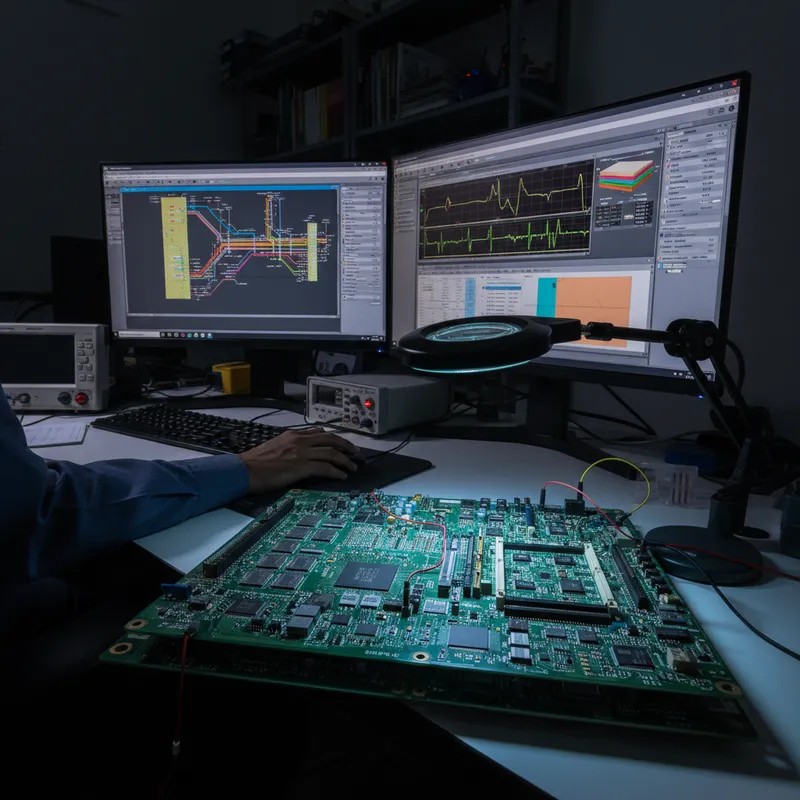
A hidden problem in any SI measurement is the fixture: the probe, the cable, the connector, the PCB trace between the DUT pad and the instrument input. Every one of those elements subtracts bandwidth and adds loss. The compliance requirement is “measured at the DUT pad”, not “measured at the scope input”. The gap is closed by de-embedding: measure the S-parameters of the fixture, invert them, and apply the inverse to the captured eye diagram.
This is where the PicoVNA 108 (also PicoVNA 106 for lower-frequency work) plays a complementary role to the scope. The PicoVNA 108 is a compact USB vector network analyzer with enough frequency range to characterize the fixtures used in typical high-speed compliance measurement. Capture the fixture S-parameters, export them as a Touchstone file, and import them into the PicoScope 9400A eye-diagram software to de-embed. The result is a DUT-plane measurement that the compliance engineer can actually defend.
PicoVNA 106 covers lower frequencies at lower cost, appropriate for USB 2.0, SATA, and PCIe Gen 1/2 fixtures.
TDR Impedance Profiling
The PicoVNA 108 also supports time-domain reflectometry (TDR) analysis via S11 inverse transformation. Capture S11 of a PCB trace or cable, transform to the time domain, and you see the impedance profile along the length of the trace. An Indian board team debugging a PCIe lane that is failing compliance can pinpoint the exact position along the trace where the impedance deviates, typically a via, a connector transition, or a stub.
Combined with the PicoScope 9400A for eye capture, the PicoVNA 108 turns a Bengaluru SoC bench into a complete SI lab at a fraction of what the equivalent Keysight / Tektronix / Rohde & Schwarz SI bench costs.
Ethernet-APL for Indian Industry 4.0
Ethernet-APL (Advanced Physical Layer) is a recent standard for running 10 Mbps Ethernet over a single twisted-pair cable, with the cable also providing DC power, aimed squarely at the process-control market where 4-20 mA current loops have dominated for decades. Indian process-industry and field-device teams in Mumbai, Pune, and Vadodara are now bringing APL-capable pressure, flow, and temperature transmitters to market.
APL compliance measurement needs a moderately fast scope (a PicoScope 6000E at 500 MHz is more than enough) plus a cable-model and loading network. The 10 Mbps line rate is low enough that deep memory and FlexRes resolution matter more than raw bandwidth, exactly the regime where PicoScope outperforms an equivalent-priced benchtop.
For a wider treatment of PicoScope signal-integrity measurement including general high-speed digital work, see PicoScope signal integrity measurement for high-speed digital.
Instrument Recommendation
For an Indian board team doing PCIe Gen 1/2 debug and USB 2.0 HS compliance: PicoScope 6000E at 1 GHz (or the 3 GHz 6428E-D for DDR debug headroom), plus the PicoVNA 106 for fixture characterization.
For an SoC or Tier-1 ECU team doing PCIe Gen 4/5 and 25G Ethernet SerDes: PicoScope 9400A sampling oscilloscope plus PicoVNA 108 for de-embedding. This combination is the practical equivalent of a Keysight/Tek SI bench at a dramatically lower cost.
For an Ethernet-APL field-device team: PicoScope 6000E at 500 MHz with the PicoScope 7 software suite and the APL loading network as an external accessory.
For a shared bench covering everything from USB 2.0 through PCIe Gen 5: PicoScope 6000E as the daily driver, PicoScope 9400A for compliance and high-lane-rate eye work, and the PicoVNA 108 for both fixture de-embedding and TDR impedance profiling.
Contact our team for a local demo at our Bengaluru, Hyderabad, Chennai, Pune, Mumbai, or Delhi NCR offices via /partners/pico-technology.
Further Reading
- Pico Technology, PicoScope 9400A Series sampling oscilloscope
- Pico Technology, PicoVNA 108 vector network analyzer
- Pico Technology, PicoScope 6000E Series high-bandwidth USB oscilloscope
- GSAS, PicoScope signal integrity measurement for high-speed digital
- GSAS, PicoScope 6000E deep dive
- GSAS, PicoScope 9400A product page
- GSAS, PicoVNA 108 product page
- GSAS, Pico Technology partner page
Also appears in:
Interested in Pico Technology tools?
Talk to our application engineers for personalized tool recommendations.
More from Pico Technology
View all →
How to Buy an Oscilloscope in India (2026): USB vs Benchtop, Bit Depth, Bandwidth: A Buying Guide
5 Jun · 11 min
PicoScope 5000D vs 5000E: Native 16-Bit or FlexRes? A Buyer's Guide for Indian Labs
4 Jun · 11 min
PicoScope 5000E in India: The World's First 4-Channel 16-Bit USB Oscilloscope, Explained
4 Jun · 11 min
PicoScope 7 Goes Native Arm64: Apple Silicon, Snapdragon Windows and Arm Linux Test Benches in India
4 Jun · 11 min
Emulating Processor Power for Thermal Testing: Why Constant Power
7 Oct · 7 min
CRPS and Rack Power Supply Testing: The Six Tests That Matter
7 Oct · 7 min