
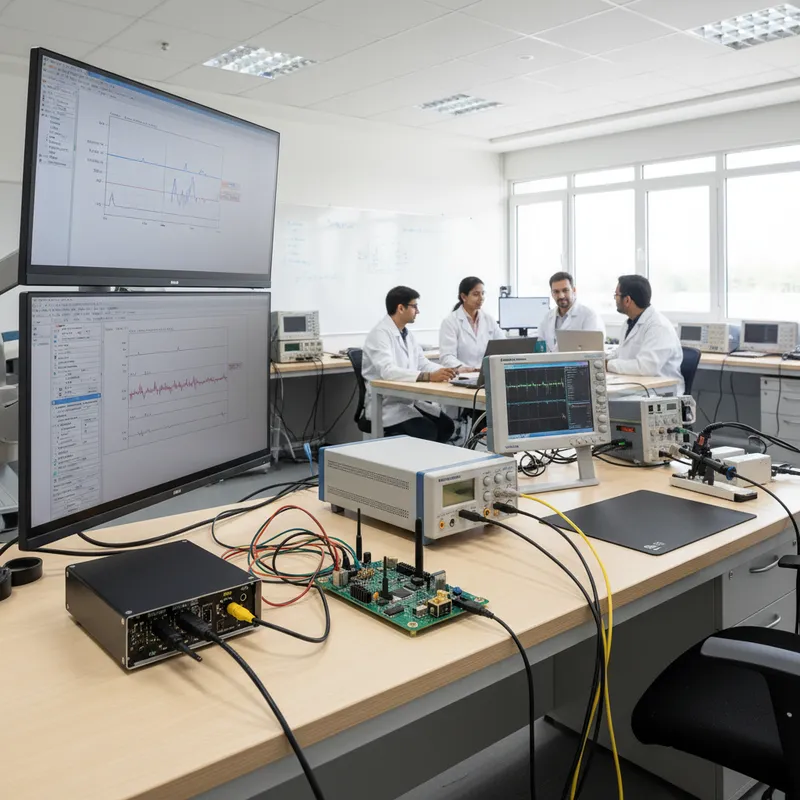
Two Pico Products That Indian RF Benches Rarely Specify: But Should
Most Indian RF and defence R&D buyers know Pico Technology as an oscilloscope vendor. When the topic turns to signal generation or pulse stimulus, procurement conversations default immediately to the benchtop catalogs from Keysight or Rohde & Schwarz, not because anyone has done a genuine comparison, but because that is the default muscle memory of an Indian RF lab. This leaves two genuinely useful Pico Technology products stranded on the wish-list: the PicoSource AS108 agile signal source and the PicoSource PG900 fast-edge pulse generator family.
Both products deliver measurement capability that matches benchtop alternatives for the specific jobs they are designed for, in a USB-connected form factor that fits an Indian RF R&D bench far more naturally than a full-width rack-mount box. This post is for RF engineering managers in Bengaluru, Hyderabad, Chennai, Pune, and Delhi NCR who want a realistic picture of where these two products fit, what they replace, and which Indian engineering contexts benefit the most.
PicoSource AS108: Agile Signal Source, 300 kHz to 8 GHz
The PicoSource AS108 is an agile USB-controlled signal source covering 300 kHz to 8 GHz. It is a synthesizer-based source with fast frequency settling, a controllable output level in the −15 to +15 dBm range, and low spurious performance suitable for use as a clean reference tone.
The “agile” part of the name is the critical feature. Traditional synthesizers can take many milliseconds to settle on a new frequency, fine for static measurements but painful for sweeping or frequency-hopping work. The AS108 settles fast enough to support applications where the source has to hop frequencies quickly: receiver sensitivity sweeps, ISM-band interference testing, and BLE or Wi-Fi channel walks.
Where the AS108 fits on an Indian RF bench:
- VNA calibration source. Pair the AS108 with a PicoVNA 108 as an external clean-tone source for power-level verification during receiver sensitivity measurements. The phase noise profile is competitive with the internal source on many benchtop VNAs.
- Spurious-free reference for receiver front-end bring-up. A typical Bengaluru-area 5G FR1 sub-8 GHz front-end team characterizing an LNA, mixer, or IF filter needs a clean tone that does not contaminate the measurement with its own spurs. The AS108 provides that clean tone at power levels useful for small-signal measurements.
- LO source for radar subsystem bring-up. For an Indian radar front-end R&D group working on a subsystem evaluation, the AS108 can substitute for a dedicated LO chain during bench characterization, letting the engineer separate the LO generator from the mixer and upconverter work without committing to the full LO build.
- BLE and Wi-Fi receiver sensitivity testing. The 2.4 GHz ISM band is entirely within the AS108’s tuning range, and the fast settling time means a receiver sensitivity sweep across all BLE channels or all 2.4 GHz Wi-Fi channels runs in a usable amount of time. This is how an IoT team in Pune characterizes a low-power Bluetooth 5.0 radio without pulling the big benchtop synthesizer out of the RF chamber.
- ISM and sub-GHz band testing. The source covers LoRa, 433 MHz industrial remote-control bands, and the 868 / 915 MHz ISM bands, all relevant to Indian industrial IoT and smart-metering work.
The honest competitive framing is this: if you already have a Keysight N5183B or an R&S SMB100B on the bench, the AS108 does not replace it, those are 20+ GHz flagship synthesizers with ultra-low phase noise that the AS108 is not targeting. But if your choice is “share the one benchtop synthesizer across six engineers in a queue” versus “give each engineer a dedicated USB source for 8 GHz-and-below work”, the AS108 is the answer for the second option.
PicoSource PG900: Sub-40 ps Edge Pulse Generator
The PicoSource PG900 family is a set of fast-edge pulse generators with transition times under 40 picoseconds on the fastest variants. A 40 ps edge has spectral content extending past 10 GHz, which is the critical property that makes the PG900 useful for time-domain reflectometry, fast-edge digital characterization, and radar pulse emulation.
Different PG900 models in the family trade off edge speed, output amplitude, and pulse-rate control. All of them are USB-controlled, compact, and sized for bench use rather than for rack mounting.
Where the PG900 fits on an Indian RF and SI bench:
- TDR stimulus for cable and PCB characterization. Pair the PG900 with the PicoVNA 108 or a PicoScope 9400A sampler for time-domain reflectometry work. A fast edge drives the cable-under-test, and the returning reflections reveal impedance discontinuities with sub-centimetre spatial resolution on short cables. An Indian interconnect supplier in Chennai or Pune shipping high-speed board-to-board cables uses exactly this setup for incoming QA.
- High-speed digital characterization, receiver testing. Many high-speed digital interfaces specify a receiver jitter tolerance test that requires a clean input signal with programmable transition times. The PG900 is suitable for those tests.
- Radar pulse emulation for subsystem R&D. Indian radar R&D teams building receiver front-ends often need a repeatable pulse stimulus to characterize receiver recovery, range-gate behaviour, and ADC over-range recovery. The PG900 provides a controllable, fast-edge pulse that can substitute for a dedicated radar pulse modulator during bench work.
- Step-recovery response characterization. For engineers characterizing step-recovery diodes, sampling bridges, or other fast-edge circuits, the PG900 provides the clean fast-edge input stimulus.
The PG900 is not a replacement for a full radar pulse modulator or a benchtop arbitrary pulse generator. It is, however, the right tool for the subset of bench work where you want a fast edge on demand, under USB control, without booking time on the big instrument.
Why These Products Are Under-Represented in Indian Procurement
There are two honest reasons the AS108 and PG900 rarely make it onto Indian RF procurement lists:
Training inertia. Most Indian RF engineers came up on Keysight or Rohde & Schwarz benchtop synthesizers and pulse generators, that is what their academic programs used and what their first jobs at Indian R&D centers exposed them to. When a new project needs a signal source, the default specification is a benchtop synthesizer because nobody on the team has hands-on time with an alternative. This is not a technical argument, it is a muscle-memory argument, but it shapes purchasing decisions.
Form-factor bias. Indian RF labs have traditionally been rack-dominated, tall 19-inch racks with a pile of benchtop instruments stacked vertically. A USB-controlled source that lives on a desk next to a laptop does not fit that mental model, even when the desk-sized solution delivers the same measurement. The move toward distributed R&D benches (one engineer, one desk, one laptop, one project) makes the USB form factor advantageous, but procurement has not fully caught up.
Neither of these is a technical limitation. Both are worth pushing back on when a new project is budgeting instruments, the USB form factor and the different cost structure genuinely change what is practical on an engineer-by-engineer basis.
Workflow Combinations: What These Products Enable
The real payoff with the AS108 and PG900 comes when they are paired with other Pico instruments on the same bench:
- AS108 + PicoVNA 108 for power-level-verified receiver sensitivity sweeps. The AS108 provides a programmable clean tone, the PicoVNA 108 characterizes the channel or matching network, and the receiver-under-test’s sensitivity is measured against a known, traceable stimulus.
- AS108 + PicoScope 9400A SXRTO for receiver characterization at the IF or baseband level. The PicoScope 9400A is a Sampler-Extended Real-Time oscilloscope with variants up to 33 GHz on the 9404A-33; it handles the receiver output while the AS108 walks the RF input across the band. For Indian 5G FR1 front-end work this pair is useful.
- PG900 + PicoVNA 108 for TDR-based cable, connector, and PCB via characterization. The PG900 provides the fast edge, and the PicoVNA 108’s S-parameter path (with inverse-FFT TDR derivation in PicoVNA 5) gives the measurement window.
- PG900 + PicoScope 9400A for fast-edge digital characterization. A receiver-under-test is driven with the PG900’s fast edge, and the scope captures the response at up to 33 GHz bandwidth on the 9404A-33 variant.
Indian Context: Where This Matters Most
The Indian engineering contexts where a PicoSource AS108 or PG900 is genuinely the right answer:
Indian RF and defence R&D benches. Government research labs and defence-adjacent R&D organizations where agile signal generation and fast-edge pulse stimulus are required as part of subsystem development. The AS108 and PG900 are suitable for Indian RF and defence R&D benches where agile signal generation and fast-edge pulse stimulus are part of the workflow, we are not claiming any specific lab uses them as its primary tool, only that the engineering fit is there for teams evaluating alternatives.
Indian 5G component developers. Front-end LNA, filter, and mixer development for sub-8 GHz FR1 bands in Bengaluru, Hyderabad, and Chennai. Receiver sensitivity testing benefits from a dedicated clean source per engineer.
Academic RF groups at Indian engineering institutes. Graduate-level RF characterization labs need usable instrumentation that can be shared across many student projects without constant calibration and re-booking. USB-native instruments are a much better fit for this use-case than shared benchtop synthesizers.
Indian radar startup companies. The small but growing community of Indian radar startups, doing imaging, automotive, and small-payload systems, need flexible, low-footprint bench instrumentation that scales with engineer headcount rather than requiring big capital commitments per seat.
Industrial ISM-band IoT in Pune and Bengaluru. Smart metering, LoRa gateways, sub-GHz industrial telemetry. An AS108 on a development engineer’s desk is the right fit for this band of work.
Instrument Recommendation
For an Indian RF startup or a lean R&D bench needing a dedicated signal source up to 8 GHz: PicoSource AS108. Pair with a PicoVNA 108 for calibrated power measurements.
For TDR, high-speed digital characterization, or fast-edge stimulus needs: PicoSource PG900 family. Pair with the PicoScope 9400A SXRTO for high-bandwidth capture.
For a full small-footprint RF bench: AS108 (source) + PG900 (pulse) + PicoVNA 108 (network analysis) + PicoScope 9400A (high-bandwidth sampling scope). This four-instrument stack is the practical Indian alternative to a full benchtop RF rack for many sub-8 GHz R&D contexts.
Further Reading
- Pico Technology, PicoSource AS108 signal source
- Pico Technology, PicoSource PG900 pulse generator series
- Pico Technology, PicoVNA 108 8.5 GHz vector network analyzer
- GSAS, PicoSource AS108 product page
- GSAS, PicoSource PG900 product page
- GSAS, PicoVNA 108 product page
- GSAS, PicoScope 9400A product page
- GSAS, PicoVNA 108 TRL calibration and de-embedding
- GSAS, Pico Technology partner page
GSAS Micro Systems is an authorized engineering partner for Pico Technology. Application advisory, demonstration, and procurement for the PicoSource AS108 and PG900 are available from our Bengaluru, Chennai, Hyderabad, Delhi NCR, Mumbai, and Pune offices.
Also appears in:
Interested in Pico Technology tools?
Talk to our application engineers for personalized tool recommendations.
More from Pico Technology
View all →
How to Buy an Oscilloscope in India (2026): USB vs Benchtop, Bit Depth, Bandwidth: A Buying Guide
5 Jun · 11 min
PicoScope 5000D vs 5000E: Native 16-Bit or FlexRes? A Buyer's Guide for Indian Labs
4 Jun · 11 min
PicoScope 5000E in India: The World's First 4-Channel 16-Bit USB Oscilloscope, Explained
4 Jun · 11 min
PicoScope 7 Goes Native Arm64: Apple Silicon, Snapdragon Windows and Arm Linux Test Benches in India
4 Jun · 11 min
Emulating Processor Power for Thermal Testing: Why Constant Power
7 Oct · 7 min
CRPS and Rack Power Supply Testing: The Six Tests That Matter
7 Oct · 7 min