
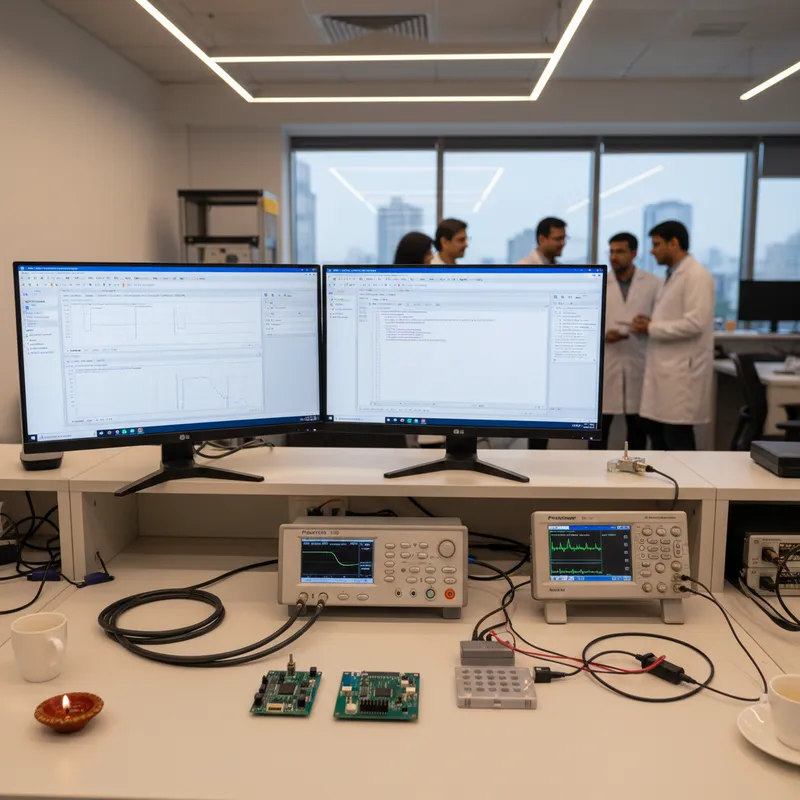
Why Indian SI Teams Run Into the Same Calibration Wall
An Indian signal-integrity engineer doing serious work on a DDR4 bring-up in Bengaluru, a PCIe Gen 4 evaluation board in Hyderabad, or a high-speed connector qualification in Pune eventually hits the same wall: their measurement is dominated not by the device under test, but by everything between the VNA’s reference plane and the DUT. Fifty millimetres of coax, an SMA launch, a via transition, a short section of stripline, a BGA landing pad, each of those contributes loss, dispersion, and reflection to the measured S-parameters. A naïve SOLT calibration at the coax tips leaves all of that fixture parasitic mashed into the result. This post explains how Indian SI teams solve that problem with the PicoVNA 108 and a fabricated TRL calibration kit.
The traditional industry answer is to buy an expensive SMT-form-factor SOLT calibration kit, one you cannot readily source in India, one that costs as much as the VNA itself, and one that only covers a specific launch geometry. The pragmatic alternative that professional SI teams actually use is Thru-Reflect-Line (TRL) calibration: you fabricate calibration standards on the same PCB stackup as the DUT, and you use the PicoVNA 108 with its PicoVNA 5 software to run a TRL cal that moves the reference plane right up to the DUT launch, with every fixture parasitic removed by design.
This post walks through the TRL workflow on the PicoVNA 108 for Indian SI teams, the fixture-design rules that make TRL actually work, the de-embedding path for downstream simulation and eye-diagram tools, and the Indian use cases where TRL pays for itself on the first project.
The PicoVNA 108 in 90 Seconds
The PicoVNA 108 is a 2-port USB-controlled vector network analyzer covering 300 kHz to 8.5 GHz. It runs over USB 3.0, is powered and controlled by PicoVNA 5 software on a host laptop, and fits in the same footprint as a PicoScope oscilloscope on an Indian SI bench. The PicoVNA 5 software covers the full calibration workflow: SOLT, TRL, enhanced-response, and fixture de-embedding via Touchstone SnP files.
Where the benchtop 4-port flagship VNAs from Keysight or Rohde & Schwarz excel at push-button automated compliance suites, the PicoVNA 108 is built around the assumption that the user knows what they want to measure and wants a compact, portable, USB-native instrument at a different price structure. For an Indian SoC bring-up team or a high-speed board design group, that tradeoff is exactly the right one.
For an introduction to PicoVNA in Indian SI work more broadly, see the PicoScope signal integrity post which covers how the PicoVNA 108 complements the PicoScope 9400A sampling scope.
What TRL Calibration Actually Does
TRL (Thru-Reflect-Line) is a self-calibrating technique: rather than using a pre-characterized calibration kit with known SOLT standards, you fabricate three standards on the same PCB stackup as the DUT fixture and let the VNA solve for the fixture’s error coefficients directly.
The three standards are:
- Thru: a zero-length (or defined-length) direct connection between the two reference planes. This is the “zero” fixture.
- Reflect: a highly reflective termination (usually a short or an open) at each reference plane. The reflection coefficient does not need to be precisely known, TRL only requires it to be symmetric between the two ports and highly reflective.
- Line: a transmission line of the same characteristic impedance as the Thru, but longer by a specific offset (typically a quarter wavelength at the center of the band of interest). Multiple Line standards extend the usable frequency range.
The mathematics of TRL extracts the error coefficients of the fixture on each side of the reference plane without ever requiring a precisely-characterized impedance standard. This is why TRL works on Indian SI benches where a commercial SMT cal kit is not practical, as long as you can etch a PCB with the required accuracy, you can calibrate to the DUT launch.
The TRL Workflow on PicoVNA 5
PicoVNA 5 software ships with a TRL calibration wizard that walks through the workflow. In practice, the steps are:
- Design the TRL kit on the DUT stackup. A Thru trace of length L1, a Reflect standard (short or open) at the reference plane, and one or more Line standards of length L1 + ΔL where ΔL is a quarter wavelength at the center of the intended band. For an 8 GHz band on a Dk ~4 FR4, ΔL is a few millimetres. For a Dk ~3 Megtron or ROGERS 4350, ΔL scales by the square root of the dielectric constant.
- Fabricate the TRL kit as part of the normal PCB run. No special process is needed. An Indian board house in Bengaluru or Delhi NCR producing the DUT board runs the TRL kit on the same panel. This is the critical cost win, the calibration standards effectively come free with the board order.
- Launch PicoVNA 5 and select TRL calibration from the calibration menu. Set the Thru, Reflect, and Line electrical offsets based on the fabricated kit. PicoVNA 5 prompts the user through each measurement.
- Measure the Thru, Reflect (at both ports), and each Line in sequence. The wizard validates each measurement and highlights any that fall outside expected bounds.
- Save the calibration to the PicoVNA 5 session. All subsequent DUT measurements are now referenced to the DUT launch, with the fixture’s loss, dispersion, and reflection mathematically removed.
A team doing this for the first time should budget half a day for the fixture design and fabrication planning, and a couple of hours on the bench for the actual calibration run. Once the workflow is proven, each new DUT project reuses the kit design and the calibration takes under an hour.
De-Embedding for Downstream SI Tools
TRL calibration moves the reference plane up to the DUT launch. The next step, for most Indian SI teams, is exporting the calibrated S-parameters as a Touchstone SnP file and feeding them into a downstream tool, HyperLynx, ADS, Sigrity, or an open-source tool like scikit-rf.
PicoVNA 5 exports 2-port S-parameters as standard Touchstone .s2p files directly from the measurement window. For cascaded analysis, where you want to characterize a connector, a cable, a PCB via, and a BGA launch as individual blocks that can be composed in simulation, you run separate TRL calibrations with the reference planes at each boundary, export each block’s S-parameters independently, and chain them in the simulation tool.
This is how a Bengaluru SoC team doing DDR4 write-level tuning uses the PicoVNA 108: measure the PCB channel from BGA to DIMM, de-embed the fixtures, export to Touchstone, feed into an IBIS-AMI simulation, and correlate the simulated eye to the PicoScope 9400A’s measured eye. When the simulation and the measurement disagree, the fixture de-embedding is usually the weak link, and a TRL cal with carefully designed standards tightens the correlation substantially.
Indian Use Cases: Where TRL Pays For Itself
PCB via and trace characterization for SoC teams. A team in Bengaluru doing DDR4 or DDR5 bring-up on a new SoC evaluation board needs per-lane insertion-loss and return-loss data from the BGA to the memory device. TRL lets them measure the channel on a test coupon, de-embed the BGA landing pad, and export the clean S-parameters for eye-diagram simulation. This is not work you can do with a SOLT cal at the coax tips, the BGA pad has too much parasitic to ignore.
Connector and cable characterization for interconnect OEMs. Indian OEMs shipping M.2, SFP+, QSFP28, or USB-C cable assemblies into the server and networking market need per-part S-parameters to demonstrate conformance. A TRL calibration with the test fixture built on the connector vendor’s evaluation PCB gives the OEM a per-part Touchstone file that can be submitted to customers or used internally for binning.
RF launch characterization for 5G front-end evaluation. A 5G mmWave team in Hyderabad or Chennai doing sub-8 GHz FR1 front-end characterization can use the PicoVNA 108 (at 8.5 GHz bandwidth, it covers all of FR1) with a TRL cal on a stripline-to-coax launch to separate the launch parasitic from the amplifier or filter under test. This is the same workflow the big OEM SI labs use, the tool is just more accessible.
Cable fault diagnosis via time-domain reflectometry. PicoVNA 5 supports TDR analysis derived from the inverse Fourier transform of S11. For an Indian industrial harness vendor in Pune or a defence interconnect supplier in Delhi NCR, this turns the PicoVNA 108 into a cable-fault locator with sub-centimetre resolution on short cables.
Pairing with the PicoScope 9400A for TX compliance. The combined workflow, PicoVNA 108 for channel S-parameter capture, feed the S21 back into the PicoScope 9400A SXRTO’s measurement flow for an accurate de-embedded TX eye diagram, is how high-speed SerDes compliance is done without buying a full Keysight or Tek SI rack. The PicoScope 9400A is a sampler-extended Real-Time oscilloscope with variants up to 33 GHz on the 9404A-33, and the 12-bit resolution plus the PicoVNA 108 de-embedded channel model delivers a compliance-grade eye at a very different cost structure.
Fixture Design Rules That Make TRL Work
TRL is powerful, but it is also unforgiving. A fixture that fails to meet the following rules will produce a calibration that looks clean but produces garbage DUT measurements:
- Uniform characteristic impedance across the Thru and Line standards. If the trace width wanders by 5 mils between the Thru and the Line, the TRL math silently fails. Specify tight trace-width tolerance on the fab drawing.
- The Line standard’s electrical length offset should land in the sweet spot of each band segment. A single Line is good for roughly an octave of bandwidth. For the full 300 kHz – 8.5 GHz range of the PicoVNA 108, you typically need two or three Line standards.
- The Reflect standard should be genuinely reflective. A short-circuited via stub works well on most PCB stackups; an open-circuit line-end works but is more susceptible to radiation losses at the top of the band.
- Symmetry between ports. Port 1 and Port 2 sides of the Thru should be electrically identical. Asymmetry leaks into the extracted error terms.
- Controlled return path. Keep reference planes continuous under the calibration standards. Split planes or anti-pad discontinuities will ruin the Line standard.
For Indian SI teams new to TRL, the smart first project is to build a simple characterization coupon alongside your next normal PCB fab run, run the TRL calibration, and compare the de-embedded result against a vendor-supplied connector or line model. The correlation work is where you learn what actually matters on your specific stackup.
Instrument Recommendation
For most Indian SI teams doing DDR, PCIe Gen 1/2/3, USB 3.x, and 5G FR1 sub-8 GHz work: The PicoVNA 108 is the right tool. 8.5 GHz bandwidth, USB 3.0, TRL support, Touchstone export.
For teams that need to go above 8.5 GHz: PCIe Gen 4/5 channel characterization, 25G or 28G Ethernet SerDes, mmWave FR2, the PicoVNA 108 is not the right tool; that work needs a higher-bandwidth benchtop VNA. But the TRL workflow documented here translates directly to any modern VNA, and the PicoVNA 108 is an excellent place to develop the discipline before scaling up.
For the complete SI bench: pair the PicoVNA 108 with the PicoScope 9400A SXRTO for eye-diagram measurement and the PicoScope 6000E for real-time mid-rate SI debug.
Further Reading
- Pico Technology, PicoVNA 108 8.5 GHz vector network analyzer
- Pico Technology, PicoVNA 5 software
- Pico Technology, PicoScope 9400A Series SXRTO
- GSAS, PicoVNA 108 product page
- GSAS, PicoVNA 106 product page
- GSAS, PicoScope 9400A product page
- GSAS, PicoScope signal integrity for USB, PCIe, DDR, and Ethernet-APL
- GSAS, Pico Technology partner page
GSAS Micro Systems is an authorized engineering partner for Pico Technology. PicoVNA 108 hardware, TRL calibration advisory, and fixture design reviews are available from our Bengaluru, Chennai, Hyderabad, Delhi NCR, Mumbai, and Pune offices.
Also appears in:
Interested in Pico Technology tools?
Talk to our application engineers for personalized tool recommendations.
More from Pico Technology
View all →
How to Buy an Oscilloscope in India (2026): USB vs Benchtop, Bit Depth, Bandwidth: A Buying Guide
5 Jun · 11 min
PicoScope 5000D vs 5000E: Native 16-Bit or FlexRes? A Buyer's Guide for Indian Labs
4 Jun · 11 min
PicoScope 5000E in India: The World's First 4-Channel 16-Bit USB Oscilloscope, Explained
4 Jun · 11 min
PicoScope 7 Goes Native Arm64: Apple Silicon, Snapdragon Windows and Arm Linux Test Benches in India
4 Jun · 11 min
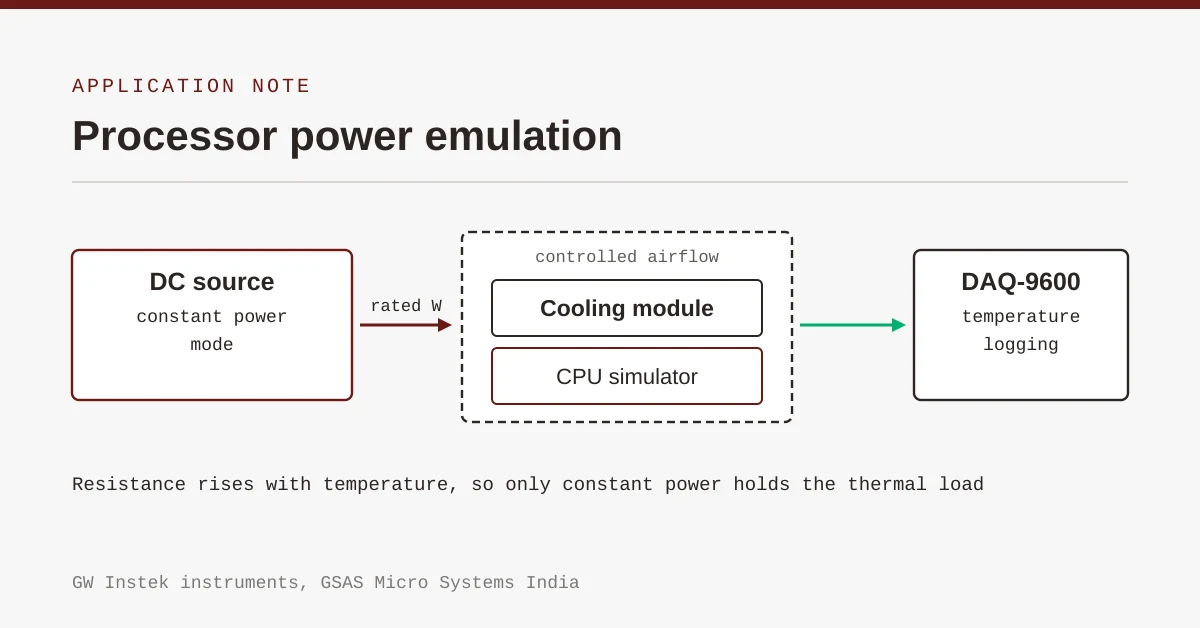
Emulating Processor Power for Thermal Testing: Why Constant Power
7 Oct · 7 min
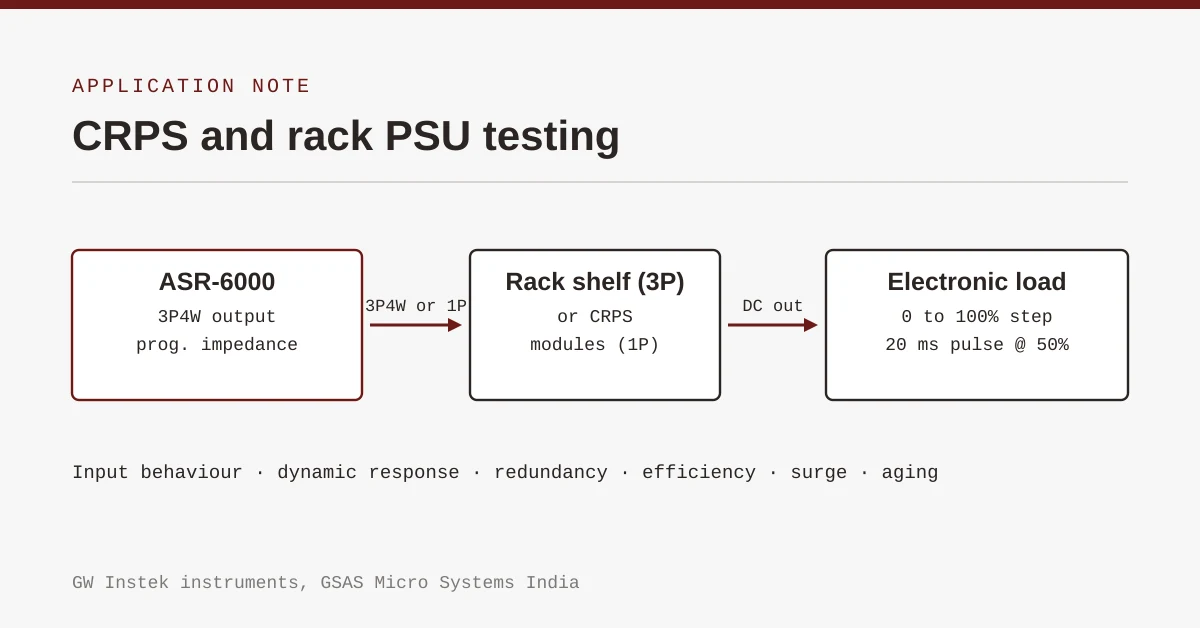
CRPS and Rack Power Supply Testing: The Six Tests That Matter
7 Oct · 7 min