The NPI-to-Production Programming Gap
New Product Introduction (NPI) is the critical transition phase where an electronics product moves from engineering development to manufacturing. During NPI, the firmware programming process must be validated: correct firmware versions, proper programming sequences, security provisioning, verify operations, and traceability logging, all confirmed on actual production boards before volume manufacturing begins.
Many Indian electronics manufacturers struggle with this transition because their NPI programming tools are disconnected from their production programming tools. Engineering uses JTAG debuggers and development kits. Production uses inline gang programmers. The programming recipes do not transfer between them, requiring re-creation and re-validation for each new product.
ProMik’s XTL family solves this with a modular system architecture where the XTL-m (manual station) and XTL-s (compact inline system) share identical project files, fixtures, and programming engines with the fully automated XTL-i.
XTL-m: The Manual Programming Station
The XTL-m is a compact desktop programming station designed for NPI, engineering sample builds, rework, and low-volume/high-mix production. Its 600 x 400 mm footprint fits on an engineering bench or a production workstation.
Key Features
| Feature | Specification |
|---|---|
| Type | Manual / semi-automated desktop |
| Footprint | 600 x 400 mm |
| Fixture Changeover | Under 2 minutes |
| Throughput | 400+ ECUs per 8-hour shift |
| Operation | One-button with status indicators |
| Scanner | Optional barcode/QR reader |
| Traceability | FlashTask Pro with pass/fail logging |
The operator loads a board into the fixture, presses a single button, and the XTL-m programs and verifies all target devices. Clear status indicators (pass/fail LEDs) provide immediate feedback. Optional barcode scanner integration captures board serial numbers for traceability.
Quick-change fixtures swap in under two minutes, supporting high-mix environments where multiple products share the same programming station. The same fixtures used on the XTL-m work on the XTL-s and XTL-i, an investment that scales across the entire production lifecycle.
NPI Workflow
During NPI, the engineering team uses the XTL-m to:
- First-article programming: program the first production boards with validated firmware and verify correct operation
- Programming recipe validation: confirm that FlashTask project settings (erase, program, verify, lock sequences) produce correctly programmed boards
- Fixture validation: verify mechanical contact between the fixture’s spring-loaded probes and the board’s programming test points
- Traceability setup: configure serial number assignment, pass/fail logging, and production reporting
- Cycle time measurement: establish baseline programming cycle times that inform production planning
XTL-s: The Compact Inline System
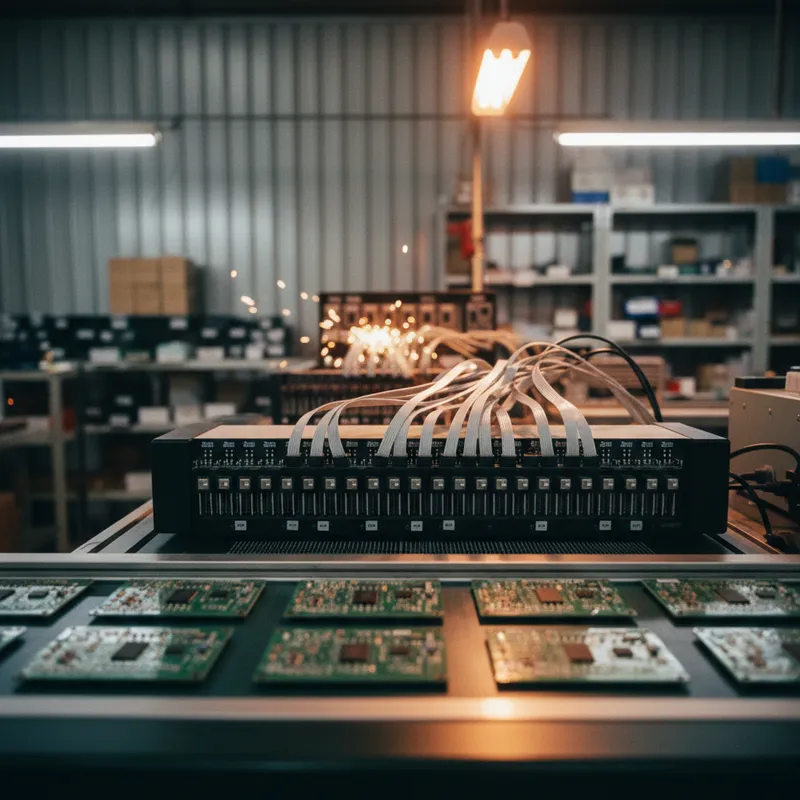
The XTL-s bridges the gap between the manual XTL-m and the fully automated XTL-i. It provides inline conveyor integration in a reduced footprint, designed for SMT production lines where floor space prevents a full-size XTL-i installation.
Key Features
| Feature | Specification |
|---|---|
| Type | Compact semi-automated inline |
| Conveyor | SMEMA-compatible |
| Throughput | 800+ ECUs per 8-hour shift |
| Verification | Automatic read-back comparison |
| MES | OPC-UA, REST API |
| Traceability | FlashTask Pro with serial number logging |
The XTL-s sits in the SMT line between upstream and downstream equipment. Boards flow through on the SMEMA-compatible conveyor. Programming, verification, and pass/fail routing happen automatically. The compact footprint fits production environments that cannot physically accommodate the larger XTL-i.
When to Choose XTL-s Over XTL-i
The XTL-s is the right choice when:
- Floor space is constrained: the production line layout cannot accommodate the XTL-i’s larger footprint
- Throughput requirements are moderate: 800+ ECUs per shift is sufficient (vs 1,200+ for the XTL-i)
- Semi-automated handling is acceptable: some manual board loading may be needed depending on board geometry
- Budget constraints: the XTL-s provides inline capability at a lower investment than the XTL-i
For Indian EMS providers and mid-volume manufacturers in Bengaluru, Chennai, and Pune who are transitioning from offline programming to inline programming for the first time, the XTL-s is often the appropriate entry point.
The Scalability Path
ProMik’s modular architecture enables a clear scalability path as production volumes grow:
Stage 1: Development and NPI (XTL-m)
Start with the XTL-m for firmware development programming and NPI validation. Develop FlashTask projects, validate fixtures, and establish programming recipes. The XTL-m handles engineering sample builds and first-article production.
Investment: single desktop station, FlashTask Pro license, target-specific fixtures.
Stage 2: Initial Production (XTL-s)
As production volumes ramp, deploy the XTL-s on the SMT line. The same FlashTask projects and fixtures from the XTL-m transfer directly, zero re-validation. Inline programming eliminates the offline bottleneck and provides automatic verification with MES integration.
Investment: XTL-s system, SMEMA conveyor integration, MES connectivity setup.
Stage 3: High-Volume Production (XTL-i)
At full production volume, upgrade to the XTL-i for fully automated inline programming with 1,200+ ECUs per shift, sub-60-second fixture changeover, and complete reject handling. Again, the same FlashTask projects and fixtures transfer without modification.
Investment: XTL-i system, automated fixture changeover mechanism, full MES integration.
Stage 4: Multi-Line Deployment
Large manufacturers deploy different XTL systems on different lines based on volume and space requirements. The XTL-m serves as the NPI and rework station. The XTL-s handles space-constrained secondary lines. The XTL-i runs on primary high-volume lines. All share fixtures, projects, and traceability infrastructure.
Shared Programming Engines
All XTL systems accept the same ProMik programmers:
- MSP2300Net: multi-protocol programmer for broad MCU and flash device coverage
- XDM-ETH: automotive Ethernet programmer for next-gen ECUs
- XDM-USB: USB 3.0 programmer for desktop environments
The programming engine is interchangeable across XTL systems. An MSP2300Net configured for a specific product works identically in the XTL-m, XTL-s, and XTL-i.
Applications in Indian Manufacturing
- Automotive tier-1 suppliers scaling from NPI to volume production of ECUs in Pune, Chennai, and Bengaluru
- EMS contract manufacturers handling multiple customers with frequent product changeovers in Noida, Mumbai, and Hyderabad
- Two-wheeler OEMs ramping production of motor controllers and BMS units
- Industrial electronics manufacturers in Bengaluru and Pune producing inverters, drives, and control modules
Why Buy from GSAS
GSAS Micro Systems is the authorised ProMik engineering partner in India, providing XTL-m and XTL-s systems with fixture sourcing, FlashTask Pro configuration, and production line integration support. Engineering teams in Bengaluru, Hyderabad, Chennai, Pune, Mumbai, Delhi NCR, and Visakhapatnam guide manufacturers through the NPI-to-production programming transition.
Explore the XTL-m, XTL-s, and XTL-i, or contact us for system evaluation and production planning consultation.
Also appears in:
Interested in ProMik tools?
Talk to our application engineers for personalized tool recommendations.
More from ProMik
View all →
Automotive ECU Programming and Traceability: Meeting IATF 16949 with ProMik
5 Apr · 7 min
Scaling Electronics Manufacturing in India: Programming Infrastructure for Growth
5 Apr · 7 min
FlashTask Pro: Production Programming Project Management with ProMik
5 Apr · 7 min
Gang Programmer vs Inline ISP: Choosing the Right Production Programming Approach
5 Apr · 7 min
Emulating Processor Power for Thermal Testing: Why Constant Power
7 Oct · 7 min
CRPS and Rack Power Supply Testing: The Six Tests That Matter
7 Oct · 7 min