In short
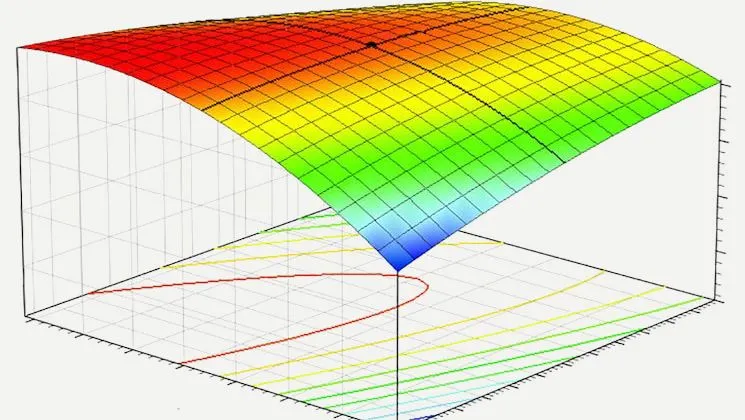
HyperLynx Design Space Exploration (DSE) optimises a PCB design without simulating every combination of variables: it runs a few combinations, builds a surrogate model of how the design responds, uses that model to choose the next runs, and repeats until it converges on the best results.
Every PCB has more knobs than anyone has time to turn. Trace width and length, via spacing, pad sizes and so on: a handful of variables, each with a realistic range, multiplies into millions of combinations. Nobody simulates them all. Most teams try a few variations, pick the one that passes, and move on, without knowing how far from the best design they stopped.
A January 2026 Siemens EDA article explains how HyperLynx Design Space Exploration (DSE) attacks that problem. This post walks through the method and what you need to define to run a study. The original article is linked under References.
Defining the problem
Design space exploration is the search for the combination of variable values that best meets your design goals. Before any simulation runs, you define four things:
| You define | Siemens’ term | Example |
|---|---|---|
| The range of each variable to explore | Design space | Trace width from one value to another |
| The output metrics used to compare designs | Responses | Insertion loss, eye height, impedance |
| The response values that mean pass or fail | Design targets | A limit the channel must meet |
| Whether each response should go up or down | Design goals | Maximise margin, minimise loss |
Writing these down is useful on its own. A team that cannot state its targets and goals does not have an optimisation problem yet; it has a debate.
How HyperLynx DSE searches
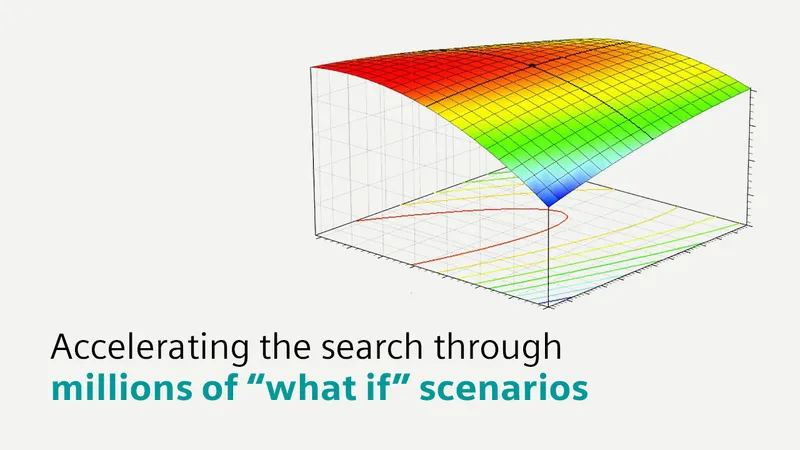
HyperLynx DSE uses Siemens’ HEEDS optimisation software as its exploration engine. Instead of sweeping every permutation, it builds a mathematical surrogate model of how the design responds across the parameter space, called a response surface model, and uses it to decide where to look next. Siemens describes the loop as:
- Try a few combinations first.
- Learn the relationship between the design variables and the electrical behaviour, and build a multidimensional model from it.
- Adjust the model using the results of the previous study.
- Predict the shape of the model and run the next study.
- Repeat until it converges on the best results.
The SHERPA algorithm guides that search. It explores the full design space so the model does not get trapped in a local minimum or maximum, but it learns from the initial runs and prunes unpromising paths, so it does not need to simulate every combination. As it learns how the variables affect the results, it picks better points and converges faster.
What it changes in practice
Siemens makes three practical claims for the approach:
- Engineers with very little optimisation experience can use HyperLynx DSE to find optimal designs in a fraction of the time a handful of manual iterations would take.
- The efficiency can “save days or even weeks of CPU time” in common optimisation studies.
- The result is a substantially more optimised design than is possible without these methods.
The second point matters most for teams that share a simulation server. A study that converges in fewer runs frees the machine for everyone else’s sign-off work.
DSE is not limited to signal integrity. In Siemens’ power electronics workflow, DSE launched from HyperLynx AMS explores feedback resistor values in a switch-mode supply; see our power electronics workflow post. For where DSE sits among the other HyperLynx analyses, see HyperLynx: six analysis disciplines in one platform.
Working with GSAS
GSAS supports the Siemens EDA portfolio in India, including HyperLynx and DSE, with local application engineers who can help you frame the first study: which variables to free, which responses to measure and what targets are realistic. Talk to us from Bengaluru, Hyderabad, Chennai, Pune, Mumbai or Delhi NCR.
References
- Siemens EDA, Electronic Systems Design blog: Accelerating the search through millions of “what if” scenarios (26 January 2026)
- Siemens EDA: HyperLynx Design Space Exploration
- Siemens: HEEDS
- HyperLynx and the Siemens EDA partner page at GSAS
Also appears in:
Interested in Siemens EDA tools?
Talk to our application engineers for personalized tool recommendations.
More from Siemens EDA
View all →
HyperLynx 2610: What's New for India's Signal and Power Integrity Teams
4 Nov · 6 min
Simulation-Based FMEDA: HyperLynx AMS and Xpedition in the Functional Safety Workflow
4 Nov · 5 min
FMI Co-Simulation in HyperLynx AMS and PartQuest Explore: Electrical, Mechanical and Thermal Models in One Run
4 Nov · 5 min
Right-Sizing Decoupling on AMD Versal Boards with HyperLynx PI
4 Nov · 5 min
From Trial and Error to Optimisation: A HyperLynx Workflow for Power Electronics Design
4 Nov · 6 min

Keil Studio for VS Code: A Four-Part GSAS Webinar Series for Cortex-M Teams
4 Nov · 5 min