The Case for EMC Pre-Compliance Before the Chamber
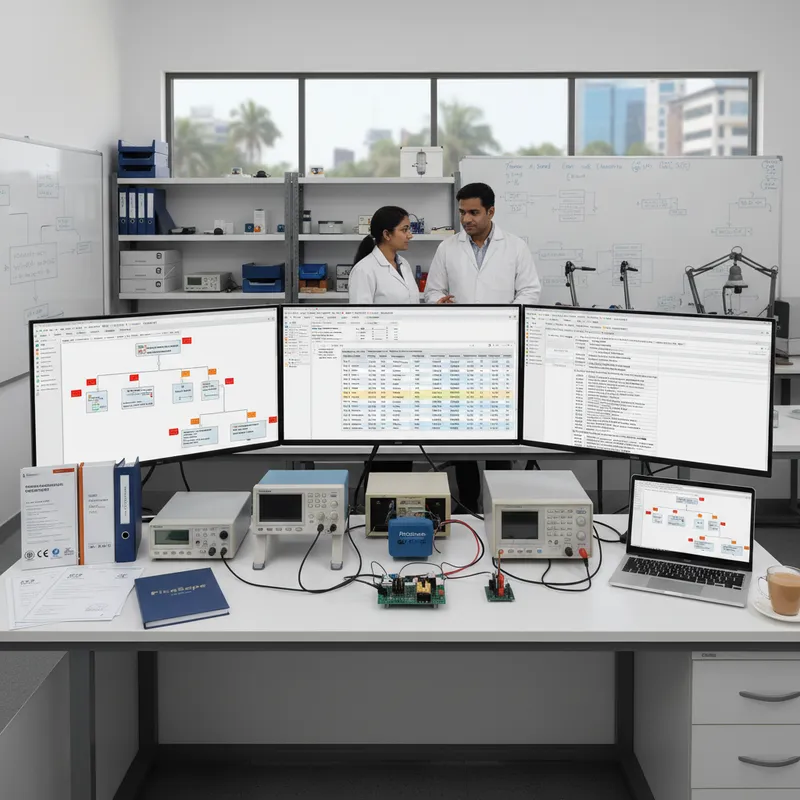
In the Indian electronics ecosystem the same question keeps coming up from EV battery management teams in Bengaluru, solar inverter OEMs in Gujarat, and medical device teams in Chennai and Hyderabad: how do we stop failing EMC at the formal chamber, again? Chamber time is expensive and scheduled weeks in advance. Fixing a conducted-emissions failure inside the chamber, shimming ferrites, adding Y-caps, re-routing a loop, is possible but painful. Fixing the same failure back at the bench, before the vehicle leaves for the lab, is roughly ten times cheaper.
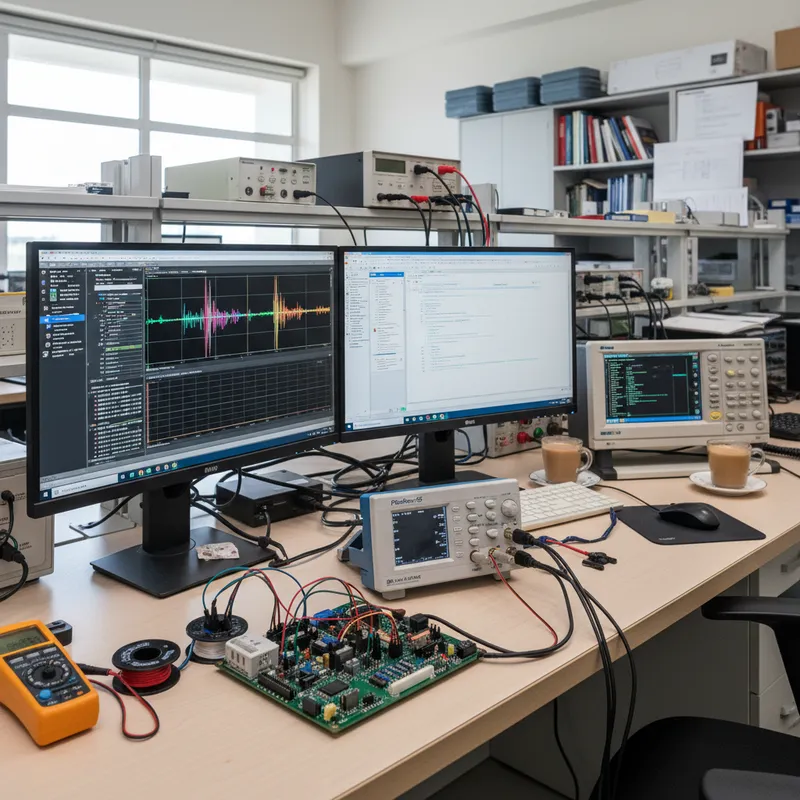
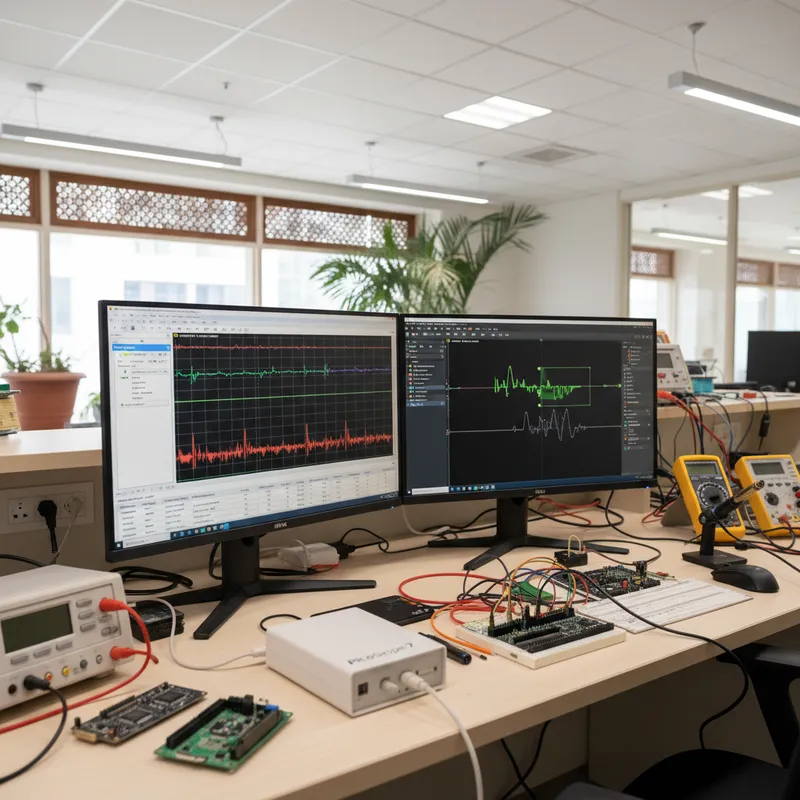
The way out is EMC pre-compliance. Build a small in-house measurement setup, PicoScope, HFCT probe, LISN, differential probe, that catches failure modes before the unit under test is ever boxed for the chamber trip. This post walks through three of the highest-value pre-compliance workflows and why PicoScope’s deep-memory FFT and true differential inputs are well matched to each.
Why Pre-Compliance Is Specifically Hard in India
Two factors make EMC pre-compliance harder for Indian product teams than it is for their European peers. First, accredited chamber slots in Bengaluru, Pune, and Delhi NCR are booked weeks out and the round-trip shipping of a bulky prototype adds days. Second, the Indian compliance surface is broader, BIS, AIS-004 and AIS-004-Part-3 for automotive, CEA guidelines for grid-tied inverters, CDSCO for medical devices, plus the export-market targets of CE, UKCA, FCC, and IEC 61000. Every slip at the chamber multiplies.
The answer is a bench-side PicoScope EMC setup that lives in the same lab as the design engineers. It does not replace the accredited chamber, it filters out the obvious failures before the chamber even sees the unit.
Workflow 1: Partial Discharge Measurement on HV Insulation
Partial discharge (PD) is a small, localized electrical breakdown inside an insulation system, a void in a cast resin, a crack in a motor winding, a delamination in a power-electronics busbar. Every PD event is a tiny fast-rising current pulse, typically in the nanosecond to microsecond range, and every one of them is slowly chewing up the insulation. Catching PD early is the difference between a twenty-year traction motor and a five-year warranty claim.
HFCT Probe + PicoScope
The standard PD measurement tool is a high-frequency current transformer (HFCT) clamped around the ground lead of the device under test. An HFCT is a wideband CT, typical useful range from a few hundred kHz to tens of MHz, that passes the PD pulse through with minimal distortion. Pair the HFCT with a fast PicoScope (the PicoScope 6000E in its 500 MHz, 1 GHz, or 3 GHz FlexRes variants is the common choice for PD research, though a PicoScope 5000D works fine for screening) and you have a PD acquisition chain.
Because PD pulses are infrequent and unpredictable, deep memory matters. A PicoScope 6000E with hundreds of megasamples of memory lets the engineer capture a full 50 Hz power cycle at full bandwidth and still have enough samples to resolve individual PD pulses. A benchtop scope with a few megasamples of memory has to choose between bandwidth and record length, you see a pulse or you see the cycle, but not both.
Phase-Resolved PD Patterns
The output is a phase-resolved partial discharge (PRPD) pattern: a plot of PD pulse amplitude against the 50 Hz phase angle. Indian traction motor suppliers, dry-type transformer manufacturers in Vadodara, and high-voltage inverter teams use PRPD patterns to tell internal voids from surface tracking from corona. PicoScope’s waveform math and streaming mode let the engineer build a PRPD plot in custom software without a dedicated PD instrument.
Workflow 2: Mains Harmonic Measurement for IEC 61000-3-2
Any product that draws more than a few amps from the Indian mains is subject to IEC 61000-3-2 (for export) and equivalent BIS harmonic limits. The standard caps the current distortion the product is allowed to push back into the supply. A power-factor-corrected boost stage does fine; a capacitor-input rectifier on a large consumer appliance or an unoptimized LED driver typically fails.
The Differential Front End
Measuring mains current cleanly requires a differential probe or a galvanically isolated current sensor. PicoScope’s 4444 is a 4-channel true differential 12/14-bit USB oscilloscope; paired with the PicoConnect 442 attenuating differential probe rated to 1000 V CAT III, it reaches the isolation budget Indian mains-measurement workflows need. That means the engineer can measure phase current and phase voltage simultaneously without building a floating ground, without creating a shock hazard, and without introducing the common-mode errors that a single-ended scope plus passive probe produces on mains work.
FFT-Based Harmonic Analysis
PicoScope 7 includes an FFT math channel. Capture one second of the mains current waveform with the 4444, apply a Hanning window, run the FFT, and the harmonics appear as discrete peaks at 50, 100, 150, 200, 250 Hz and so on. IEC 61000-3-2 defines the Class A/B/C/D limit at each harmonic; the engineer reads the FFT peaks against the table and either ships or goes back to redesign the front end.
This is pre-compliance, not accredited compliance, the accredited test uses a calibrated power analyzer and a standards-compliant source impedance. But it catches the obvious cases weeks before chamber time. For the full conducted-emissions treatment see PicoScope EMC pre-compliance conducted emissions.
Workflow 3: Conducted Emissions Pre-Screening with a LISN
Conducted emissions: the noise a product radiates back into its power cable, is the most common EMC chamber failure mode for Indian power electronics and consumer products. The standard frequency range is 150 kHz to 30 MHz (CISPR 32 / CISPR 11).
LISN + PicoScope FFT
A LISN (line impedance stabilization network) sits between the product under test and the mains. It presents a defined, standard impedance to the product at EMC frequencies and gives the engineer a 50-ohm RF output port that carries the noise the product is injecting onto its power lead. Connect that 50-ohm port to a PicoScope 6000E, capture a few seconds of data at 250 MS/s, run the FFT, and the conducted emissions spectrum appears. Compare against the CISPR mask for the target class and the engineer knows whether the product passes or needs more filtering.
Again, pre-compliance, not accredited. But the difference between “we know it’s 10 dB over at 2 MHz” and “the chamber told us it fails somewhere” is worth many days of schedule.
Peak vs Quasi-Peak vs Average
A standards-compliant EMC receiver measures peak, quasi-peak, and average detectors separately. A PicoScope’s FFT gives you the spectrum; building proper quasi-peak weighting requires additional post-processing in the pyPicoSDK or in a MATLAB/Python script. For pre-compliance the peak FFT is usually enough to localize the problem frequency and identify the filter change needed.
The CMRR Discipline
Every instrumentation measurement depends on common-mode rejection (CMRR). The PicoScope 4444 publishes its CMRR against frequency; an engineer choosing a differential probe for EV or inverter work has to compare the probe’s CMRR against the common-mode voltage the measurement point actually sees. A high-side gate-source measurement on a 400 V bus with a 100 kHz switching frequency demands orders of magnitude more rejection than a thermocouple measurement on a heatsink.
The same CMRR discipline applies to LISN-based conducted-emissions work and to HFCT-based PD work. Check the probe’s CMRR specification, check the common-mode voltage at the measurement point, and budget the resulting error against the measurement margin. If the error eats the margin, pick a better probe.
Instrument Recommendation
For EV battery and inverter EMC pre-compliance: PicoScope 4444 for differential mains and phase measurement, plus a PicoScope 6000E for the high-bandwidth conducted-emissions and PD work. The 6000E’s FlexRes mode trades sample rate for extra resolution bits, useful when spectrum-hunting for a weak harmonic buried in a strong carrier.
For solar inverter and grid-tied work in Gujarat: PicoScope 4444 is the primary instrument; a LISN rated for the product’s current draw is the critical external accessory.
For medical device pre-screening in Bengaluru and Hyderabad: PicoScope 5000D FlexRes is usually enough for IEC 60601-compliant harmonic screening at lower cost, with a 4444 on the side for differential mains measurement.
For a local demo at our Bengaluru, Pune, Mumbai, Delhi NCR, or Chennai office, see /partners/pico-technology.
Further Reading
- Pico Technology, PicoScope 4444 differential oscilloscope
- Pico Technology, PicoScope 6000E Series overview
- Pico Technology, Partial discharge measurement with PicoScope (application note library)
- GSAS, PicoScope EMC pre-compliance conducted emissions
- GSAS, PicoScope 4444 product page
- GSAS, PicoScope 6000E deep dive
- GSAS, EV and energy systems solutions
- GSAS, Pico Technology partner page
Also appears in:
Interested in Pico Technology tools?
Talk to our application engineers for personalized tool recommendations.
More from Pico Technology
View all →
How to Buy an Oscilloscope in India (2026): USB vs Benchtop, Bit Depth, Bandwidth: A Buying Guide
5 Jun · 11 min
PicoScope 5000D vs 5000E: Native 16-Bit or FlexRes? A Buyer's Guide for Indian Labs
4 Jun · 11 min
PicoScope 5000E in India: The World's First 4-Channel 16-Bit USB Oscilloscope, Explained
4 Jun · 11 min
PicoScope 7 Goes Native Arm64: Apple Silicon, Snapdragon Windows and Arm Linux Test Benches in India
4 Jun · 11 min
Emulating Processor Power for Thermal Testing: Why Constant Power
7 Oct · 7 min
CRPS and Rack Power Supply Testing: The Six Tests That Matter
7 Oct · 7 min