
Most production programming toolchains are purchased for a single lifecycle stage. Development teams buy bench programmers for prototyping. Manufacturing engineers specify inline systems for series production. Repair depots procure standalone flash tools for rework. Each stage operates with different hardware, different software, and different configuration, and every transition between stages means rebuilding the programming setup from scratch.
ProMik takes a fundamentally different approach: a standardized toolchain that spans the entire product lifecycle, from development through sample build, series production, and repair. The hardware and software invested in at the development stage carry forward through every subsequent phase, eliminating redundant procurement and configuration work.
Four Lifecycle Stages, One Toolchain
ProMik’s toolchain architecture maps to four distinct stages of the product lifecycle:
Development
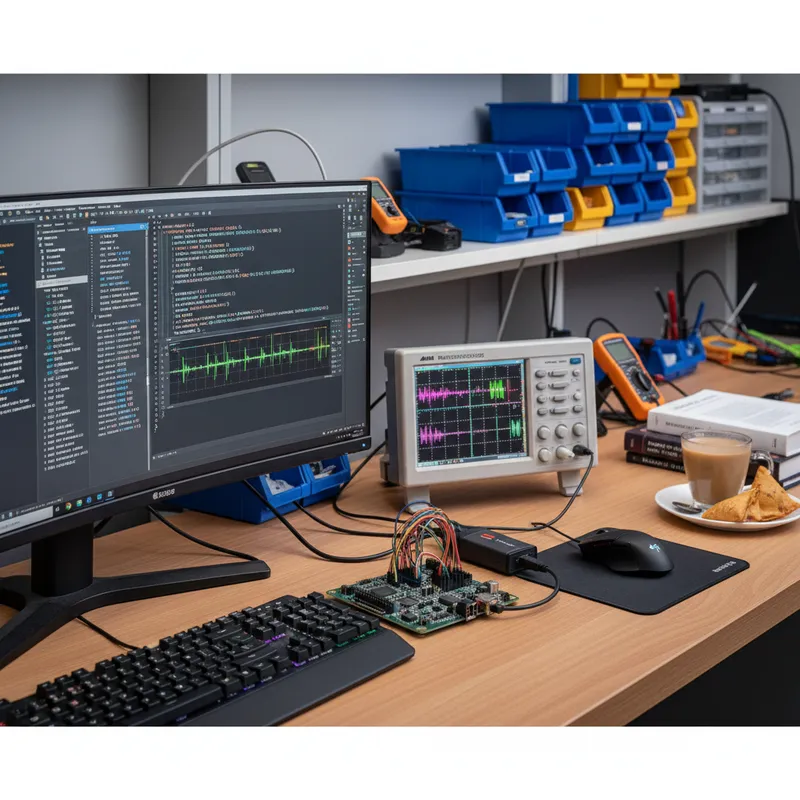
The lifecycle begins with consulting for design for manufacturing (DFM), where ProMik’s engineers work with the customer’s hardware team to ensure that programming and test access points are correctly placed, interfaces are routed for signal integrity, and the PCB layout accommodates production fixturing. Development tools, including ProMik’s MSP2100Net and XDM-USB programmers, handle firmware bring-up, debugging support, and initial programming workflow development.
Sample Build
As the product moves from development into sample build and NPI (new product introduction), ProMik provides ramp-up support and development support for software changes that inevitably emerge during early production runs. MES connectivity and cybersecurity provisioning are configured at this stage, establishing the traceability and security infrastructure before series production begins.
Series Production
In series production, the emphasis shifts to speed and reliability. ProMik delivers optimized software for the fastest flash and test times, the same algorithms and device support libraries from development, refined for production throughput. The fixtures used during development and sample build are compatible with series production systems like the XTL-i and XTL-s, so fixture investment carries forward. MES connectivity provides complete traceability for every unit programmed.
Repair, Rework, and Reflash
Products return from the field for repair, rework, or reflash, whether for firmware updates, cybersecurity credential rotation, or defect remediation. ProMik’s toolchain supports cybersecurity rework and re-flash solutions using the same software and device configurations that were established during production, ensuring that repaired units are programmed to the same standard as new production.
Hardware and Software Reuse Across Stages
The architectural principle underlying ProMik’s lifecycle approach is hardware and software reuse from development to sample build to series. The FlashTask Pro software environment, the device algorithm libraries, and the programming configurations created during development are the same assets deployed in series production. When a development engineer validates a programming sequence on an MSP2100Net at the bench, that sequence runs without modification on an XTL-i inline system at the production line.
This reuse eliminates the re-validation effort that typically accompanies each lifecycle transition. There is no “porting” step, no re-qualification of a different tool vendor’s software, and no risk of subtle behavioral differences between development and production programming environments.
Core Design Principles
ProMik’s toolchain architecture reflects several deliberate design decisions:
IP protection: Programming algorithms, firmware images, and cybersecurity keys are managed with appropriate access controls across all lifecycle stages. The same IP protection mechanisms that secure production programming apply to development and repair.
Modular design: One hardware platform handles flash programming, functional test, cybersecurity key injection, and MES integration. This modularity eliminates the need for separate instruments at each lifecycle stage.
Flexibility: The toolchain scales from desktop configurations for development and repair, to inline systems for high-volume production, to compact systems for small-scale and ramp-up scenarios. The XTL-m serves NPI and rework, the XTL-s handles compact inline requirements, and the XTL-i addresses full-scale series production.
Ease of integration: ProMik’s architecture places the programmer outside the fixture, simplifying mechanical integration and enabling fixture changes without disturbing the programming hardware. This separation of fixture from programmer is what makes cross-stage fixture compatibility practical.
The Business Case for Lifecycle Reuse
The benefits of a standardized toolchain across the product lifecycle are concrete:
- Faster production cycles: No re-qualification or re-configuration when transitioning between lifecycle stages
- High reusability across projects: Programming hardware, software, and fixtures serve multiple product programs, amortizing the toolchain investment across a broader base
- Optimized for both inline and offline processes: The same toolchain architecture adapts to high-volume inline production and low-volume offline scenarios without requiring parallel tool ecosystems
Why This Matters for Indian Manufacturing Teams
India’s electronics manufacturing ecosystem increasingly handles the full product lifecycle, from design services and NPI through series production and after-sales repair. A toolchain that spans this entire lifecycle, with genuine hardware and software reuse at each stage, reduces total cost of ownership and simplifies the engineering organization’s tool management burden.
GSAS Micro Systems is the authorized ProMik engineering partner in India, supporting teams across Bengaluru, Hyderabad, Chennai, Pune, Mumbai, Delhi NCR, and Visakhapatnam with ProMik’s full lifecycle toolchain. From DFM consulting during development to production ramp support and after-sales re-flash solutions, our engineers ensure continuity across every stage.
Also appears in:
Interested in ProMik tools?
Talk to our application engineers for personalized tool recommendations.
More from ProMik
View all →
Automotive ECU Programming and Traceability: Meeting IATF 16949 with ProMik
5 Apr · 7 min
Scaling Electronics Manufacturing in India: Programming Infrastructure for Growth
5 Apr · 7 min
FlashTask Pro: Production Programming Project Management with ProMik
5 Apr · 7 min
Gang Programmer vs Inline ISP: Choosing the Right Production Programming Approach
5 Apr · 7 min
Emulating Processor Power for Thermal Testing: Why Constant Power
7 Oct · 7 min
CRPS and Rack Power Supply Testing: The Six Tests That Matter
7 Oct · 7 min