Why Automotive Ethernet Changes Production Programming
The automotive industry’s transition from CAN-based to Ethernet-based E/E architectures is not just a design engineering challenge, it fundamentally changes how ECUs are programmed on the production line.
Traditional automotive ECU programming uses CAN or diagnostic protocols (UDS over CAN) to flash firmware during end-of-line testing. With next-generation ADAS domain controllers, zone ECUs, and central compute platforms communicating over automotive Ethernet (100BASE-T1, 1000BASE-T1), the production programming interface shifts to Ethernet as well. Firmware images for these ECUs often exceed several gigabytes, infotainment systems, ADAS sensor fusion, and navigation stacks, far beyond what CAN-based programming can deliver in acceptable cycle times.
The ProMik XDM-ETH is purpose-built for this transition.
Hardware Architecture
The XDM-ETH provides four independent automotive Ethernet channels, each delivering 100 MB/sec throughput via 100BASE-T1 or 1000BASE-T1 interfaces. The Zynq UltraScale+ processing engine, shared with the XDM-USB for project file compatibility, handles the protocol processing and firmware image management.
Onboard SATA3 SSD
The XDM-ETH’s defining hardware feature is its onboard SATA3 SSD, supporting up to 2 TB of storage with 600 MB/sec read throughput. Firmware images are stored locally on the SSD, not streamed over the network for each programming cycle.
This architecture eliminates the network bandwidth bottleneck that limits conventional network-based programmers. When programming an ADAS domain controller with a 4 GB firmware image, the XDM-ETH reads the image from the local SSD at 600 MB/sec and programs the target at the full Ethernet channel speed. Network congestion, server load, and switch bandwidth do not affect programming cycle time.
For Indian automotive production facilities running multiple programming stations on a shared factory network, this independence from network performance is operationally significant.
Key Specifications
| Feature | Specification |
|---|---|
| Channels | 4x automotive Ethernet (100/1000BASE-T1) |
| Throughput | 100 MB/sec per channel |
| On-Board Storage | SATA3 SSD, up to 2 TB |
| Compliance | Open Alliance TC8 |
| Security | HSM key injection, secure boot provisioning |
| Cybersecurity | UNECE R155/R156 compliance support |
| Expansion | Optional 4-ch Ethernet MUX (up to 16 targets) |
| Form Factor | 19-inch rack mount, hot-swappable |
| Software | FlashTask Pro, pOnline Pro |
Cybersecurity: HSM Key Injection and Secure Boot
Modern automotive ECUs require cryptographic security provisioning during production. UNECE Regulation R155 (Cyber Security Management System) and R156 (Software Update Management System) mandate that automotive manufacturers implement secure firmware update mechanisms and protect ECU integrity against tampering.
The XDM-ETH supports:
- HSM key injection: provision cryptographic keys into the ECU’s Hardware Security Module during production programming. Keys are stored securely on the XDM-ETH and injected through an authenticated channel.
- Secure boot activation: configure the ECU’s secure boot chain during production so that only authenticated firmware executes after deployment.
- Certificate provisioning: install X.509 certificates for vehicle-to-cloud communication, V2X authentication, and OTA update verification.
For Indian automotive tier-1 suppliers manufacturing ECUs for global OEMs, UNECE R155/R156 compliance is a production requirement, not optional. The XDM-ETH provides the production tooling to implement these security provisioning workflows at line speed.
Scaling with Ethernet Multiplexer
The optional 4-channel Ethernet multiplexer expands each XDM-ETH channel to four endpoints. A single XDM-ETH rack unit with the multiplexer supports 16 simultaneous programming targets, enough for programming multiple ECUs on a single vehicle in a single production cycle.
This is relevant for end-of-line programming stations where an assembled vehicle needs firmware programmed into its gateway ECU, ADAS controller, infotainment head unit, and body controller simultaneously. The XDM-ETH with multiplexer handles all four ECUs in parallel from a single rack-mount device.
FlashTask Pro Integration
FlashTask Pro manages programming projects on the XDM-ETH just as it does on the XDM-USB. This means:
- Projects developed and validated on the XDM-USB at the engineering bench transfer to the XDM-ETH on the production floor with zero re-porting
- Programming sequences, security provisioning steps, and verify operations are identical across both platforms
- Production logging (serial numbers, pass/fail results, programming timestamps) feeds into FlashTask Pro’s traceability system
pOnline Pro provides centralized management across multiple XDM-ETH units on the factory floor, firmware image distribution, production job scheduling, and yield reporting.
Integration with XTL Inline Systems
The XDM-ETH serves as the programming engine inside ProMik’s automated inline systems:
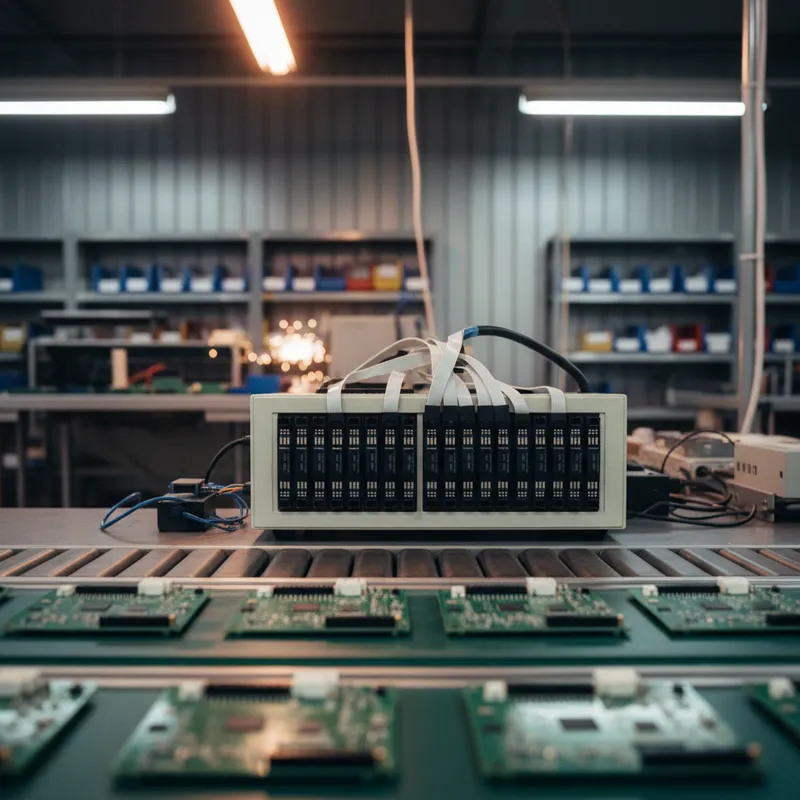
- XTL-i: fully automated inline system with SMEMA conveyor integration, using XDM-ETH for Ethernet-based programming at 1,200+ ECUs per shift
- XTL-s: compact inline system for space-constrained lines
- XTL-m: manual station for NPI and rework
In each configuration, the XDM-ETH provides the same programming performance and security provisioning capability. The choice of XTL system determines the level of automation and board handling, the programming engine remains consistent.
Applications in Indian Automotive Manufacturing
- ADAS ECU production: programming domain controllers and sensor fusion ECUs with multi-gigabyte firmware images over automotive Ethernet
- Gateway ECU manufacturing: flashing central gateway modules that bridge CAN, CAN-FD, LIN, and Ethernet domains
- EV powertrain: programming battery management system controllers, motor inverters, and on-board charger firmware
- Infotainment and digital cockpit: deploying large OS images and navigation data to head units and instrument clusters
Indian tier-1 suppliers in Bengaluru, Chennai, Pune, and Noida manufacturing ECUs for domestic and export markets benefit from the XDM-ETH’s combination of automotive Ethernet performance, cybersecurity provisioning, and production-grade traceability.
Why Buy from GSAS
GSAS Micro Systems is the authorised ProMik engineering partner in India, providing the XDM-ETH with INR invoicing, production line integration support, automotive Ethernet fixture design consultation, and HSM key provisioning workflow assistance. Engineering teams in Bengaluru, Hyderabad, Chennai, Pune, Mumbai, Delhi NCR, and Visakhapatnam support tier-1 automotive suppliers implementing secure production programming.
Explore the XDM-ETH and ProMik product range, or contact us for evaluation and production line consultation.
Also appears in:
Interested in ProMik tools?
Talk to our application engineers for personalized tool recommendations.
More from ProMik
View all →
Automotive ECU Programming and Traceability: Meeting IATF 16949 with ProMik
5 Apr · 7 min

Scaling Electronics Manufacturing in India: Programming Infrastructure for Growth
5 Apr · 7 min
FlashTask Pro: Production Programming Project Management with ProMik
5 Apr · 7 min
Gang Programmer vs Inline ISP: Choosing the Right Production Programming Approach
5 Apr · 7 min
Emulating Processor Power for Thermal Testing: Why Constant Power
7 Oct · 7 min
CRPS and Rack Power Supply Testing: The Six Tests That Matter
7 Oct · 7 min