The Development-to-Production Gap
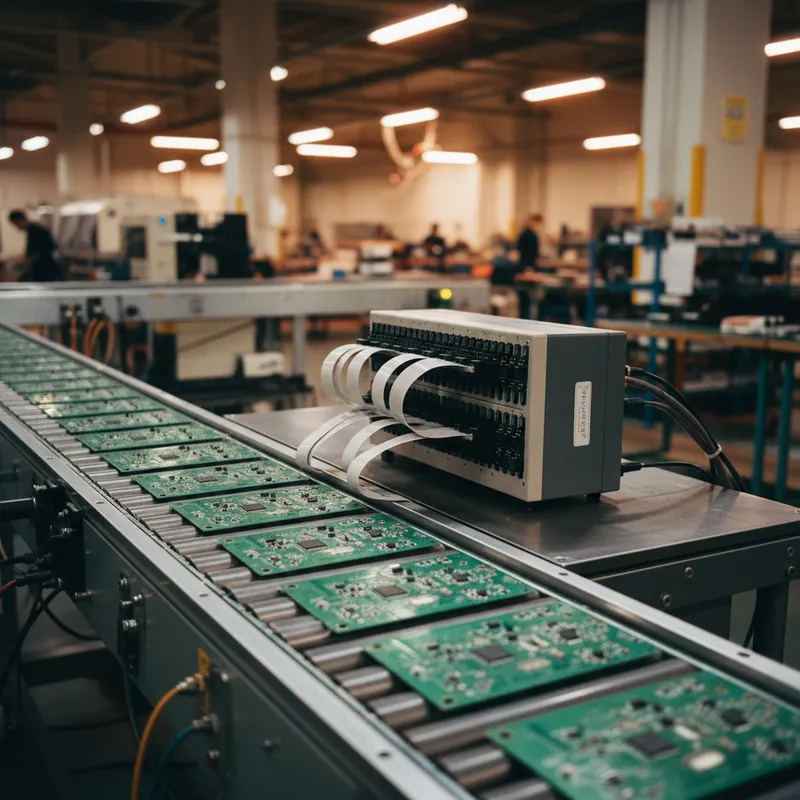
In electronics manufacturing, there is a persistent gap between development programming and production programming. During product development, firmware engineers use JTAG debuggers, SWD probes, and development kits to program and debug microcontrollers at their desks. When the product transitions to production, a different set of tools, typically gang programmers or inline programming systems, takes over.
The problem: programming projects developed on bench tools often need to be re-created from scratch for production tools. Different software, different project formats, different hardware interfaces. This re-porting effort introduces risk (transcription errors, configuration mismatches) and delay (weeks of validation before production can start).
The ProMik XDM-USB eliminates this gap.
XDM-USB Architecture
The XDM-USB is a four-channel USB 3.0 ISP (In-System Programming) programmer built on the Xilinx Zynq UltraScale+ processing platform. This is the same silicon engine used in ProMik’s production-grade XDM-ETH, ensuring hardware-level compatibility between the USB desktop unit and the Ethernet production unit.
Key Specifications
| Feature | Specification |
|---|---|
| Interface | USB 3.0 SuperSpeed |
| Channels | 4 independent |
| Throughput | Up to 300 MB/sec (USB 3.0) |
| Engine | Zynq UltraScale+ |
| Protocols | JTAG, SWD, SPI, Qualcomm Sahara/Firehose |
| Software | FlashTask Pro, pOnline Pro |
| Form Factor | Compact desktop |
Four independent channels mean four devices can be programmed simultaneously, each at full USB 3.0 SuperSpeed throughput. For firmware images in the megabyte range (common for Cortex-M microcontrollers), programming cycles complete in seconds. For larger images, multi-gigabyte Qualcomm chipset firmware, Linux system images for application processors, the 300 MB/sec USB 3.0 bandwidth keeps cycle times practical.
FlashTask Pro: Unified Project Management
FlashTask Pro is ProMik’s programming project management software. A FlashTask project encapsulates everything needed to program a target device:
- Firmware image files (binary, hex, S-record)
- Target device configuration (protocol, clock speed, voltage levels)
- Programming sequence (erase, program, verify, lock)
- Security provisioning (key injection, secure boot configuration)
- Traceability settings (serial number logging, pass/fail tracking)
The critical feature: a FlashTask project created on the XDM-USB transfers directly to the XDM-ETH production system with zero re-porting. The same project file, the same programming sequence, the same security provisioning, validated on the USB desktop unit, deployed on the Ethernet production unit without modification.
Qualcomm Chipset Support
The XDM-USB provides native support for Qualcomm Sahara and Firehose protocols with direct QFIL project import. This is significant for Indian electronics manufacturers producing:
- 5G infrastructure equipment: base station modules and small cells using Qualcomm chipsets
- IoT gateways and routers: edge computing devices, cellular gateways, and industrial routers
- Automotive infotainment: head units and digital cockpit platforms on Qualcomm Snapdragon Automotive
Manufacturers can import existing QFIL projects directly into FlashTask Pro, eliminating the need to re-create programming configurations from the Qualcomm toolchain.
Development Workflow
The XDM-USB fits into the electronics product development lifecycle at two critical points:
Firmware Development
During firmware development, the XDM-USB serves as the programming station on the engineer’s bench. Firmware is compiled, programmed to the target hardware via the XDM-USB, tested, and iterated. The FlashTask project evolves alongside the firmware, programming parameters are tuned, verify sequences are added, and the complete programming recipe is validated.
NPI (New Product Introduction)
When the product transitions from development to NPI, the XDM-USB programs the first production samples. These samples go through design verification testing (DVT) and production validation testing (PVT). The FlashTask project used to program these critical validation samples is the same project that will be used in volume production, no re-porting, no re-validation.
Scaling to Production
When production volumes justify moving from manual desktop programming to inline automation, the XDM-USB’s FlashTask projects transfer to:
- XDM-ETH: four-channel automotive Ethernet programmer for rack-mount production environments
- XTL-m: manual programming station for low-volume/high-mix production
- XTL-s: compact inline system for space-constrained SMT lines
- XTL-i: fully automated inline system for high-volume production
This scalability pathway means an Indian electronics manufacturer can start with a single XDM-USB at the engineering bench and scale to a fully automated production line, using the same programming recipes throughout, with zero re-validation at each transition.
Rack Configuration
For environments that need more than four simultaneous channels but want to remain on USB connectivity, the XDM-USB supports rack-mount configuration using the ProMik standard 19-inch rack with PSU 2048 power supply. Multiple XDM-USB units mount in a single rack, each providing four channels, for medium-volume production environments that do not require the XDM-ETH’s Ethernet infrastructure.
Applications in Indian Manufacturing
- Contract electronics manufacturers (EMS) in Bengaluru, Chennai, Pune, and Noida programming multi-variant products across different customers
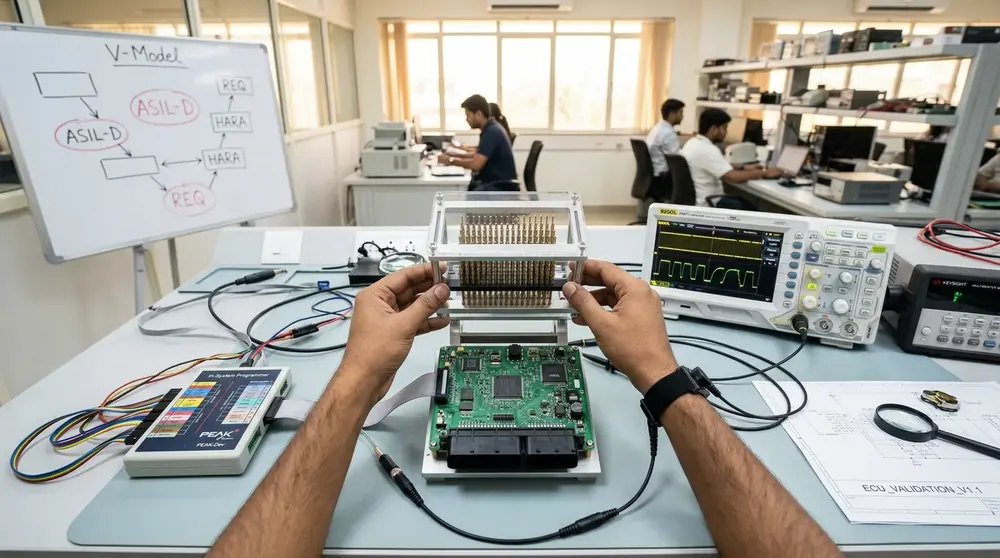
- Automotive tier-1 suppliers developing and validating ECU firmware before transferring to inline production
- IoT device manufacturers programming cellular modules, MCUs, and secure elements in edge computing products
- 5G equipment producers programming Qualcomm-based small cells and base station modules
Why Buy from GSAS
GSAS Micro Systems is the authorised ProMik engineering partner in India, providing the XDM-USB with INR invoicing, FlashTask Pro licensing, target fixture sourcing, and programming workflow consultation. Engineering teams in Bengaluru, Hyderabad, Chennai, Pune, Mumbai, Delhi NCR, and Visakhapatnam provide hands-on support for development-to-production programming transitions.
Explore the XDM-USB and full ProMik product range, or contact us for evaluation and volume pricing.
Also appears in:
Interested in ProMik tools?
Talk to our application engineers for personalized tool recommendations.
More from ProMik
View all →
Automotive ECU Programming and Traceability: Meeting IATF 16949 with ProMik
5 Apr · 7 min

Scaling Electronics Manufacturing in India: Programming Infrastructure for Growth
5 Apr · 7 min
FlashTask Pro: Production Programming Project Management with ProMik
5 Apr · 7 min
Gang Programmer vs Inline ISP: Choosing the Right Production Programming Approach
5 Apr · 7 min
Emulating Processor Power for Thermal Testing: Why Constant Power
7 Oct · 7 min
CRPS and Rack Power Supply Testing: The Six Tests That Matter
7 Oct · 7 min