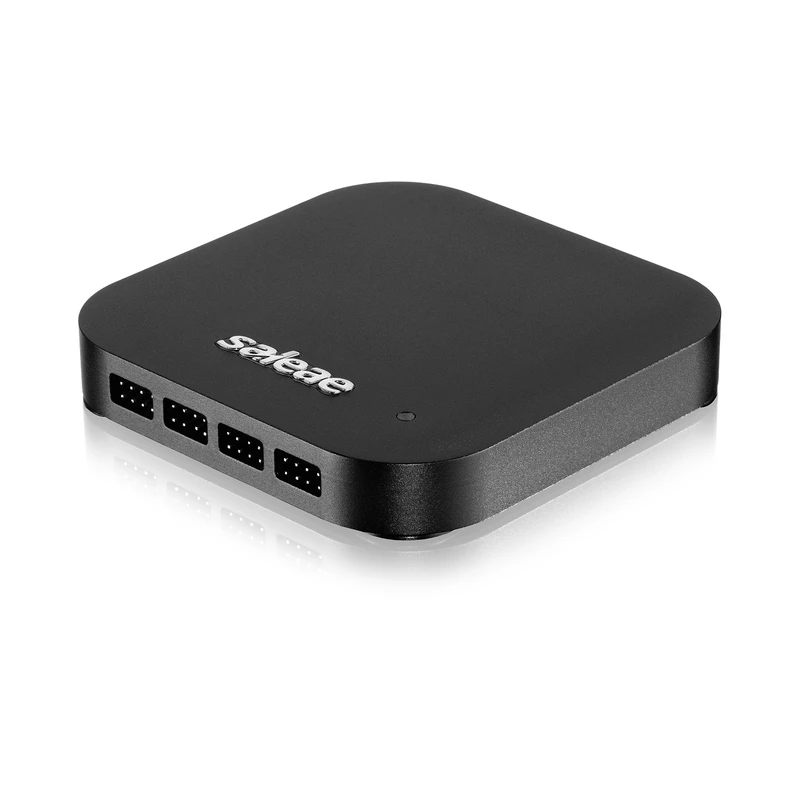
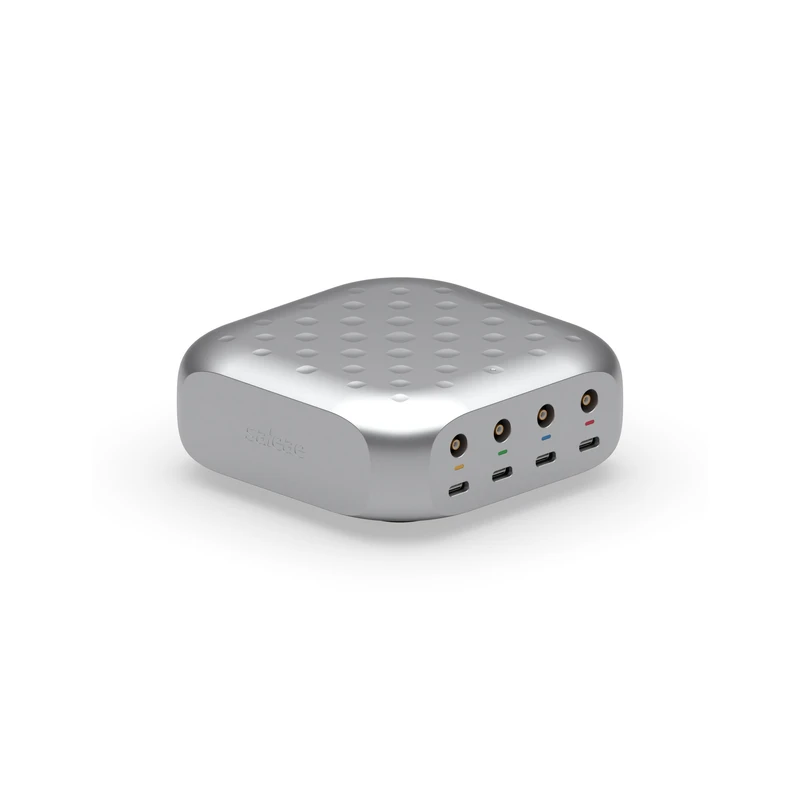
Saleae’s Logic MSO is the company’s first mixed-signal oscilloscope: three pod variants (MSO 2×100, MSO 4×100, MSO 4×200) that combine real analog scope channels with the existing Logic 2 protocol-decode workflow. This post covers the engineering decision Indian teams face: when an MSO pod replaces a benchtop oscilloscope plus a separate USB logic analyser on the bench, and when it does not.
GSAS Micro Systems is an authorised India engineering partner. The notes below draw on pre-sales bench visits with Indian semiconductor, automotive, and embedded teams since the MSO line launched.
The three Saleae Logic MSO variants
The MSO line has three pods, each available in a Standard and a Pro variant (same hardware, firmware-unlocked resolution and memory depth):
| Model | Analog channels | Analog bandwidth | Sample rate | Digital channels (built-in / expandable) |
|---|---|---|---|---|
| Saleae Logic MSO 2×100 | 2 | 100 MHz | 1.0 GS/s | 8 / 20 |
| Saleae Logic MSO 4×100 | 4 | 100 MHz | 1.0 GS/s | 8 / 20 |
| Saleae Logic MSO 4×200 | 4 | 200 MHz | 1.6 GS/s | 8 / 20 |
Standard vs Pro is the same trade-off across all three pods:
- Standard: 9-bit analog vertical resolution, 100 M sample memory per channel
- Pro: 12-bit analog vertical resolution, 1 B sample memory per channel, software upgrade Std → Pro available on the same hardware
For full Standard-vs-Pro comparison tables, see the individual product pages (each has a dedicated section).
What does “replacing a benchtop scope + logic analyzer” actually mean?
A typical Indian embedded debug bench today has:
- A 4-channel benchtop oscilloscope (Tektronix MDO, Rigol MSO5000, GW Instek GDS, Keysight DSOX), ₹50,000 to ₹3,00,000 depending on bandwidth and brand
- A separate USB logic analyzer (often a Saleae Logic Pro 16), for protocol decode
- Software on each instrument that does not talk to the other
The Logic MSO 4×200 collapses that into one USB pod that runs Logic 2 software. Same 4 analog channels at 200 MHz, same digital protocol decode framework as every Saleae Logic device. One screen, one capture, one timebase, one trigger, analog and digital signals correlated in a single waveform view.
For embedded debug under 200 MHz analog content, the MSO 4×200 covers the workflow. The pod is smaller than a benchtop scope, runs from a laptop, ships with 10:1 passive scope probes, and captures continuously over USB 3.0 to the PC (Pro variant streams 1 B samples per channel).
It does not replace:
- RF / high-speed-serial work above 200 MHz analog content (you still want a higher-bandwidth dedicated scope)
- Compliance-grade oscilloscope work that requires calibrated, vendor-certified measurement traceability
- Use cases where a physical knob-and-button benchtop interface is required (some compliance labs and automotive certification environments)
When does the Logic MSO 2×100 fit?
The 2-channel version is the value pick when you only need to watch one analog rail and one analog signal at a time, alongside the digital bus traffic. Common Indian use cases:
- IoT bring-up at semiconductor design houses in Bengaluru and Hyderabad: one analog channel on the SoC’s main rail, one on the wakeup signal, 8 digital channels on the I²C/SPI bus to the sensor
- Single-rail switching regulator debug: one analog on the output rail under load, one on the FB pin, digital on the enable/PWM control lines
- Audio codec bring-up: one analog on the audio output, one on the rail, digital on I²S clock + frame + data
The Pro variant becomes meaningful when you need long-duration captures (drift, settling, multi-second start-up sequences), the 1 B sample memory holds an order of magnitude more than the Standard variant.
When does the Logic MSO 4×100 fit?
The 4-channel 100 MHz pod is the everyday workhorse for mixed-signal debug on 4-rail boards. Most common use cases in India:
- Industrial-control bring-up in Pune: 4 analog channels watching the four PSU rails (12 V, 5 V, 3.3 V, 1.8 V) while digital monitors the watchdog and reset lines
- EV charger boards: analog on the charging current sense, the battery voltage, the SoC supply, and one diagnostic test point; digital on the CAN bus and main MCU GPIOs
- Audio / I²S debug: multiple analog channels watching the codec rails and the analog output simultaneously with the digital protocol traffic
Step up to the 4×200 when you need 200 MHz analog content, typically DDR margin work, high-speed serial bring-up, or 1 GHz+ digital edges where you want clean analog reconstruction.
When does the Logic MSO 4×200 fit?
The flagship is the right pick for India teams doing:
- DDR3/DDR4 margin captures at semiconductor design houses: 1.6 GS/s analog sampling at 200 MHz catches the analog edge content of high-speed digital signals
- PCIe Gen 2 / Gen 3 SerDes bring-up (at lane level)
- High-frequency switching regulator analysis (GaN-FET, multi-MHz switching)
- ISO 26262 / IEC 62304 traceable mixed-signal evidence: Pro variant’s 1 B-sample memory captures every sample on disk for the safety-auditor record
- Long-duration regression captures on a CI/CD bench rack
If you are weighing the MSO 4×200 Pro against a benchtop 200 MHz scope plus a separate logic analyzer, a GSAS field application engineer can capture your live signal on both during a half-day bench visit. You see the analog reconstruction quality on both side by side before committing to the purchase order.
Digital channel expansion
All three MSO pods ship with 8 built-in digital channels, expandable to 20 by ordering additional Saleae Digital Probes (each probe carries 4 digital channels, up to 5 probes supported). This is the answer when an Indian buyer asks “do I lose digital channel count moving from the Logic Pro 16 to an MSO?”, the answer is no, the MSO gets to 20 digital channels with the right accessory order.
Python automation works identically across the MSO and Logic lines
Saleae ships a Python Automation API across the MSO and Logic lines. The Logic 2 Automation API drives capture, decode, export, and .sal diff against a known-good baseline, same Python interface as the rest of the Saleae Logic family. The pattern most Indian teams adopt:
- Lead engineer’s bench: an MSO 4×100 or 4×200 Pro for everyday mixed-signal debug
- CI/CD rack on a bench Raspberry Pi or x86 mini-PC: same Python automation drives nightly regression captures; the MSO pod is reused or a dedicated CI device runs unattended
See our Saleae Python API for CI/CD post for the working pattern.
How to buy Saleae Logic MSO in India
GSAS supplies all three Logic MSO variants (Std and Pro) through standard Indian procurement frameworks: direct PO, GeM, SAP Ariba, Coupa, and TReDS. For pricing context and India procurement details, see our Saleae Logic in India buyer’s guide. For a quote, Request a Quote with the model name and quantity and we will reply with INR pricing, GST treatment, and lead time within one working day.
For bench evaluation, capture your live signal on the MSO alongside your current scope + logic analyzer setup, Contact GSAS or call any of our offices across Bengaluru, Hyderabad, Chennai, Pune, Mumbai, or Delhi NCR.
Related reading
- Saleae Logic MSO 2×100 product page: full specs, Standard vs Pro comparison
- Saleae Logic MSO 4×100 product page: full specs
- Saleae Logic MSO 4×200 product page: flagship specs + bench-replacement context
- Saleae Logic in India, buyer’s guide and pricing: procurement and pricing context
- Saleae Logic Pro 16 vs Logic Pro 8 vs Logic 8: Logic-line model comparison
- Saleae partner page: full GSAS Saleae catalogue
Also appears in:
Interested in Saleae tools?
Talk to our application engineers for personalized tool recommendations.
More from Saleae
View all →
Saleae Logic MSO: Standard or Pro? The India Buying Decision
17 Jul · 6 min
Best Logic Analyzer in India (2026): A Vendor-Neutral Buying Guide for Embedded Teams
5 Jun · 10 min
AI Data Centers in India: Test, Measurement & Memory Boom
4 Jun · 14 min
Logic Analyzer vs Oscilloscope vs MSO: When You Actually Need Analog Channels (Saleae Logic MSO)
4 Jun · 10 min
Emulating Processor Power for Thermal Testing: Why Constant Power
7 Oct · 7 min
CRPS and Rack Power Supply Testing: The Six Tests That Matter
7 Oct · 7 min