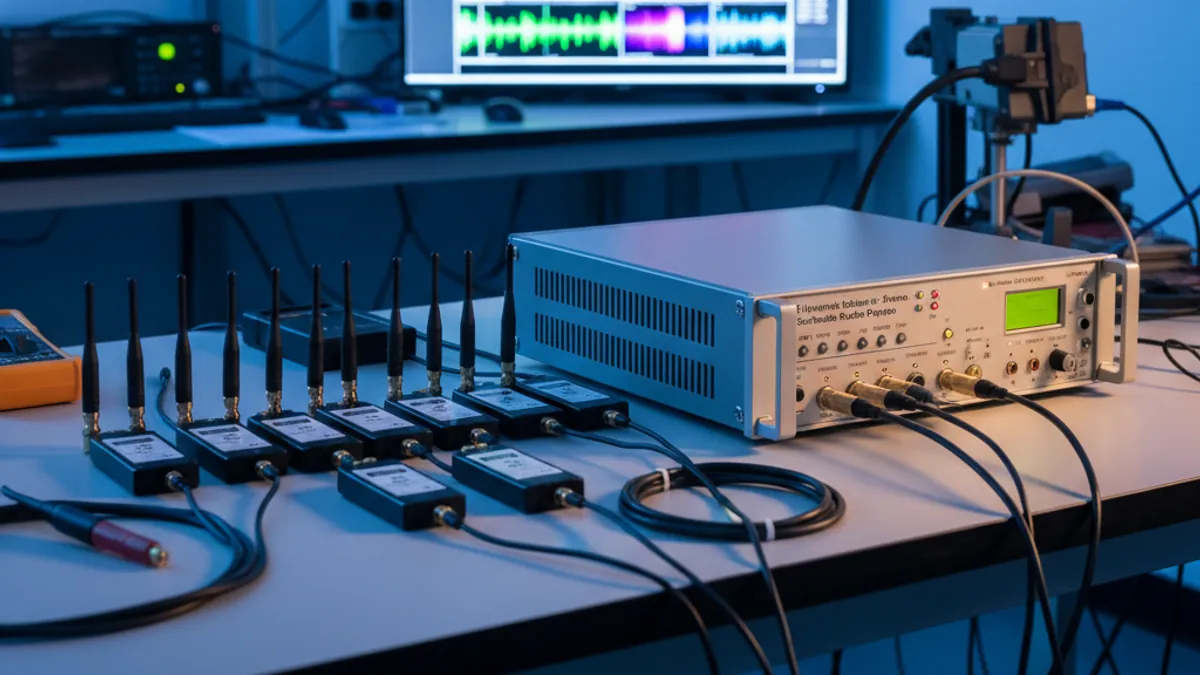
The NI Ettus USRP family spans a wide range, from credit-card-sized bus-powered radios to rack-mount research platforms, so choosing the right one for an Indian RF lab, a 5G/LTE prototype, or an embedded sensing node is a matter of matching four variables: how many channels you need, how much instantaneous bandwidth, what host link your processing can sustain, and whether the radio must run standalone. This guide compares five USRPs that GSAS supplies in India, the B200mini, B205mini-i, B210, X310, and E320: on exactly those axes.
New to software defined radio? Start with our explainer on what software defined radio is and how it works, then come back here to pick a radio.
Start With the Four Questions
- Channels: single Tx/Rx, or 2x2 MIMO?
- Bandwidth: tens of MHz (AD936x-class) or up to 160 MHz per channel (X-series with daughterboards)?
- Host link: USB 3.0 to a laptop, or 10 GbE / PCIe to a workstation?
- Standalone: does the radio need onboard processing to run without a host PC?
Every USRP recommendation falls out of those four answers.
The Compact USB Radios: B200mini and B205mini-i
When the requirement is small, portable, or OEM-embeddable, the bus-powered mini modules win.
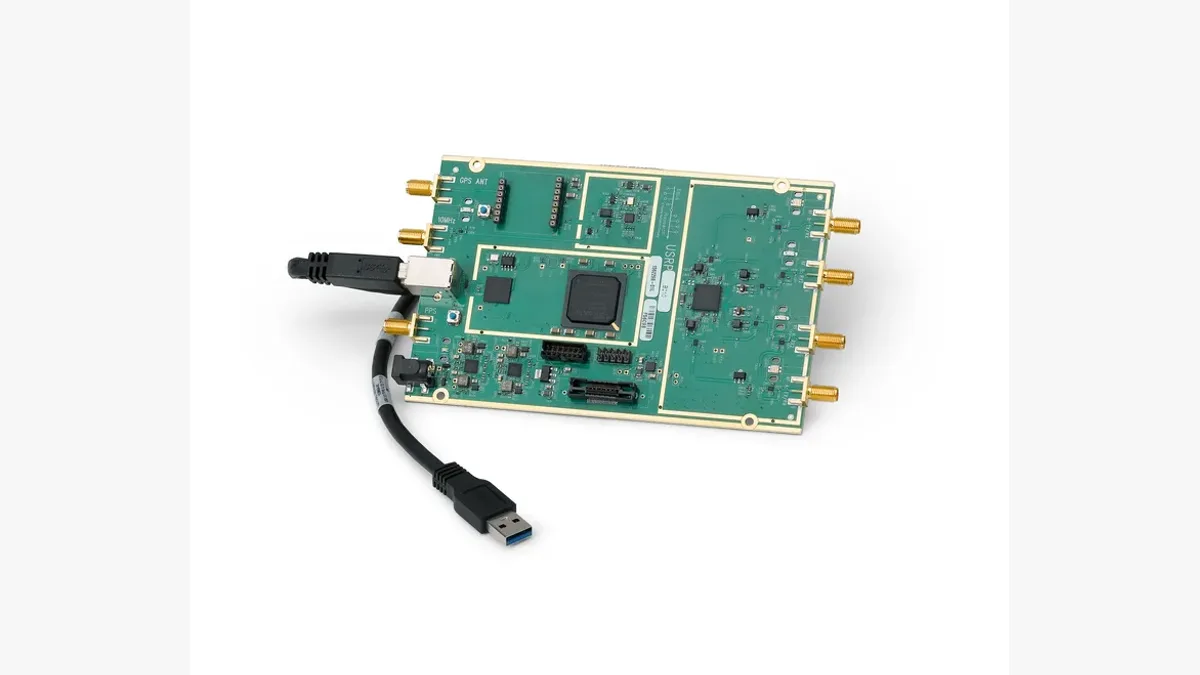
The USRP B200mini is a single-channel (1 Tx / 1 Rx, full duplex) radio covering 70 MHz to 6 GHz with up to 56 MHz of bandwidth, built around the Analog Devices AD9364 RF IC and a Xilinx Spartan-6 FPGA, all in a credit-card-sized board over USB 3.0 bus power. It packs the RF performance of the full-size B200 into a footprint that fits drone payloads, handheld direction-finding rigs, and space-constrained product integrations.
The USRP B205mini-i builds on that form factor and adds a GPIO header and optional GPSDO (GPS-disciplined oscillator) for frequency-locked, time-synchronized, and location-stamped measurements. Choose the B205mini-i over the B200mini when you need deployed sensing, geolocation work, or distributed spectrum monitoring where timing discipline matters.
The Mainstream Workhorse: USRP B210
The USRP B210 is the radio most labs reach for first. It is a 2x2 MIMO platform (2 Tx / 2 Rx, full duplex) covering 70 MHz to 6 GHz continuous with up to 56 MHz of real-time bandwidth per channel, built on the Analog Devices AD9361 RF IC and a Xilinx Spartan-6 XC6SLX150 FPGA, connected over a single USB 3.0 cable with bus power for basic operation.
The B210 is the default choice for 5G/LTE prototyping, GNSS work, spectrum monitoring, and general RF test where two coherent channels and a 70 MHz–6 GHz sweep cover the requirement. It runs with UHD, GNU Radio, and MATLAB, so it slots into virtually any SDR toolchain.
Bandwidth and Channel Density: USRP X310
When tens of MHz are not enough, the USRP X310 steps up to a research-grade platform. It is built around a Xilinx Kintex-7 XC7K410T FPGA (406K logic cells) with 1 GB DDR3, in a half-wide 1U enclosure with two modular RF daughterboard slots that set its frequency range, supporting up to 160 MHz of bandwidth per channel with the right daughterboards.
The X310’s defining advantage is its host link: dual 10 GbE (2x RX at 200 MS/s per channel) and PCIe (200 MS/s full duplex), with 1 GbE for lower-rate work. That moves enough samples to a workstation for wideband signal intelligence, RF instrumentation, and multi-channel research. Choose the X310 when bandwidth, channel flexibility, and sustained host throughput drive the design.
Standalone Embedded SDR: USRP E320
The USRP E320 answers the standalone question. It is a 2x2 MIMO radio covering 70 MHz to 6 GHz on receive with up to 56 MHz per channel, built around a Xilinx Zynq-7045 SoC (dual Arm Cortex-A9 plus FPGA fabric) and the AD9361 RF IC. Because the Zynq runs a full Linux environment onboard, the E320 operates standalone over the network: no host PC required, connected over its SFP+ port (1 GbE, 10 GbE or Aurora) or its RJ45 1 GbE port.
The E320 is the radio for distributed RF monitoring, deployed sensing, and embedded radio products where the processing has to live at the edge. Where the B210 needs a tethered laptop, the E320 can be dropped into a remote enclosure and managed over the network.
Selection Matrix
| Need | Pick |
|---|---|
| Smallest, single-channel, portable | B200mini |
| Compact + GPSDO / GPIO, timing-locked | B205mini-i |
| Mainstream 2x2 MIMO over USB 3.0 | B210 |
| Up to 160 MHz/ch, 10 GbE/PCIe, daughterboards | X310 |
| Standalone networked 2x2 MIMO with onboard Arm + FPGA | E320 |
Frequently Asked Questions
What is the difference between the B200mini and B205mini-i? Both are compact single-channel 70 MHz–6 GHz radios over USB 3.0. The B205mini-i adds a GPIO header and optional GPSDO for time-synchronized, frequency-locked, and location-stamped operation, useful for deployed sensing and geolocation. If you only need a small bench or embedded radio, the B200mini is sufficient.
Why choose the X310 over the B210? The B210 gives 2x2 MIMO and up to 56 MHz of bandwidth over USB 3.0. The X310 adds modular daughterboards (up to 160 MHz per channel), a larger Kintex-7 FPGA, and dual 10 GbE / PCIe host links for sustained wideband throughput. Choose the X310 when bandwidth, channel flexibility, and host data rate exceed what USB 3.0 and the AD9361 can deliver.
Which USRP can run without a host PC? The E320. Its Xilinx Zynq-7045 SoC (Arm Cortex-A9 + FPGA) runs Linux onboard, enabling standalone, networked SDR operation. The B-series and X310 require a host computer (USB 3.0 or 10 GbE/PCIe respectively).
What software do these USRPs use? All of them work with the USRP Hardware Driver (UHD), GNU Radio, and MATLAB, so a design can move between models with minimal toolchain change.
How do I buy NI Ettus USRP SDRs in India? GSAS Micro Systems is an authorized Digilent engineering partner in India. We supply the USRP B-series, X-series, and E-series with INR invoicing, RF application support, and GeM/SAP Ariba/Coupa/TReDS procurement. Request a quote for current pricing and lead time.
Buy USRP SDR in India from GSAS
From a credit-card B200mini to a rack-mount X310, GSAS Micro Systems helps RF and telecom teams choose the USRP that matches their channels, bandwidth, host link, and deployment model. Our application engineers support SDR bring-up and INR procurement for teams across Bengaluru, Hyderabad, Chennai, Pune, Mumbai, and Delhi NCR. Request a quote to compare the USRP B210, X310, E320, and the mini modules for your RF program.
Also appears in:
Interested in Digilent tools?
Talk to our application engineers for personalized tool recommendations.
More from Digilent
View all →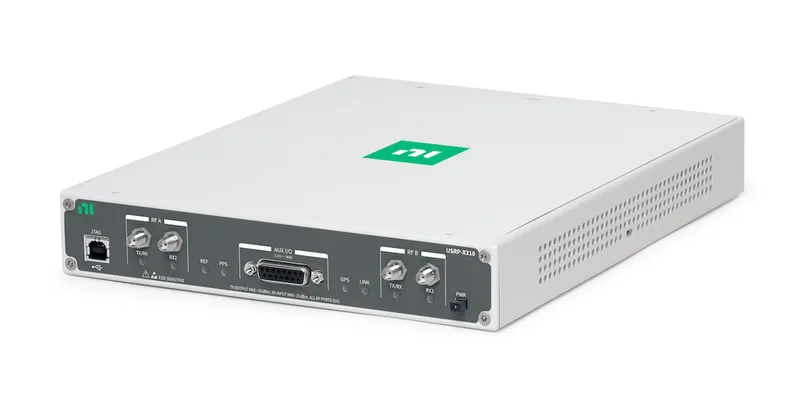
Real-World SDR Applications: 5G Research, Satellites, IoT and ADS-B
28 Aug · 6 min
What Is Software Defined Radio (SDR)? A Practical Explainer for Indian Engineering Teams
19 Aug · 9 min

ZedBoard FPGA-in-the-Loop: HDL Verifier vs HDL Coder
5 Aug · 9 min

AI Data Centers in India: Test, Measurement & Memory Boom
4 Jun · 14 min
Emulating Processor Power for Thermal Testing: Why Constant Power
7 Oct · 7 min
CRPS and Rack Power Supply Testing: The Six Tests That Matter
7 Oct · 7 min