In short
Valor NPI 2610, released by Siemens in October 2026, adds a unified AI-enabled user experience with a Product Support Copilot, runs DFM verification inside Xpedition EDM with full traceability, adds nine IPC Class 1-3 by Level A-C profiles developed with the Global Electronics Association, strengthens the Valor Parts Library, and adds board-size-aware rules and multi-termination trench via support.
Siemens describes Valor NPI 2610, announced on 26 October 2026, as a major product update. It touches almost every part of the product: a new user experience, verification managed inside Xpedition EDM, embedded IPC standards compliance, changes to the Valor Parts Library, and new DFM checks. This post summarises each, based on Siemens’ release article linked under References. For the previous release, see Valor NPI 2604.
A new, AI-enabled user experience
2610 introduces a unified verification environment. Its initial scope covers design preparation, Valor Parts Library (VPL) validation, netlist and DFM analysis, results review and CAM Compare.
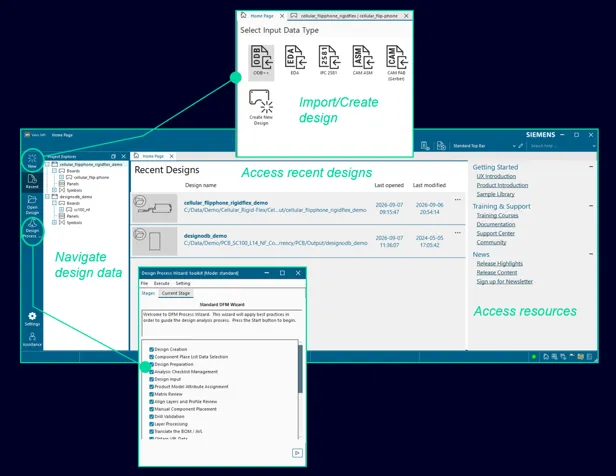
- Home Page and Project Explorer. The Home Page is the launch point for projects, recent designs, the Design Process Wizard and learning material; Project Explorer handles design data and navigation.
- Multiple workspaces in one application. Board Viewer, Matrix, BOM Manager and CAM Compare each customise independently.
- Natural-language and predictive command search. Search recognises common terminology, acronyms and product-specific language, and Predictive Commands suggest next actions from usage patterns. Both can be managed in the customisation settings.
- Display and settings. Mouse and keyboard navigation, widescreen and 4K support with native Windows scaling, and searchable settings for appearance, workspaces, scripts, libraries and administration.
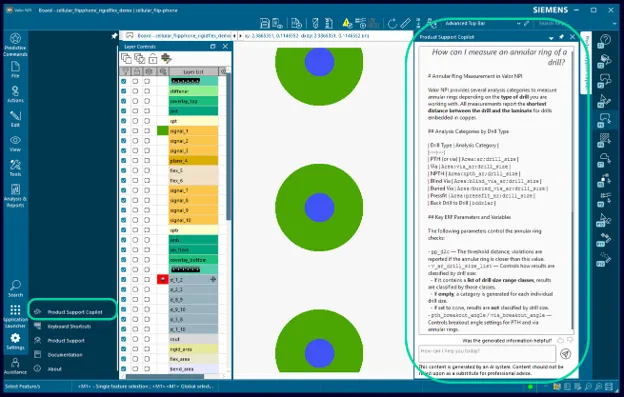
- Product Support Copilot. AI assistance answers natural-language questions from Valor NPI documentation and support content, with documentation opening in an embedded tab beside the work.
Adopt on your own timetable. 2610 ships both the unified experience and Classic Mode. Organisations define the default, users can switch, and Database Mode remains supported through Classic Mode in 2610 while modernisation continues in later releases. For production teams with established scripts and habits, that removes the pressure to migrate everyone on day one.
Verification inside Xpedition EDM
With 2610, Valor NPI joins the Xpedition EDM verification suite alongside HyperLynx DRC, Schematic Analysis, Signal Integrity and Power Integrity (see Xpedition 2610 and HyperLynx 2610).
- Verification runs against a specific PCB revision, and Valor NPI data goes through check-in, check-out and approval. Synchronisation with Xpedition Layout keeps teams on the latest design.
- Each check-in stores the rule set and factors, the results and the comments of every reviewer.
- MRA summaries show the verification history: run dates, job size, ownership, approval and release status, and the matching PCB revision.
- Teams can verify concurrently in a shared design or independently against the same revision, from EDM Cockpit or directly from Xpedition Layout through an integrated DFM workflow.
Siemens’ point is that this history becomes data: design properties, verification settings, results and reviewer feedback connected across revisions give a foundation for AI-assisted analysis of recurring issues and of how design decisions affect manufacturing outcomes.
Embedded IPC standards compliance
Design for Standards Compliance (DFSC) is new in 2610. It uses IPC profiles built by the Global Electronics Association (GEA) for use only in Valor NPI. On edition availability, GEA states that the advanced IPC DFM profiles are currently available through Valor NPI Premium.
There are nine profiles, built jointly by Siemens EDA and GEA, one for each pairing of:
- IPC performance Class 1, 2 or 3: from general electronic products, through products needing continued performance and extended life, to products where operation on demand is critical and downtime is unacceptable.
- Producibility Level A, B or C: how widely the needed manufacturing capability is available across the global PCB supply chain.
| Producibility level | What it means for manufacturing |
|---|---|
| Level A, general (preferred) | Broadly available capability, widest choice of suppliers |
| Level B, moderate (standard) | Greater process demands, a narrower pool of capable suppliers |
| Level C, least (reduced) | Advanced capability from a limited number of specialised suppliers |
Class and Level are separate choices: a Class 3 product does not automatically need Level C manufacturing. Each profile reports pass/fail against its thresholds; Siemens notes these are not severity rankings.
The profiles extend coverage to HDI and microvias, flex and rigid-flex, RF, high layer counts and heavy copper. They draw on the IPC-2220 and IPC-6010 series, IPC J-STD-001, IPC-4101, IPC-2152, IPC-2141, IPC-4562, IPC-7351 and IPC-4202/4203/4204, among related standards, and GEA surveyed global PCB suppliers to set copper size and clearance limits by copper weight and thickness. The profiles are reviewed twice a year.
The profiles implement the requirements for automated checking; the standards themselves remain the reference for the reasoning behind each value. Siemens points readers to GEA for both. For Indian teams building to export customers’ IPC class requirements, having those checks inside the DFM run is a practical gain.
Component intelligence in the Valor Parts Library
- Security. Part data is more strongly encrypted in system-to-system communication, and the VPL Content Server supports LDAP authentication against existing enterprise credentials.
- Recovery. VPL 2610 can roll back to a previously stable state if a software update or installation fails.
- MPN-only search. Parts can be found by manufacturer part number without the vendor name, which helps when incoming BOM data is incomplete or inconsistent.
New and improved DFM checks
Constraints grouped by manufacturing intent. Pass/fail constraints are organised into groups based on shared constraint factors, including etch, mechanical, quality, solder, process setup and component placement.
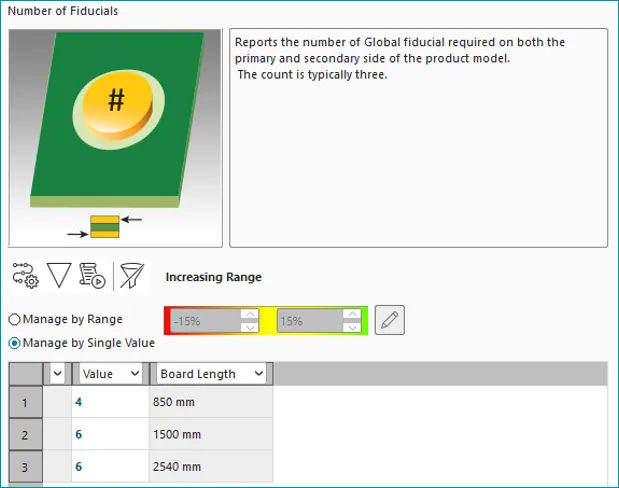
Rules that adapt to board size. Board width and length are now factors, so analysis adapts to product size. Siemens’ example: longer and wider boards are more prone to warping and need more fiducials or wider fiducial spacing, and larger boards need extra tooling holes to limit flex during assembly.
Multi-termination trench vias. Trench vias, laser-cut and electroplated continuous lines on blind or buried drill layers in rigid HDI boards, were previously limited to point-to-point lines, with overlapping paths classed as illegal. 2610 supports multiple terminations from a single starting point, allowing three- and four-termination microvia trench configurations.
Working with GSAS
GSAS supports the Siemens EDA portfolio in India, including Valor NPI, with local application engineers who help design and manufacturing teams set up DFM profiles, adopt the new IPC compliance checks and connect Valor to Xpedition EDM. Talk to us from Bengaluru, Hyderabad, Chennai, Pune, Mumbai or Delhi NCR.
References
- Siemens EDA, Electronic Systems Design blog: What’s new in Valor 2610 (26 October 2026)
- Global Electronics Association: Standards-compliant design and manufacturing
- Valor NPI and the Siemens EDA partner page at GSAS
Also appears in:
Interested in Siemens EDA tools?
Talk to our application engineers for personalized tool recommendations.
More from Siemens EDA
View all →
HyperLynx 2610: What's New for India's Signal and Power Integrity Teams
4 Nov · 6 min
Simulation-Based FMEDA: HyperLynx AMS and Xpedition in the Functional Safety Workflow
4 Nov · 5 min
FMI Co-Simulation in HyperLynx AMS and PartQuest Explore: Electrical, Mechanical and Thermal Models in One Run
4 Nov · 5 min
HyperLynx DSE: Searching Millions of PCB "What If" Scenarios Without Simulating Them All
4 Nov · 5 min
Right-Sizing Decoupling on AMD Versal Boards with HyperLynx PI
4 Nov · 5 min
From Trial and Error to Optimisation: A HyperLynx Workflow for Power Electronics Design
4 Nov · 6 min