In short
Xpedition tokens are floating tokens, offered by Siemens in packs of 25 or 50, that let Xpedition Standard users check out four add-ons (pre-layout and post-layout signal integrity simulation powered by HyperLynx, rigid-flex design and advanced ECAD-MCAD co-design), all of which Siemens' buyer's guide says are included in the Xpedition Advanced subscription. GSAS' rule of thumb: stay on tokens while the add-ons your team has open at one time fit one shared pool, and choose Advanced when they regularly do not, or when you need a capability with no token add-on, such as concurrent schematic design for up to two schematic users.
Per Siemens, Xpedition tokens give Xpedition Standard users on-demand access to four add-ons: pre-layout and post-layout signal integrity simulation powered by HyperLynx, rigid-flex design and advanced ECAD-MCAD co-design. Siemens introduced Xpedition Advanced with the Xpedition 2610 release, announced on 26 October 2026, and its buyer’s guide states that all of those capabilities “are included in the Xpedition Advanced subscription tier”. A Standard team now has two routes. Stay on tokens while the add-on work your team has open at one time fits one shared pool. Move seats to Advanced when demand regularly outgrows the pool, or when you need capabilities that no token add-on provides.
Every product statement below comes from Siemens’ token add-ons page and flyer, its March 2026 add-ons blog, its edition checklist, its buyer’s guide, and its Xpedition Advanced page, fact sheet and Getting Started guide, all linked under References. We do not publish prices for Xpedition Standard, its token packs or Xpedition Advanced, so this post makes no cost comparison. The decision comes down to three things you can observe in your own team.
The editions are laid out on our Xpedition family page, with product pages for Xpedition Standard and Xpedition Advanced. For what the two simulation add-ons are used for, see our earlier post on Xpedition tokens and HyperLynx signal integrity.
What Siemens publishes about tokens
- Packs. Siemens offers tokens for Xpedition Standard in packs of 25 or 50. It calls them floating tokens and says a pack serves “Xpedition users within an enterprise cloud account”.
- Checkout. Siemens’ add-ons flyer says users “check out tokens for specific workflows and return them to the pool when finished”, and its March 2026 add-ons blog says that after use “tokens are automatically returned to the pool”. As we read those two statements, a pack is a ceiling on what can be open at one moment, and frequent use by itself does not use a pack up. Ask us to confirm the details with your quotation before you size a pack.
- Counts. Siemens publishes three (as of 18 November 2026): pre-layout signal integrity 15 tokens, post-layout signal integrity 25 and rigid-flex design 10. Its token page says purchasing tokens “allows access to all four add-on capabilities”, but it gives no count for the fourth, advanced ECAD-MCAD co-design. Siemens’ buyer’s guide describes that add-on as co-design “with Siemens NX”. Ask us to confirm the count before you plan around that add-on.
The same capabilities on Standard and on Advanced
The entries follow Siemens’ edition checklist, reproduced on our family page, with token counts from Siemens’ token page. “Not listed” stands for an empty checklist cell. The checklist has one row for basic signal integrity simulation, where the token page has two add-ons, pre-layout and post-layout.
| Capability | On Xpedition Standard | On Xpedition Advanced |
|---|---|---|
| Pre-layout signal integrity simulation (HyperLynx) | Add-on, 15 tokens | Included |
| Post-layout signal integrity simulation (HyperLynx) | Add-on, 25 tokens | Included |
| Rigid-flex design | Add-on, 10 tokens | Included |
| Advanced ECAD-MCAD co-design | Add-on, token count not published | Included |
| Concurrent schematic design | Not listed | Included, up to two schematic users |
| Design constraints, schematic and layout | Core | Extended |
| Automated routing | Core | Extended |
| Sketch planning | Not listed | Included |
| Table-based design | Not listed | Included |
| Panelization | Not listed | Included |
| Full signal integrity, power integrity, electrical rule checks, schematic analysis | Option | Option |
The first four rows are the token add-ons. The last row is a caution for both routes: deeper analysis is an option on either edition, and the Advanced fact sheet also lists DDRx Wizard as an option for both. If your boards need power integrity analysis, neither a token pack nor an Advanced seat includes it. See HyperLynx.
1. How often are the add-ons open?
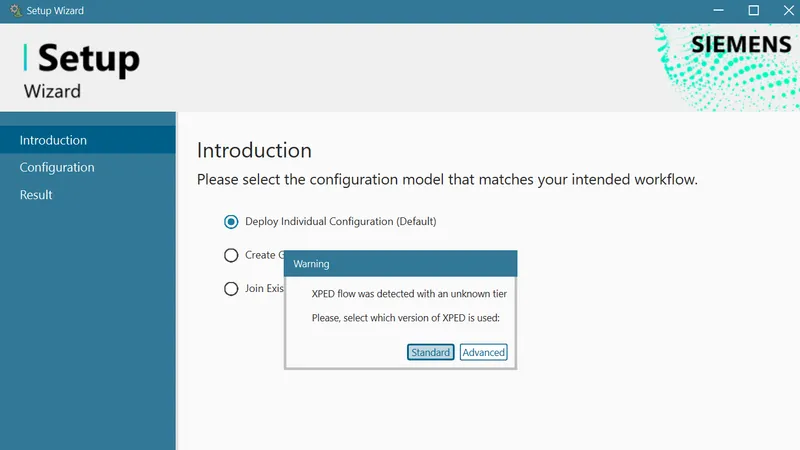
Look back over your last three or four boards. Count how many needed an add-on, and for how many working days it was open. Siemens’ Getting Started guide for Xpedition Advanced describes the Enterprise Cloud Account administrator as the person who manages add-on tokens, through the Siemens Xcelerator Admin Console, so ask that person first. If there is no record, keep a log for one project.
Then compare the result with Siemens’ own wording. Per Siemens, the 25-token pack “is best for individual engineers with occasional advanced feature needs” and the 50-token pack “is best for small teams that frequently work with high-speed design and rigid-flex designs”. The buyer’s guide fit guidelines put “occasional SI checks” in the Standard column and “built-in SI planning” in the Advanced column.
Frequency matters because of overlap. The more days an add-on is open, the more likely it is that two people want tokens on the same day.
Rigid-flex is the add-on to plan for separately. Siemens’ flyer says tokens are returned “when finished”, and the Siemens pages under References do not define that point for any add-on. A simulation is a bounded task, while rigid-flex work lasts as long as the board is in layout, so plan as if those 10 tokens are out for the whole layout phase until that is confirmed. Our rigid-flex post covers the capability itself.
2. How many people need them at the same time?
The table below is our arithmetic, derived from Siemens’ published token counts. It is not a Siemens table. It assumes each user’s open add-on holds its full count until it is returned, which is how we read “check out”. Advanced ECAD-MCAD co-design is left out because it has no published count.
| Open at the same time | Tokens held | 25-token pack | 50-token pack |
|---|---|---|---|
| One post-layout simulation | 25 | Fits, none left | Fits, 25 left |
| One pre-layout simulation and one rigid-flex design | 25 | Fits, none left | Fits, 25 left |
| Two pre-layout simulations | 30 | Does not fit | Fits, 20 left |
| One post-layout simulation and one rigid-flex design | 35 | Does not fit | Fits, 15 left |
| Two post-layout simulations | 50 | Does not fit | Fits, none left |
| One post-layout, one pre-layout and one rigid-flex | 50 | Does not fit | Fits, none left |
Mark your worst realistic week on this table. If it fits your pack, tokens are doing their job. If engineers regularly wait for tokens to come back, there are two ways out: more token capacity, or Advanced seats for the people who collide. Which costs less is a question for a quotation. Also ask whether a second pack joins the same pool. The Siemens pages under References do not say.
Per Siemens’ buyer’s guide, the four capabilities are included in the Xpedition Advanced subscription, and that subscription is named-user. Siemens’ Advanced fact sheet says named-user licensing “gives each user dedicated access”, so, as we read it, an Advanced user does not draw on a shared pool for them.
3. Do you need what tokens cannot add?
Siemens lists four token add-ons and no others. The rest of what separates Advanced from Standard on the checklist has no token route:
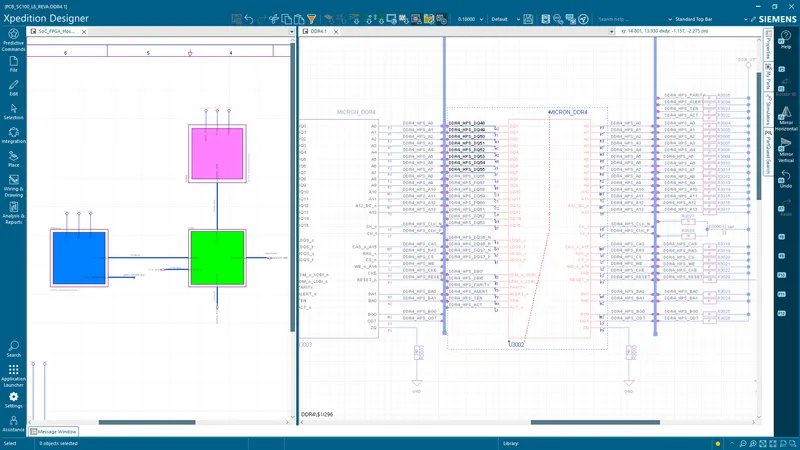
- Concurrent schematic design. Per Siemens, up to two schematic users work at the same time on different sheets (and constraints) of the same schematic, and a third user can open the design in Layout through flow concurrency. See our concurrent schematic design post.
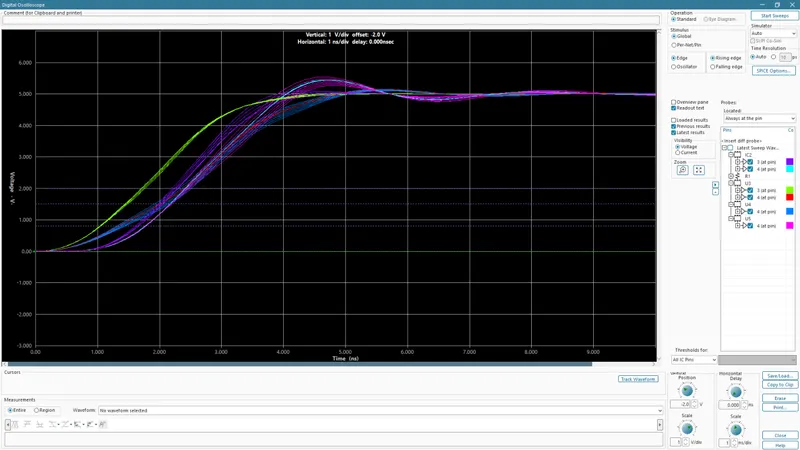
- Extended design constraints. Siemens’ Advanced page describes these as covering “requirements such as time-of-flight delay, parallelism, crosstalk and topology”. More in our high-speed design post.
- Extended automated routing, sketch planning and table-based design. On Standard the checklist shows automated routing as Core and leaves the other two cells empty.
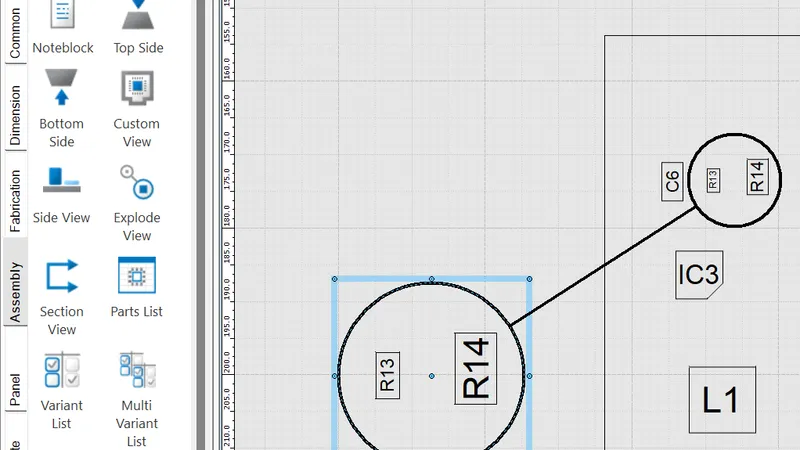
- Panelization. Siemens’ Advanced page also names “additional BluePrint capabilities such as pack and release and assembly panel design”.
If one of these is a real need, the token question is settled, because no pack size adds it. Our Standard vs Advanced comparison goes through the rows one by one.
You can move some seats and keep the rest
The choice is per seat. Siemens’ buyer’s guide says: “We expect seats of Xpedition Standard, Xpedition Advanced, and Xpedition Advanced DS to co-exist within an organization. As a result, they are fully compatible forward and back.” Siemens’ Advanced page says the two editions are “fully compatible in both directions for libraries and designs”.
So a team can move the engineer who simulates every board, or who owns the flex designs, to Advanced and keep the others on Standard with a pack for occasional use. The Advanced fact sheet adds one caveat: Advanced-specific capabilities “may be read-only or unavailable when opened in Standard”. Decide who edits what before you split the seats.
Buying in India
GSAS Micro Systems is an authorized Siemens EDA partner in India. We supply Xpedition Standard with token-based add-ons, Xpedition Advanced, Xpedition Advanced DS (the schematic-only companion seat to Advanced) and Xpedition Enterprise. Siemens can change its India list price without notice and a GSAS quotation may differ from it, so we quote rather than publish a figure.
Send us your add-on log and the list of roles that share the pool, and ask for both routes to be quoted in INR with a GST invoice. GSAS has offices in cities including Bengaluru, Hyderabad, Chennai, Pune, Mumbai and Delhi NCR. Request a quote or book a demo.
References
- Siemens: Token-based add-ons for Xpedition (token packs, token counts, who each pack is for)
- Siemens EDA, Electronic Systems Design blog: Powering innovation: how Xpedition add-ons transform PCB design (16 March 2026: tokens are returned to the pool)
- Siemens: Scale design capabilities with adaptable add-ons (flyer: shared token pool, check out and return)
- Siemens: Xpedition product family, section “Choose the right PCB design solution for you” (edition checklist)
- Siemens: Xpedition buyer’s guide (purchase options, fit guidelines, seat compatibility)
- Siemens: Xpedition Advanced (product page and FAQ)
- Siemens: Xpedition Advanced fact sheet (named-user licensing, compatibility caveat, analysis options)
- Siemens: Getting Started guide for Xpedition Advanced (administrator role and add-on tokens)
- Siemens EDA, Electronic Systems Design blog: What’s new in Xpedition 2610 (26 October 2026)
Also appears in:
Interested in Siemens EDA tools?
Talk to our application engineers for personalized tool recommendations.
More from Siemens EDA
View all →
PADS Pro Essentials vs Xpedition Standard: Which One to Start With
18 Nov · 8 min
Concurrent Schematic Design in Xpedition Advanced and Advanced DS
18 Nov · 7 min
From Layout to Fabrication in Xpedition Advanced: BluePrint, Panels, DFM
18 Nov · 10 min
Getting Started with Xpedition Advanced: An Onboarding Checklist
18 Nov · 8 min
High-Speed PCB Design in Xpedition Advanced: Constraints, Routing and SI
18 Nov · 9 min
Rigid-Flex PCB Design in Xpedition Advanced: Stackups, Bend Areas and 3D
18 Nov · 8 min