Binho Nova vs Supernova vs Pulsar: Which USB Host Adapter Is Right for You?
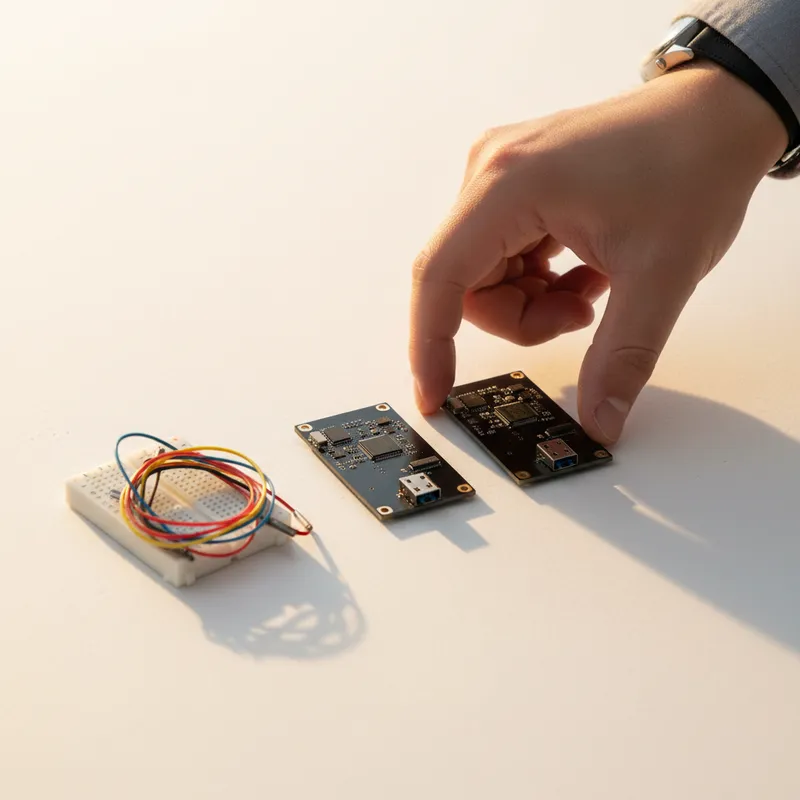
Binho makes three USB host adapters. They share a software ecosystem but differ in which buses they reach, how fast, and at what signalling voltage.
This comparison uses only Binho’s published specifications, and it flags explicitly where a capability is announced but not yet shipping. That distinction matters more on this product line than on most, because Binho publishes a visible coming-soon roadmap on the Pulsar and a good deal of secondhand coverage reads those roadmap items as shipping features.
Binho Nova: The First-Generation Adapter
Binho lists the Binho Nova protocols as exactly I2C, SPI, UART and 1-Wire. I2C runs up to 3.4 MHz (high-speed I2C), SPI up to a 12 MHz max clock speed, and UART up to 1 Mbps. There are 5x shared GPIO pins, logic levels are 3.3 V, and the instrument is powered directly from USB on a USB 2.0 Full Speed, 12 Mbps link over USB Type-C.
Choose the Nova when:
- Your boards are conventional I2C, SPI and UART designs and 12 MHz SPI is enough
- You need 1-Wire for DS18B20 temperature sensors, iButton devices or similar parts
- You want a single bus-powered tool with no external supply
- I3C is not on your roadmap
Binho has not retired the Nova. Its own framing is that “While newer models like Supernova and Pulsar offer expanded capabilities, the Nova remains a reliable and cost-effective solution.” One practical constraint to know: Mission Control 3 supports the Supernova and Pulsar, and the Nova continues on Mission Control 2.
Binho Supernova: The I3C Instrument
The Binho Supernova is built around MIPI I3C. Binho specifies spec versions v1.0, v1.1.1 and v1.2, up to 12.5 MHz, in SDR mode and HDR-DDR, with In-Band Interrupts, Hot-Join and all Common Command Codes, at an I3C signalling range of 0.8 V to 3.3 V.
The specification that most comparisons miss is the role: Binho lists the Supernova’s I3C role as Controller or Target. One instrument can drive a bus of target devices, or present itself as a target to the controller under test. That second direction is the harder half of I3C validation and it is worth a post of its own, which we wrote: running the Binho Supernova as an I3C target.
Alongside I3C, Binho specifies a 1 MHz I2C controller with configurable pull-ups, 7-bit addressing and clock stretching; a 50 MHz SPI controller with up to four chip selects and all four SPI modes; UART at 115200 baud with hardware flow control; and six dedicated configurable GPIO pins, all at 1.2 V to 3.3 V.
Choose the Supernova when:
- Your current or upcoming designs use MIPI I3C
- You need to exercise an I3C bus as controller, or emulate a target against somebody else’s controller
- You need I3C signalling below 1.2 V, which the 0.8 V lower bound reaches and the legacy-bus pins do not
- You want 50 MHz SPI alongside I3C on one instrument
Note what the Supernova does not list: 1-Wire and RS-485 are not part of its published protocol set.
Binho Pulsar: RS-485 and Programmable Downstream Power
The Binho Pulsar ships with SPI Controller, I2C Controller, UART, RS-485 and GPIO. The SPI controller matches the Supernova at 50 MHz with 4x CS and all four modes; I2C is a 1 MHz controller with configurable pull-ups; UART is 115200 baud with hardware flow control. The distinguishing interfaces are a half-duplex RS-485 with a -7 V to +12 V common-mode input range, and programmable downstream power from 1.2 V to 3.3 V. The host link is USB 2.0 High Speed at 480 Mbps.
Binho publishes the following as coming soon on the Pulsar: SPI Peripheral, I2C Peripheral, I2C 10-bit addressing, CAN-FD (up to 5 Mbps, optimized for use in 12 V systems), 1-Wire, and GPIO PWM.
Choose the Pulsar when:
- You need RS-485 for Modbus RTU or another industrial fieldbus
- You want the adapter itself to supply a 1.2 V to 3.3 V peripheral rail during bring-up
- You want 50 MHz SPI without needing I3C
- You can wait on, or do not need, the coming-soon items
Comparison Table
Published specifications only. “Coming soon” entries are Binho’s own label, not a GSAS assessment.
| Capability | Nova | Supernova | Pulsar |
|---|---|---|---|
| I2C | Up to 3.4 MHz | 1 MHz controller | 1 MHz controller |
| I2C Peripheral | Not listed | Not listed | Coming soon |
| SPI | Up to 12 MHz | 50 MHz, 4x CS, all 4 modes | 50 MHz, 4x CS, all 4 modes |
| SPI Peripheral | Not listed | Not listed | Coming soon |
| UART | Up to 1 Mbps | 115200 baud, HW flow control | 115200 baud, HW flow control |
| I3C | No | 12.5 MHz, SDR + HDR-DDR, Controller or Target | No |
| RS-485 | No | No | Half-duplex, -7 V to +12 V common-mode |
| CAN-FD | No | No | Coming soon (up to 5 Mbps) |
| 1-Wire | Yes | Not listed | Coming soon |
| GPIO | 5x (shared) | 6x dedicated, configurable | 6x, configurable as interrupts |
| GPIO PWM | Not listed | Not listed | Coming soon |
| Logic voltage | 3.3 V | I3C 0.8–3.3 V; others 1.2–3.3 V | 1.2–3.3 V |
| Downstream power | USB bus powered | Not listed | Programmable 1.2–3.3 V |
| USB link | USB 2.0 Full Speed, 12 Mbps | USB Type-C | USB 2.0 High Speed, 480 Mbps |
| Mission Control 3 | Binho states MC3 drives every Binho USB host adapter | Yes (I3C, I2C, SPI, GPIO) | Yes (I2C, SPI, GPIO) |
| SDKs | Python | Python, C, C++, C# | Python, C, C++, C# |
Building a Team Kit
Most teams end up with more than one, because the three do not overlap as much as the shared software suggests.
- Nova on the firmware engineer’s bench for everyday I2C, SPI, UART and 1-Wire debug
- Supernova shared across the team once I3C work starts, and for any I3C target emulation
- Pulsar with the industrial or field engineer, for RS-485 work and bring-up that needs a programmable rail
Scripts move between them where the protocols overlap, so an I2C validation routine written against one adapter is largely portable. That is the argument for standardising on the ecosystem rather than on a single instrument. What it does not do is make one adapter a substitute for another where the protocol set genuinely differs, which is the mistake we see most often.
Why Buy from GSAS
GSAS Micro Systems is an authorized Binho engineering partner in India. We help teams assess their protocol requirements and recommend the right combination of Nova, Supernova, and Pulsar, including telling you when a capability you are counting on is still on Binho’s roadmap. Our applications engineers in Bengaluru, Hyderabad, Chennai, Pune, Mumbai, and Delhi NCR provide hands-on support for Mission Control setup, Python SDK integration, and workflow development. Contact us for evaluation units or a technical consultation.
Also appears in:
Interested in Binho tools?
Talk to our application engineers for personalized tool recommendations.
More from Binho
View all →
I3C FAQ for Firmware Teams: What the Bus Is, What Changes, and What You Need on the Bench
31 Jul · 8 min
Running the Binho Supernova as an I3C Target: Emulating a Device Against Your Own Controller
31 Jul · 7 min
Binho Mission Control 3 (Public Preview): Point-and-Click I2C, SPI, I3C, and GPIO
20 Jul · 5 min
Binho Mission Control: Point-and-Click I2C, SPI, and UART Without Writing Code
7 Apr · 5 min
Emulating Processor Power for Thermal Testing: Why Constant Power
7 Oct · 7 min
CRPS and Rack Power Supply Testing: The Six Tests That Matter
7 Oct · 7 min