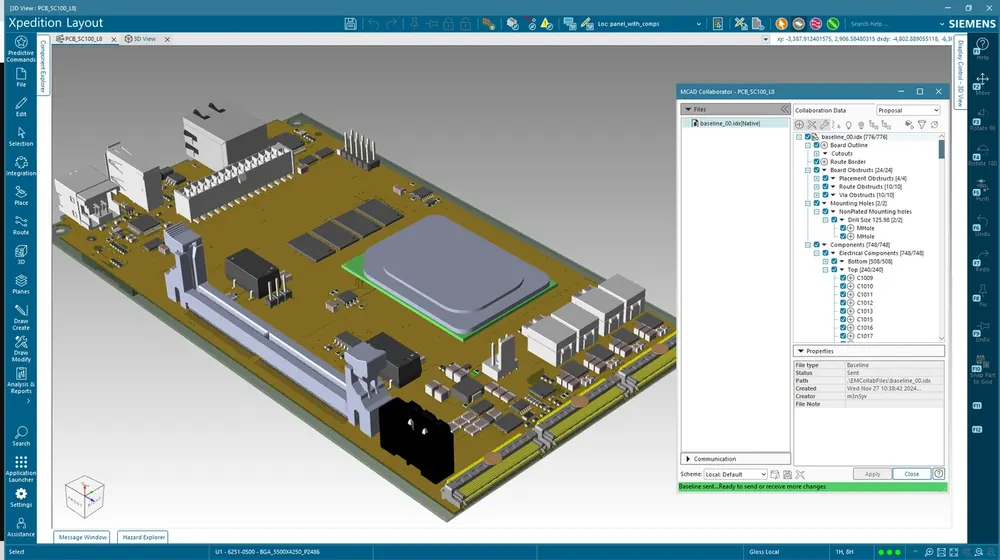
PCB designs rarely arrive at peak complexity all at once. A board starts as a 4-layer prototype with a few high-speed signals. Then DDR4 enters the picture. Then a flexible section connects two rigid boards. Then mechanical constraints push the placement. Then signal integrity issues turn what was supposed to be a one-month layout into a three-month iteration cycle. Xpedition Standard was designed for this: start with the base subscription, scale verification capabilities on demand via the token-based add-on system, and consolidate the workflow before complexity becomes a project-killer.
To see this in action, watch the Siemens EDA on-demand webinar Scaling Design Capabilities with Adaptable Add-Ons: Signal Integrity, Rigid-Flex, and Advanced ECAD-MCAD.
What the Webinar Covers
The Siemens EDA team walks through the three Xpedition Standard add-ons that PCB design teams reach for first as their boards grow in complexity:
Signal Integrity (HyperLynx LineSim + BoardSim): The token-based pre-layout and post-layout SI add-ons let designers verify high-speed nets at exactly the moment they need to, without committing to a permanent SI license. The webinar shows DDR4 + USB 3.x + PCIe verification workflows running on a real board, including how to read the eye diagram outputs and decide when a topology needs to be re-routed.
Rigid-Flex Design: Adding flexible PCB sections to a rigid board introduces stackup complexity, bend-region constraints, and 3D mechanical considerations that flat-board tools cannot handle cleanly. The Rigid-Flex token enables Xpedition Standard’s bend region modeling and 3D bend visualization, letting designers see exactly how the flex section will fold during assembly. The webinar demonstrates a wearable device flex circuit walkthrough end-to-end.
Advanced ECAD-MCAD Integration (NX): For teams using Siemens NX as their MCAD tool, this VBL goes beyond the standard IDX format exchange to provide tight bidirectional collaboration: 3D component placements stay in sync, mechanical clearance violations flag in both environments, and ECO changes propagate without manual rework. The webinar shows the live ECAD-MCAD round-trip on a multi-board enclosure design.
Why Token-Based Verification Matters for Indian Design Teams
Indian PCB design teams typically range from 2-10 engineers at startups and mid-size product companies through 50+ engineers at major automotive Tier-1 suppliers. The verification cadence varies dramatically across these segments, and historically the licensing model didn’t.
Traditional EDA licensing forces teams to either buy permanent SI/PI/rigid-flex licenses upfront (locking up budget that sits idle most of the year) or skip verification entirely (and accept the field-failure risk). The Xpedition Standard token system gives a third option: pay only for what you actually verify, when you verify it.
A typical 25-token pack lasts a small Indian design team an entire year of verification on 4-6 boards. A 50-token pack covers a larger team or a single safety-critical project where every interface needs both pre- and post-layout sign-off. And because tokens float across the team, whoever needs HyperLynx for an afternoon stackup exploration can pull from the shared pool.
For the full mechanics, token costs per add-on, how the pool works, how to size your pack, see our companion deep-dive on Xpedition tokens and HyperLynx signal integrity.
What Indian Teams Should Watch For
When you watch the webinar, pay attention to these moments:
- The HyperLynx eye diagram interpretation: the difference between a marginal eye and a failing eye is often a few picoseconds of jitter. Indian DDR4 designs running at 1600-3200 MT/s frequently sit on this margin.
- The rigid-flex stackup zones demonstration: most Indian flex circuit projects suffer from misunderstood bend radius requirements that lead to assembly failures. The bend region visualization catches this before fabrication.
- The token consumption flow: how a 15-token pre-layout run looks from the engineer’s perspective. This is the workflow you’ll be onboarding your team to.
How GSAS Helps Indian Teams Adopt Xpedition Standard with Tokens
GSAS Micro Systems is an authorized Siemens EDA engineering partner in India. Our applications engineering team supports PCB design teams across Bengaluru, Hyderabad, Chennai, Pune, Mumbai, and Delhi NCR through:
- Stackup review before any routing begins
- Token pack sizing based on your verification cadence and board complexity
- HyperLynx LineSim and BoardSim training: hands-on workshops on your actual boards
- Rigid-flex design consulting for wearable and IoT teams adding flex sections to existing designs
- ECAD-MCAD workflow integration for teams adopting Siemens NX alongside Xpedition Standard
Our engineers have spent years inside Xpedition on real product programs across Indian automotive, aerospace, telecom, EV, and medical device customers.
Try Xpedition Standard with HyperLynx
If the webinar convinces you that the token-based model fits your team, the Xpedition Standard 30-day trial is the next step. The trial includes the base environment plus token allocations for HyperLynx LineSim, BoardSim, and rigid-flex design, enough to verify a real critical interface on a real board and see what the workflow feels like.
Further Reading
- Xpedition tokens and HyperLynx signal integrity deep-dive, companion post on the token mechanics
- Xpedition Standard product page, full product details + virtual tour
- HyperLynx product page, signal integrity, power integrity, electrical DRC
- Choosing the right Siemens EDA tier, Standard vs Enterprise decision framework
- Siemens EDA partnership, full GSAS authorized partner page
The webinar Scaling Design Capabilities with Adaptable Add-Ons is hosted on webinars.sw.siemens.com and is available on demand. All technical claims about Xpedition Standard add-ons and the token system are sourced from official Siemens documentation.
Also appears in:
Interested in Siemens EDA tools?
Talk to our application engineers for personalized tool recommendations.
More from Siemens EDA
View all →
India's EDA Moment: Why Design Tool Demand Is Growing, and the Engineering Careers It Creates
21 Sept · 9 min

AI and Complexity Are Redrawing EDA: Siemens on the Trillion-Transistor Era
13 Sept · 6 min
Calibre Vision AI: Bringing Order to DRC Debug at Advanced Nodes
24 Aug · 4 min
Siemens EDA EBS Expert Series: 6 Free PCB Design Webinars (Jul-Aug 2026)
20 Jul · 8 min
Emulating Processor Power for Thermal Testing: Why Constant Power
7 Oct · 7 min
CRPS and Rack Power Supply Testing: The Six Tests That Matter
7 Oct · 7 min