In short
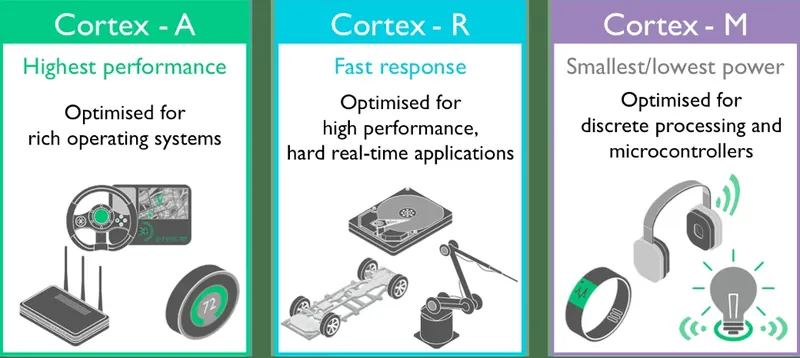
Choose an Arm Cortex core by starting from the workload, not the clock speed. Cortex-M is the right class when the product is a microcontroller with deterministic interrupt latency and no rich OS. Cortex-R is the right class when the product needs hard real-time guarantees with a memory protection unit rather than virtual memory. Cortex-A is the right class when the product must boot Linux or another rich OS and therefore needs a memory management unit.
Arm processors are pervasive across embedded silicon, from the lowest-power IoT sensor consuming microwatts to the multi-core application processors driving smartphones, automotive ADAS, and edge AI. For Indian embedded design teams in 2026, choosing the right Arm Cortex variant is one of the highest-leverage technical decisions in a product’s lifecycle. The wrong choice locks you into either insufficient performance or wasted silicon for years.
This guide breaks down the Arm Cortex family by architecture class (Cortex-M, Cortex-R, Cortex-A, Cortex-X), covers which MCU and SoC vendors ship which cores, and walks through the toolchains, debug probes, and compliance requirements that Indian engineering teams need to consider before locking in a processor choice.
If what you need is the reference list rather than the decision, the complete Arm Cortex processor family list and comparison guide enumerates every core by profile.
The Arm Cortex Family at a Glance
Arm structures its processor IP into four main classes, each optimized for a different point on the performance, power, and real-time spectrum:
| Class | Use case | Typical clock | Memory | Real-time | Linux capable |
|---|---|---|---|---|---|
| Cortex-M | Microcontrollers, IoT, sensors, motor control | 16 MHz – 600 MHz | KB to a few MB | Yes | No |
| Cortex-R | Real-time safety-critical (automotive ECUs, storage, baseband) | 200 MHz – 1.5 GHz | MB | Yes (deterministic) | Limited |
| Cortex-A | Application processors (mobile, automotive infotainment, edge servers) | 800 MHz – 3+ GHz | GB | No (best-effort) | Yes (full Linux/Android) |
| Cortex-X | Flagship-tier Cortex-A variants for peak single-thread performance | 3+ GHz | GB | No | Yes |
The decision tree for an Indian design team usually starts with one question: does this product need Linux? If yes, Cortex-A. If no but it needs deterministic real-time response under safety constraints, Cortex-R. If neither, Cortex-M.
Cortex-M Family (Microcontrollers)
Cortex-M is the most-deployed processor architecture in history. Every Cortex-M variant uses the Thumb-2 instruction set, runs deterministically on bare metal or under an RTOS, and ships in MCUs from STMicroelectronics, NXP, Microchip, Infineon, Renesas, Silicon Labs, Nordic Semiconductor, and a dozen smaller players.
Cortex-M0 / M0+: Smallest, Lowest Power
The entry-level Cortex-M0 and the slightly-improved Cortex-M0+ are designed for the absolute lowest power and smallest die area. They lack hardware divide and have a minimal interrupt controller. M0+ adds a 2-stage pipeline and an optional Memory Protection Unit (MPU). Indian teams use these in:
- 8-bit replacement: replacing legacy 8051, PIC, or AVR microcontrollers in cost-sensitive consumer and industrial designs
- IoT sensor nodes: battery-powered Bluetooth Low Energy or LoRa modules where every microamp counts
- Co-processors: handling sensor pre-processing in larger SoC designs
Common MCU vendors: STMicroelectronics STM32C0/L0, NXP LPC11/LPC81/LPC82, Microchip SAM-D series, Nordic nRF52805.
Cortex-M3: The Workhorse
Cortex-M3 added hardware divide, saturating arithmetic, and a more capable Nested Vectored Interrupt Controller (NVIC). For more than a decade it was the default choice for general-purpose MCU applications. Indian teams still build on M3 for cost-optimized industrial controls, mid-range consumer products, and educational platforms.
Common MCU vendors: STMicroelectronics STM32F1, NXP LPC17xx, Texas Instruments Stellaris.
Cortex-M4 / M4F: DSP + Optional FPU
Cortex-M4 is Cortex-M3 plus DSP instructions (single-cycle MAC, SIMD on packed bytes), and the M4F variant adds a single-precision floating-point unit. This combination is the right call when you need real-time signal processing, audio codecs, motor control, sensor fusion, without the cost or power of a Cortex-A application processor.
Common MCU vendors: STMicroelectronics STM32F3/F4, NXP Kinetis K-series, Microchip SAM4, Nordic nRF52840 (used in millions of consumer Bluetooth products).
For motor control applications specifically, the M4F’s single-cycle MAC and FPU make field-oriented control (FOC) algorithms run at audio rates without breaking the 100 µs control loop budget that BLDC and PMSM motors demand.
Cortex-M7: Highest-Performance MCU Class
Cortex-M7 is the highest-performance core in the Cortex-M line. It has a 6-stage dual-issue superscalar pipeline, optional double-precision FPU, instruction and data caches, and tightly-coupled memory (TCM) interfaces for deterministic latency. Clocks reach 600 MHz on modern silicon.
Indian teams use M7 in:
- High-end motor control: multi-axis servo systems, robotics, industrial automation
- Edge audio: voice-activated devices, beamforming microphone arrays
- Industrial vision: low-resolution image processing without a separate vision processor
- High-channel-count data acquisition: multi-channel ADC sampling at MHz rates
Common MCU vendors: STMicroelectronics STM32H7 / STM32H5, NXP i.MX RT crossover MCUs, Microchip SAMV70/SAMV71, Renesas RA8.
Cortex-M23 / M33: Armv8-M with TrustZone
Cortex-M23 (similar to M0+ in performance) and Cortex-M33 (similar to M4 in performance) are the first Armv8-M cores. They introduce TrustZone for Cortex-M: a hardware security extension that creates secure and non-secure worlds inside the same MCU. This is the foundation for secure boot, secure firmware update, and secure key storage on connected IoT devices.
For Indian teams shipping connected products into markets that require security certification (EU CRA, UK PSTI, IEC 62443, ETSI EN 303 645), Cortex-M33 with TrustZone is becoming the default choice. The CRA enforcement deadline of December 2027 makes this urgent, see our EU Cyber Resilience Act guide for context.
Common MCU vendors: STMicroelectronics STM32L5/U5/N6, NXP LPC55, Microchip SAML1, Nordic nRF54L15, Infineon PSOC 6.
Cortex-M55 / M85: AI at the MCU
Cortex-M55 and Cortex-M85 are the newest Cortex-M cores, both featuring Helium (the M-Profile Vector Extension) for accelerated machine learning inference. Helium adds 128-bit vector instructions optimized for the multiply-accumulate operations at the heart of every neural network.
These cores are how Arm is bringing edge AI down to the MCU class. A Cortex-M85 with Helium can run a quantized keyword-spotting model, a small object detector, or a vibration anomaly detector in milliseconds while consuming MCU-class power.
Indian teams targeting these cores: edge AI startups, predictive maintenance product designers, smart-home voice products. Common MCU vendors: Alif Ensemble (Cortex-M55 + Ethos-U55), Renesas RA8 (Cortex-M85), Himax HX6538 (Cortex-M55). NXP’s current Cortex-M55 / Ethos-U85 part for edge AI is the i.MX RT700 family. (Note: NXP MCX N947 is a Cortex-M33 part, not Cortex-M55, verify the specific NXP part number against the NXP datasheet before designing in.)
Cortex-R Family (Real-Time Safety-Critical)
Cortex-R cores are designed for deterministic real-time response under safety constraints. They run at higher clocks than Cortex-M but trade application-processor flexibility (no MMU, limited Linux support) for lockstep redundancy, ECC-protected memories, and certified safety toolchains.
Cortex-R5 / R5F: The Automotive Workhorse
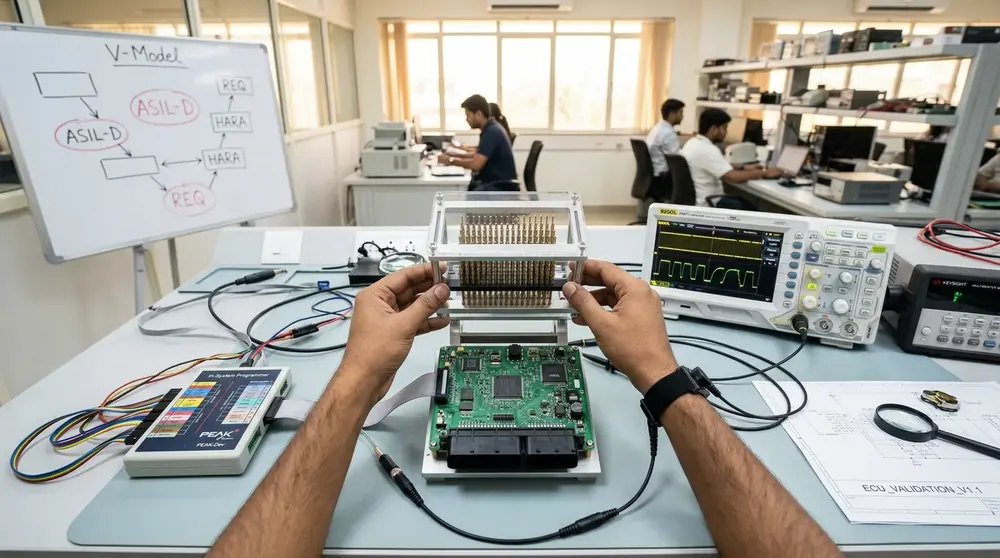
Cortex-R5 is the most common Cortex-R variant in automotive. It runs in dual-core lockstep mode where two physical cores execute the same instructions in parallel and a comparator flags any divergence as a fault. This is the architectural foundation for ISO 26262 ASIL D safety requirements.
Indian automotive teams use Cortex-R5 in:
- Electric vehicle motor controllers: where a single-bit fault in the inverter PWM could cause uncontrolled torque
- Battery management systems (BMS): state-of-charge and cell-balancing under safety constraints
- Brake-by-wire and steering controllers: where fail-safe behavior is non-negotiable
Common SoC vendors with Cortex-R cores: Texas Instruments Hercules TMS570/RM4x (Cortex-R5), NXP S32R (Cortex-R), NXP S32Z/S32E (Cortex-R52). Note: Infineon AURIX uses Infineon’s own TriCore architecture, not Cortex-R, AURIX sometimes appears in the same automotive bring-up bench as a Cortex-R companion part, but the AURIX core itself is not Cortex. Renesas RH850 uses the V850-derived RH850 ISA, also not Cortex-R.
Cortex-R52 / R52+: Next-Gen Safety SoCs
Cortex-R52 is the first Armv8-R Cortex-R, with hardware-enforced separation between safety-critical and non-safety code (the “hypervisor” mode). This enables mixed-criticality consolidation: running ASIL D safety-critical code and ASIL A or QM (Quality Managed) code on the same physical SoC without a separate microcontroller for each.
For Indian Tier-1 automotive suppliers consolidating ECUs, Cortex-R52 is one architectural enabler. NXP S32Z / S32E are the leading commercial Cortex-R52 implementations. Infineon AURIX TC4xx is not Cortex-R: it is TriCore, but it is a competing automotive consolidation SoC that Indian Tier-1s evaluate against the Cortex-R52 path; the choice between the two depends on supplier history, AUTOSAR-stack reuse, and the safety-architecture preferences of the specific OEM programme.
Cortex-R52+ adds dual-core lockstep + extended performance for safety-critical applications that need both ASIL D and high throughput simultaneously (radar processing, sensor fusion, ADAS).
Cortex-R82: 64-bit Real-Time
Cortex-R82 is the first 64-bit Cortex-R, targeting storage controllers (NVMe SSDs) and networking infrastructure where deterministic latency matters but the addressable memory needs to grow beyond 4 GB. Less common in mainstream Indian embedded; more prevalent in datacenter / storage / 5G infrastructure programs.
Cortex-A Family (Application Processors)
Cortex-A cores run full operating systems, Linux, Android, QNX, integrity. They have an MMU, full caches, multi-core SMP support, and SIMD via NEON. These are the cores in smartphone SoCs, automotive infotainment, edge servers, single-board computers, and consumer electronics.
Cortex-A53 / A55: Efficiency Tier
Cortex-A53 is the workhorse efficiency-tier 64-bit application processor, it’s in the Raspberry Pi 3, Snapdragon 4xx series, Amlogic S905, Allwinner H6, NXP i.MX 8M, Rockchip RK3308, and dozens of Indian-designed industrial SBCs. It’s not the fastest, but it has the best performance-per-watt at its price point.
Cortex-A55 is the newer Armv8.2-A successor, ~15% more efficient at the same clock with improved memory subsystem and dot-product instructions for ML inference.
Indian teams use A53/A55 in:
- Industrial gateways: edge compute boxes that aggregate sensor data and run lightweight ML
- Entry-level infotainment: in-vehicle Linux dashboards
- Consumer electronics: smart TVs, set-top boxes, OTT streaming devices
Cortex-A72 / A76 / A78: Performance Tier
Cortex-A72 was the high-performance Armv8 core in 2016 (Raspberry Pi 4, Snapdragon 6xx). A76 (2018) improved single-thread performance by ~35%. A78 (2020) added another ~20% with better power efficiency.
Indian engineering teams choose these for higher-throughput edge compute, automotive infotainment with simultaneous Android Auto / CarPlay / native HMI, and consumer products that need responsive UIs.
Cortex-A510 / A715 / A720: Armv9 Era
Armv9 introduced SVE2 (Scalable Vector Extension 2) for ML and DSP workloads, CCA (Confidential Compute Architecture) for trusted execution, and MTE (Memory Tagging Extension) for memory safety. The Cortex-A510 (efficiency tier) and A715/A720 (mid-tier) are the modern application processors most commonly seen in 2025-2026 mobile SoCs.
Indian SoC design centres at companies like Qualcomm and MediaTek build on these cores for the global mobile and tablet market.
Cortex-X Family (Flagship Performance)
Cortex-X1 (2020), X2, X3, X4, X925, these are the peak single-thread performance cores Arm releases each year for flagship smartphone and tablet SoCs. They use significantly more power and die area than mainstream Cortex-A cores in exchange for ~30-50% higher single-thread IPC.
Cortex-X cores are almost exclusively used by global silicon vendors (Qualcomm, MediaTek, Apple, and other flagship SoC vendors) in flagship mobile SoCs. Indian embedded design teams rarely target these directly because the silicon is locked behind silicon-vendor design partnerships, but Indian semiconductor design centres (Qualcomm Bengaluru, MediaTek Bengaluru) work on them.
Toolchains for Arm Cortex Development in India
Choosing a processor is half the decision. The toolchain you use to compile, debug, and certify the firmware on it is the other half.
Arm Keil MDK v6
Keil MDK v6 is Arm’s official integrated development environment for Cortex-M development. It includes the Arm Compiler 6 (formerly armcc), the µVision IDE, RTX RTOS, CMSIS-Pack support, and debug capabilities. For functional safety programs, the Keil MDK Functional Safety edition ships with TÜV SÜD-qualified compiler binaries and certification kits for ISO 26262 and IEC 61508.
Indian Tier-1 automotive suppliers and consumer-product engineering teams use Keil MDK v6 as the default toolchain. GSAS provides authorized Keil MDK licensing, evaluation units, and migration consulting from Keil MDK v5 to v6 across India, see Arm partnership for details.
Arm Development Studio (Cortex-A and Cortex-R)
Arm Development Studio (formerly DS-5) is the professional toolchain for Cortex-A and Cortex-R development. It includes the Arm Compiler, Linaro GCC integration, the DS-5 debugger, system-wide trace and profiling, and bare-metal-to-Linux debug spanning. For Cortex-R automotive safety programs running RTOS or AUTOSAR Classic Platform stacks, Arm Development Studio is the standard.
CMSIS and CMSIS-Pack
The Cortex Microcontroller Software Interface Standard (CMSIS) is the vendor-neutral abstraction layer for Cortex-M. Every MCU vendor ships CMSIS-Pack files describing their devices, peripherals, and example code. This means switching from STMicroelectronics to NXP to Renesas is mostly a CMSIS-Pack swap rather than a full firmware rewrite.
CMSIS-Toolbox is the modern command-line build system for CMSIS-Pack-based projects, integrating cleanly with CI/CD pipelines (GitHub Actions, GitLab CI, Jenkins). GSAS provides CI/CD integration consulting for Indian teams adopting CMSIS-Toolbox.
Debug Probes for Arm Cortex Development
A toolchain without a debug probe is useless on real silicon. The right probe matters as much as the right compiler.
Keil ULINKplus and ULINKpro
Keil ULINKplus is the modern Keil debug probe with high-speed JTAG/SWD, integrated power measurement (~1 µA resolution for IoT optimization), and SWO trace capture. ULINKpro adds ETM trace for execution profiling and code coverage. Both work with Keil MDK v6.
SEGGER J-Link PRO
For teams using Arm Compiler 6 outside the Keil ecosystem (Eclipse, VS Code, command-line CMSIS builds), SEGGER J-Link PRO is the de-facto standard debug probe. It supports every Cortex-M, Cortex-R, and Cortex-A variant, runs on Windows/Linux/macOS, and is the default debug probe in most CI/CD-integrated firmware build pipelines. GSAS is an authorized SEGGER engineering partner in India.
Arm DSTREAM-ST
For high-bandwidth Cortex-A and Cortex-R trace capture, the Arm DSTREAM-ST supports parallel trace and high-speed serial trace at multi-Gbps rates. Used by Indian semiconductor design centres for SoC bring-up and silicon validation.
Compliance and Functional Safety
Indian automotive, industrial, medical, and aerospace teams using Arm Cortex processors face specific compliance requirements:
- ISO 26262 (automotive functional safety, up to ASIL D), requires safety-qualified compilers, MISRA C enforcement, and unit testing with statement and MC/DC coverage
- IEC 61508 (industrial functional safety, up to SIL 3), similar toolchain qualification requirements
- DO-178C (aerospace software, up to DAL A), qualified compilers and structural coverage analysis
- IEC 62304 (medical device software), process and tool requirements
- ISO 21434 / UNECE R155 (automotive cybersecurity), secure boot, secure firmware update
GSAS has supported 40+ functional safety and cybersecurity programs across Indian automotive, aerospace, defence, and medical device customers. The full toolchain, Keil MDK with FuSa, Perforce QAC for MISRA, Razorcat Tessy for unit testing, ULINKplus for debug, is available with hands-on application engineering support. See functional safety capability for the complete picture.
Choosing the Right Cortex for Your Product
Quick decision tree:
- Does your product run Linux or Android? → Cortex-A or Cortex-X (and that decision is usually made by your SoC vendor, not by you)
- Does your product need ASIL B/C/D safety with deterministic real-time response? → Cortex-R5 or R52
- Do you need to run an ML model on the MCU itself? → Cortex-M55 or M85 with Helium
- Do you ship into a market with cybersecurity certification requirements (EU CRA, UK PSTI)? → Cortex-M33 or M55 with TrustZone
- Do you need real-time control with FPU and DSP (motor control, audio, sensor fusion)? → Cortex-M4F or M7
- Cost-optimized general-purpose MCU? → Cortex-M0+, M3, or M4
Working with GSAS for Arm Tool Adoption in Bengaluru, Hyderabad, Chennai, Pune, Mumbai, Delhi NCR
GSAS Micro Systems is Arm’s authorized partner in India for Arm Development Tools. We support Indian embedded design teams across the full Arm Cortex stack with hands-on field application engineering, toolchain selection, debug probe configuration, RTOS integration, functional safety compliance, and CI/CD pipeline setup.
Active engagements span:
- Bengaluru: semiconductor design centres, fabless chip companies, aerospace and defence, telecom 5G
- Hyderabad: defence electronics, semiconductor design, telecom hardware
- Chennai: automotive Tier-1 suppliers, ECU firmware, ADAS algorithm teams
- Pune: automotive R&D, industrial automation, IoT product companies
- Mumbai: telecom infrastructure, fintech hardware, industrial electronics
- Delhi NCR: defence establishments, telecom R&D, automotive supplier ecosystem
For an evaluation Keil MDK license, J-Link PRO loaner unit, or a hands-on workshop on Arm Compiler 6 + CMSIS-Toolbox + CI/CD integration, contact our applications engineering team. Our engineers have spent years inside the Arm tool ecosystem on real product programs.
Further Reading
- Cortex-A vs Cortex-R vs Cortex-M architectural deep-dive, original 2020 GSAS post that established this content series
- Arm partnership, full GSAS Arm authorized partner page
- Arm Keil MDK v6, flagship Arm IDE with safety qualification
- Keil ULINKplus, debug probe with power measurement
- Arm DSTREAM-ST, high-speed trace probe for Cortex-A/R
- Arm Functional Safety RTS, qualified RTOS for ISO 26262
- Functional Safety capability, full ISO 26262 / IEC 61508 / DO-178C consulting
- EU Cyber Resilience Act guide for Indian embedded companies, cybersecurity compliance context
Also appears in:
Interested in Arm tools?
Talk to our application engineers for personalized tool recommendations.
More from Arm
View all →
Meet the GSAS Team at electronica India 2026, Stall H3.I45
15 Sept · 3 min
Arm's Agentic AI Push: What Indian Embedded Teams Can Actually Use Today
13 Sept · 7 min
Arm User-Based Licensing in CI/CD: armlm, Proxy Activation and What Breaks
28 Jul · 11 min
Two Arm Keil MDK Webinars This Summer: DevOps and Edge AI for Indian Cortex-M Teams
17 Jun · 4 min
Emulating Processor Power for Thermal Testing: Why Constant Power
7 Oct · 7 min
CRPS and Rack Power Supply Testing: The Six Tests That Matter
7 Oct · 7 min