In short
Most automotive Ethernet test gear, meaning 100BASE-T1 media converters, taps and lab switches, is usually imported to order in India rather than held as shelf stock, so the number to budget is a landed cost that includes freight and insurance, basic customs duty, IGST on import and clearance and handling, and the schedule to plan is a procurement lead time rather than a delivery date. A first bench needs six hardware capabilities and one free software stack, and only three of those seven are needed on day one.
Search for a 100BASE-T1 tap, or a T1 to RJ45 media converter, from an address in India, and the results are wrong in a specific way: fibre to copper media converters, office LAN cable testers, RJ45 crimp kits. None of them touch a single balanced twisted pair. Refine it and you get vendor pages written for a global buyer: no price, no availability, no answer to what this costs to land in Pune and how long it takes. Almost nothing is written by anyone who has been through the purchase from here.
This is that page: what a first bench needs with a defer-or-borrow column, what is stocked here and what is not, the parts of a landed cost as a structure rather than a number, the compliance portals your teams will use, and the questions to put to any supplier. No prices, no duty percentages, no lead-time weeks. All three move, and an article that quotes them is wrong within a quarter.
What a first automotive Ethernet bench needs
Six hardware capabilities and one software stack. Not six products: one box can meet two capabilities, or one capability can be split across two boxes. The table makes the requirement explicit before a catalogue does it for you.
| Capability | Why the bench needs it | Typical starting point | Defer or borrow |
|---|---|---|---|
| Media conversion to a laptop | Your host has RJ45, the ECU has T1, and no software bridges that | A single-link converter at your ECU’s speed, role settable | Buy first. Nothing else works without it |
| Tap or mirror for capture | You cannot debug traffic you cannot see, and the methods differ in fidelity | A mirror port on a switch you have | A tap waits for timing or error-frame work |
| Accurate timestamping | Any number in a test report inherits the delay in front of the stamp | Host timestamps, understood as such | A capture module waits until a report depends on one |
| Link and physical-layer diagnostics | Link-up and signal-quality failures look identical from software | Register reads over the driver interface, plus any scope the team has | Instrument-grade equipment waits for conformance |
| Switch with VLAN and priority control | Two ECUs talking means reproducing a network | A boxed switch with configurable T1 ports and readable config | Defer while the bench is one ECU. Borrow for a first multi-node trial |
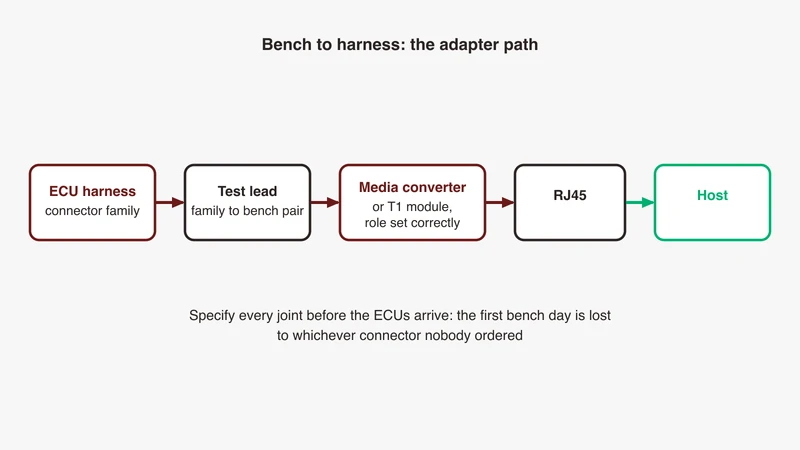
| Cabling, connectors and power | The ECU arrives with a connector nobody has a mate for | Test leads that mate the actual ECU connector, plus a bench supply | Never. This is the item that stops the bench |
| Free software | The analysis half of the bench costs nothing and is not optional | A packet analyser, the open Python UDS and DoIP libraries, a packet-crafting library, the open PTP daemons | Nothing. Install it before the hardware lands |
Reading the table: what you buy and what you download
Six rows are purchases and one is not. The analysis stack is free and decides whether the hardware gets used, so install it while the hardware is in transit: the SOME/IP decode fix list and the UDS service walkthrough both run against a capture file before equipment arrives. Most hardware rows delegate their depth to a guide that already exists: media converters, lab switches, taps and mirror ports and cables and connectors, with loggers covered for the lab that gets as far as the shopping list below. If the physical layer is new, start with what automotive Ethernet is.
The one thing teams forget: the vehicle side of the cable
Benches get delayed at the last step by connectors: the converter arrives, the switch arrives, and the ECU has a connector nothing mates with. One rule: get the ECU connector part number off the harness drawing first, and put the mating test lead on the same purchase order as the converter. If the ECU sits on a multidrop segment rather than a point-to-point link, that is a different physical layer again, and the 10BASE-T1S and PLCA explainer sets out what changes.
Buy now, buy later, or borrow
What to have before the first ECU arrives
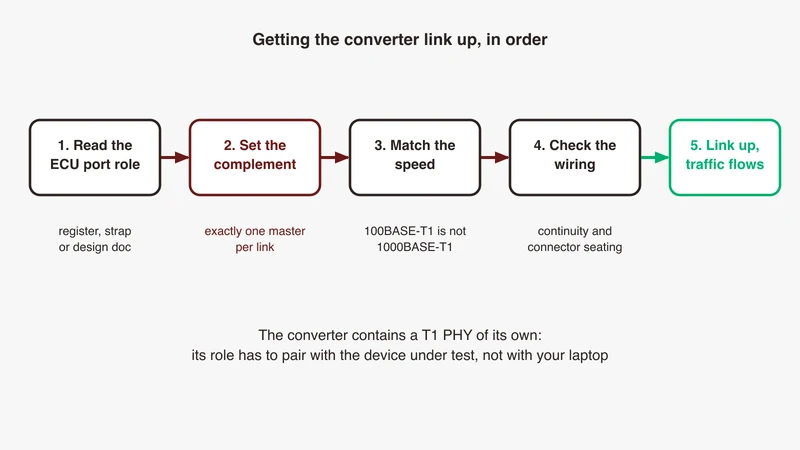
Media conversion, cabling that mates with the ECU, power, and the software stack. That list answers the first three questions of bring-up: does the link come up, do the services appear, does a diagnostic session open. If the link does not come up, work the link-up checklist before suspecting the hardware.
What to defer until conformance work starts
Instrument-grade physical-layer equipment and its calibration. Buying that early means owning an expensive item through the period when nobody knows how to drive it, and conformance testing above TC8 is usually a test house rather than a purchase. Timing equipment is the same, with one exception: if a requirement names synchronisation, read how to prove 802.1AS works first, because the software side of that proof costs nothing.
What is worth a loaner or a demo rather than a purchase
Anything where the decision hinges on how a box behaves on your traffic rather than on a specification: mirror fidelity under your load, whether a logger keeps up with your aggregate rate, whether a capture module’s encapsulation decodes cleanly. Evaluations succeed when the ask is specific and the exit criterion is written down first.
What is stocked in India and what is imported to order
The honest split
In our experience T1 test equipment is rarely held as shelf stock here, and the reason is arithmetic rather than neglect: the buying population is small and configurations differ by port count, speed mix and connector variant, so a stocked unit is often the wrong unit. The commodity end moves faster: cables, bench supplies, standard RJ45 infrastructure. Units with T1 ports and a configuration sheet behind them are usually imported against your order, which changes the shape of your schedule: you are not waiting for a delivery, you are waiting for a procurement cycle.
Lead time: the structure, not a band
We will not publish lead-time bands, and you should be suspicious of anyone who does so in an article rather than on a quotation: a band published in one quarter is wrong in the next. What is stable is the structure. An imported item has four sequential steps, each moving independently: a manufacturing or allocation window at the source, an international freight leg, customs clearance, and domestic delivery. Ask which is the long pole for your configuration, get the answer in writing on the quotation, and ask what changing the connector variant or the port count does to it. Configuration changes are the most common reason a lead time quietly doubles. The current bands come from that conversation, the only place the number exists.
Who takes the technical call before the purchase order
This decides whether the equipment gets used, and it is almost never on the comparison sheet. A bench purchase contains several decisions a commercial process cannot make: master and slave assignment per link, the connector variant on the vehicle side, whether the mirror path is honest enough for your analysis, whether the port count survives the second ECU, whether the timestamp class matches what your report will claim. Every one has a wrong answer that looks fine on a purchase order and shows up on the bench.
So the question is not whether a supplier can supply the item. It is who, by name and location, takes that call before the order goes out, and whether they are still reachable when the link does not come up. A quotation from someone who cannot answer the master and slave question is for the wrong bench at the right price.
Landed cost, and the parts of the number
The stack
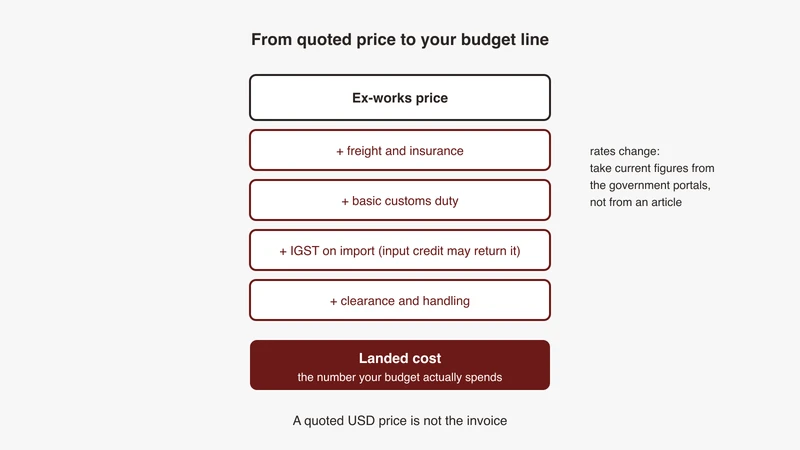
The quoted price is the bottom of a stack, not the number that reaches your budget line.
Ex-works or FOB price. What the item costs where it leaves the manufacturer, usually in a foreign currency and excluding everything below.
Freight and insurance. The international leg, priced by weight, dimensions and mode. For a light, high-value instrument the air-or-sea choice is made on schedule, not on freight cost.
Basic customs duty. Levied on the assessable value of the consignment, at a rate set by how the item is classified. Any surcharge on it sits in the same line.
IGST on import, and input credit. Structurally different from the duty line: duty is a cost, while IGST paid on import is a tax a GST-registered entity may be able to take input credit against, subject to the conditions in the GST law. Settle it with finance early, because it changes the effective number differently for different entities.
Clearance and handling. Customs broker fees, port or airport handling, documentation charges and domestic delivery.
Rates and classifications change, so this article links the sources rather than quoting them. CBIC publishes the customs material and, separately, the GST material. The ICEGATE Compliance Information Portal is described on the ICEGATE site as a portal for customs procedures, compliance, agency links, tariffs and duties for each commodity, the first stop for a specific item class.
Why a quoted price is not the invoice
Three things. Currency, because a foreign-currency quotation converts on a date you do not control and expires. Incoterms, because the same number means different things depending on which party carries freight, insurance and clearance, so two quotations on different terms are not comparable. And the duty and tax lines above, absent unless you asked for a delivered, duty-paid number. Ask every supplier for the same thing: delivered price to your site, freight, duty and tax on separate lines.
Three bench classes rather than three prices
We publish no figures, but the classes are what a budget conversation needs.
A bring-up bench is one converter, one set of vehicle-side leads, a laptop and free software. The smallest capital item here, and the one teams under-order by leaving the leads off.
An integration lab adds a boxed T1 switch with configurable ports, a defensible capture path, and a logger once anything runs longer than a session. The spend steps up here, and a wrong port count or a dropping mirror costs more than the equipment.
A conformance-adjacent lab adds instrument-grade physical-layer equipment, fixtures and calibration. A different order of spend, and for most teams a test-house relationship rather than a purchase.
Establish your class first: a supplier who assumes the third will quote the third.
The costs that arrive after year one
Licences and maintenance, where a lapsed contract can mean losing decode and firmware updates. And calibration, where any item whose output is quoted as a measurement carries a recurring interval and the cost of being without the instrument. Ask at the quotation stage what renews, on what cycle, and what stops working if it lapses.
Compliance and paperwork
This describes what your own teams handle. GSAS does not act as your customs broker, and where you import directly your entity is the importer of record. Where a purchase is routed through us as a domestic sale, the import is on our side of the transaction and yours is a domestic one. None of this is import advice: it is a map of which portal governs what, so the right question reaches the right team.
Importer of record, and what finance will ask for
If your company imports directly, your entity is the importer of record. The DGFT portal describes the Importer Exporter Code as a key business identification number which is mandatory for exports or imports, and states that no person shall make any import or export except under an IEC number granted by DGFT. If the purchase is routed through an Indian supplier who imports and then sells to you domestically, the supplier is the importer of record and your transaction is a domestic one. The two routes have different paperwork, so establish which you are on before the order.
Applicability check for the item class before you order
Two checks, neither to be assumed.
Classification: the item’s ITC(HS) code determines the duty rate and any policy conditions on the import, and the DGFT portal carries the ITC(HS) based import and export policy with a product search by code or description. Confirm the ITC-HS classification for the item class with your customs broker before the order goes out.
Standards and certification: BIS states that it implements conformity assessment schemes, maintains lists of products under compulsory certification, and administers a mandatory registration scheme for certain product categories. Whether an item class falls inside those lists is a check against the BIS material, made before the consignment ships.
Radio approval if the device has any wireless interface
Most bench equipment here is wired and this does not apply. But some loggers, capture appliances and accessories carry Wi-Fi, Bluetooth or a cellular modem, and a wireless interface brings the device under the radio equipment approval regime administered by the Wireless Planning and Coordination wing of the Department of Telecommunications, with applications handled through the Department’s Saral Sanchar portal. Check the datasheet for any radio before you order.
Documentation to keep
Commercial invoice, packing list, bill of lading or airway bill, bill of entry, the duty and IGST payment records, and any certificates that applied. ICEGATE, which describes itself as the Indian Customs National Trade Portal, carries the filing and payment records, and eSanchit, which ICEGATE describes as e-Storage and Computerized Handling of Indirect Tax documents, is where the supporting documents are filed. Keep the set with the purchase order: the audit questions arrive months later, all at once.
Support, calibration and the timezone problem
Firmware, licence and decode-update windows
Three specifics belong on the purchase order: the firmware version shipped, because features documented on a website are sometimes in a later release; whether the licence is tied to a machine, a person or a dongle; and whether decode and protocol updates come with maintenance or cost extra.
The RMA path for imported gear
A return on an imported item is a second import problem in the other direction, and the cost is a stalled bench rather than the repair. Establish before the order who raises the RMA, whether the unit goes back to the manufacturer or is handled in India, whether a replacement is available meanwhile, and how the return and re-import clear customs.
Calibration and traceability where the item class needs it
If a number from the equipment goes into a test report, it needs traceability, which means recurring calibration at an accredited laboratory. Establish the interval and how long the instrument is away. Equipment that tells you whether something works, rather than by how much, avoids this cost entirely.
Support inside your working day
The difference between a supported bench and an unsupported one is the length of the loop. A question raised late in the afternoon in Pune reaches a queue that is not working yet and is answered overnight, so every exchange costs a working day. Inside IST the loop closes the same day, and a stalled bench costs more than most of the line items on it.
A worked shopping list by team size
| Capability | Two-engineer bring-up bench | Six-engineer integration lab | Conformance-adjacent lab |
|---|---|---|---|
| Media conversion | One link, at the ECU’s speed | One per engineer, plus spares | Several, plus fixtures |
| Capture | Host capture off the converter | Tap or mirror, arithmetic checked | Tap, with instrument-grade timestamps |
| Timestamping | Host stamps, understood as such | Capture module once a report quotes a number | Traceable, calibrated |
| Switch | Not yet | Boxed T1 switch, configurable ports, readable config | As integration lab, plus timing features |
| Physical-layer diagnostics | Register reads, plus a shared scope | A scope with automotive decode on the bench | Instrument-grade, calibrated, with fixtures |
| Cabling, connectors and power | Test leads that mate the ECU’s actual connector | An adapter kit for each connector family in use, plus spares | As integration lab, plus fixture-grade leads |
| Logging | Not yet | Logger sized against the measured aggregate rate | As integration lab |
| Software | Analyser and open libraries | Same, plus configuration under version control | Same, plus the test-house toolchain |
What each column can honestly skip
The bring-up bench skips the switch, the logger and every timing purchase: its job is to prove the link and the services, and a converter and free software do that. The integration lab skips instrument-grade physical-layer equipment and calibration, because it needs a scope for signal-quality questions rather than a conformance measurement, and the oscilloscope-based multi-bus decode work covers what that instrument class gives you. The conformance-adjacent lab skips almost nothing, which is why the honest answer is usually a test house.
One item spans all three columns: configuration under version control, because a bench you cannot restore from a file is rebuilt by hand every time somebody changes a port. Treating network configuration as code is what stops that.
Questions to ask any supplier
- Who takes the technical call on this configuration, by name, and are they in India.
- Is this item stock or an import to order.
- What is the lead time, in writing on the quotation, and what changes it.
- How are duty and GST treated here, and is the price delivered to our site.
- What is the warranty, and what is the RMA route for an imported unit.
- Is the licence portable between machines and engineers.
- How do decode and firmware updates reach us, and are they part of maintenance.
- Can we evaluate first, and against what exit criterion.
Eight answers in writing turn a purchase order into a decision you can defend later, when the bench is either working or not.
Where GSAS fits
GSAS Micro Systems is an engineering partner, and the useful first conversation about a bench is about the network you have to reproduce rather than about a catalogue. Which links, at which speeds. Who owns the master and slave assignment on the ECU side. Whether any number in your report comes from a timestamp. Which connector is on the vehicle side of the ECU you are about to receive. Those four answers cut most of a shortlist, sometimes to equipment you already own. This is a lab bench. If the requirement is programming ECUs on a production line rather than validating them on a bench, that is a different purchase, and the production-line Ethernet programming guide is the right starting point.
On the commercial side, we invoice in India with GST, are registered on GeM for public sector and defence buyers, and support SAP Ariba and Coupa for buyers who raise purchase orders through those systems. Applications engineering runs in IST, so a bench session lands inside your working day rather than the following one, and the teams we work with sit in Bengaluru, Pune, Chennai and Hyderabad. What we will not do is quote a price or a lead time in an article, because both are specific to a configuration and a moment.
Start with the automotive Ethernet capability page, then request a scoped conversation with your topology, your ECU connector and the class of bench you think you need. Where the answer is that a converter and free software already cover what you are doing, that is the answer you get.
References
- Central Board of Indirect Taxes and Customs, customs and tariff material: https://www.cbic.gov.in/
- CBIC, Goods and Services Tax portal: https://cbic-gst.gov.in/
- ICEGATE, Indian Customs National Trade Portal: https://www.icegate.gov.in/
- ICEGATE Compliance Information Portal, described as a portal for customs procedures, compliance, agency links, tariffs, and duties for each commodity: https://foservices.icegate.gov.in/cip/cip#/
- Directorate General of Foreign Trade, Importer Exporter Code and the ITC(HS) based import and export policy: https://www.dgft.gov.in/CP/
- Bureau of Indian Standards, conformity assessment schemes and compulsory certification: https://www.bis.gov.in/
- Department of Telecommunications, Saral Sanchar licensing and registration portal: https://saralsanchar.gov.in/
- OPEN Alliance specification index: https://opensig.org/automotive-ethernet-specifications/
- Wireshark documentation: https://www.wireshark.org/docs/
- Wireshark wiki, CaptureSetup/Ethernet: https://wiki.wireshark.org/CaptureSetup/Ethernet
udsoncan, open Python UDS library: https://udsoncan.readthedocs.io/python-doipclient, open Python DoIP client: https://python-doipclient.readthedocs.io/- Scapy automotive layers: https://scapy.readthedocs.io/en/latest/layers/automotive.html
- linuxptp
ptp4lmanual page: https://manpages.debian.org/unstable/linuxptp/ptp4l.8.en.html
Also appears in:
Building for Automotive & Mobility?
Talk to our application engineers for personalized tool recommendations.